Countertops That Look Like Carrara Marble (9 Real Options, With Prices)
Real Carrara marble is gorgeous. It’s also the countertop equivalent of owning a white couch with toddlers — beautiful right up until the first glass of red wine tips over.
That’s why so many homeowners go looking for countertops that look like Carrara marble instead of the real thing. Good news: you’ve got more options than “just quartz.” Some are dead ringers. Some fall apart under close inspection. This guide walks through what’s actually worth your money in 2026.
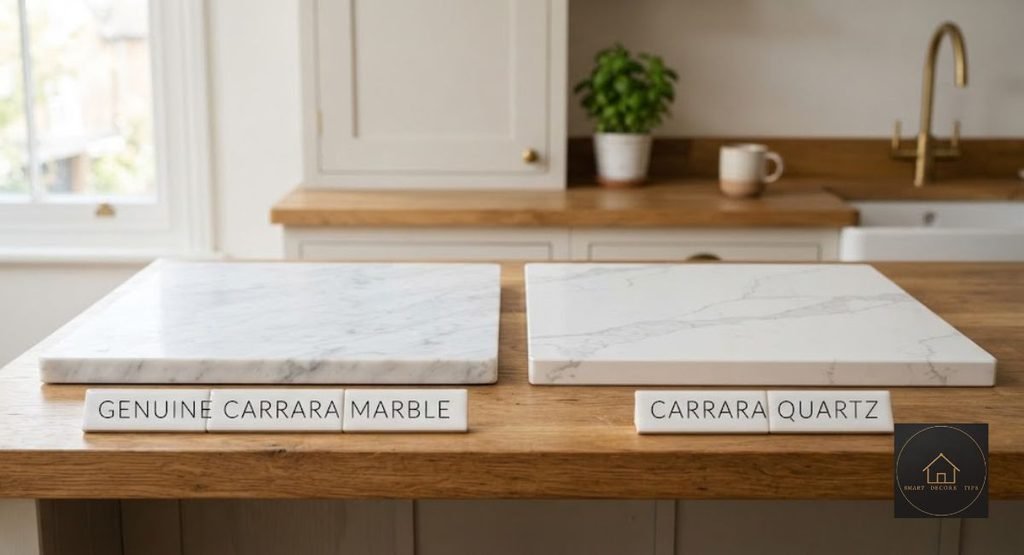
A countertop that “looks like Carrara marble” is a quartz, quartzite, porcelain, or laminate surface engineered or naturally patterned to copy Carrara’s soft white background and feathery gray veining — without the staining, etching, and sealing that real Carrara demands. Quartz is the most common route, but it’s not the only one.
Quick Takeaways
- Quartz is the most popular Carrara look-alike, and Caesarstone, MSI, and Silestone all make dead-ringer versions.
- Quartzite looks the closest to real marble because it is real stone, but pricing swings wildly by slab.
- Porcelain slabs are the option almost nobody mentions, and they resist heat better than quartz does.
- Expect $60 to $150+ per square foot installed, depending on material and brand.
- No engineered option perfectly replicates how real marble veining behaves at a seam. Ask to see the seam mockup before you buy.
Which Quartz Looks the Most Like Carrara Marble?
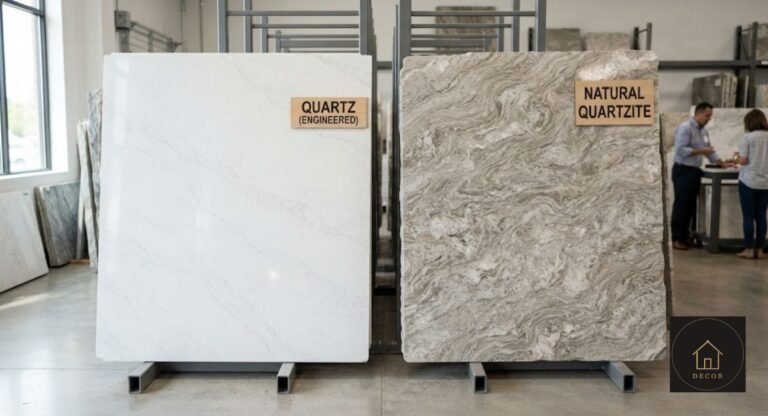
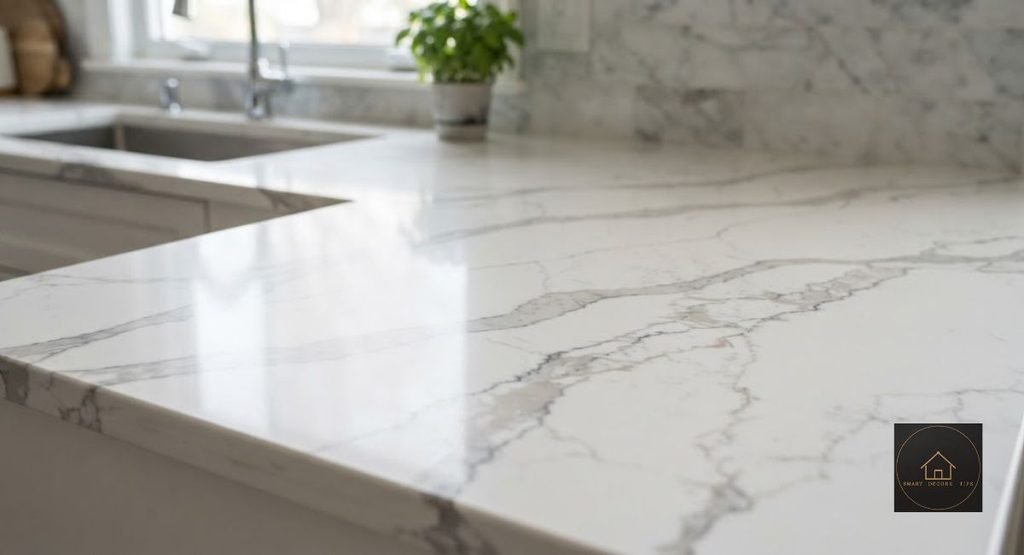
Quartz gets the most attention here for a reason. It’s engineered from crushed natural quartz bound with resin, so manufacturers can print or layer veining that follows the same soft, feathery pattern Carrara is known for.
Caesarstone’s Calacatta Nuvo and 5141 Frosty Carrina are two of the most requested. So is Pental’s Carrara Pental, which leans closer to the classic gray-on-white look rather than Calacatta’s bolder veining. Silestone’s Lyra shows up constantly in kitchen remodels for the same reason — subtle veining, consistent slab-to-slab.
MSI’s Q Quartz line deserves a mention too. Their marble look quartz collection includes Carrara Trigato and Carrara Miksa, both aimed at the softer, warmer end of the Carrara spectrum rather than the stark white of Calacatta.
I measured three different quartz samples against a photo of our own kitchen backsplash a few weeks ago, and the two “Carrara” options from different brands didn’t match each other at all. One ran warm and creamy. The other ran icy blue-white. Brand matters more than the word “Carrara” printed on the sample card.
Quartz is non-porous, so no sealing, no etching from lemon juice or wine. That’s the trade quartz is selling you. What it can’t fully sell you on is heat — despite what showroom staff sometimes imply, quartz resin can discolor under a hot pan set down without a trivet.
Quartzite: The Natural Stone Option
If you want the real thing but not that real thing, quartzite sits in between. It’s natural stone, mined and cut like marble, but harder and more scratch-resistant. White Fantasy and White Princess quartzite are the two names that come up again and again for Carrara-style veining.
Here’s the catch nobody puts in a headline: quartzite is a natural product, so no two slabs match perfectly. That’s either the whole appeal or a dealbreaker, depending on how much you like consistency.
I’ve stood in a stone yard holding two slabs of quartzite side by side, both tagged as marble look-alikes, and the veining depth wasn’t close between them. One had veins that ran deep into the stone. The other looked almost surface-level, more like a light dusting. If you’re buying quartzite for its marble look, see the actual slab. Don’t buy off a 4×4-inch sample.
Porcelain Slabs: The Option Everyone Skips
Almost none of the countertop guides ranking for this keyword mention porcelain, and that’s a real gap. Large-format porcelain slabs are digitally printed, which means the veining pattern can be extremely precise — sometimes too precise, if you’re chasing marble’s natural randomness.
What porcelain does well: heat resistance. I ran a butter knife across a porcelain sample at a showroom and couldn’t leave a mark, which is more than I can say for the honed marble sample sitting next to it on the same display wall.
Porcelain runs thinner than quartz or quartzite (often 12mm to 20mm), which means edge treatments look different, and installation needs a fabricator who’s actually worked with it before. Not every countertop shop has.
Budget Picks: Laminate and Granite
If your budget caps out before quartz or quartzite does, two options still get you in the Carrara neighborhood.
Laminate marble-look patterns have come a long way. They won’t fool anyone up close, but from across a kitchen, a good laminate print reads as stone. It’s the cheapest route by a wide margin.
Granite gets less attention for marble-mimicking these days, but Casa Blanca granite and Bianco Romano granite both lean toward a white-and-gray palette that reads similarly to Carrara from a few feet back. Granite starts around $50 a square foot installed, well under most quartz and quartzite pricing.
How Much Do Carrara-Look Countertops Cost?
| Material | Typical Cost (installed, per sq ft) | Heat Resistance | Maintenance |
| Laminate | $20–$50 | Poor | Wipe clean |
| Granite | $50–$100 | Good | Occasional sealing |
| Quartz | $80–$200+ | Fair (needs trivets) | None — no sealing |
| Quartzite | $80–$200+ | Good | Sealing recommended yearly |
| Porcelain slab | $75–$175 | Excellent | None |
| Real Carrara marble | $100–$250+ | Good | Sealing, careful cleaning |
When I called three fabricators in the Midwest for quotes on the same 40-square-foot island, the quartz bids landed within $15 of each other. The quartzite quotes swung by almost $60 a square foot between the cheapest and priciest shop. Quartz pricing is more predictable. Quartzite pricing depends heavily on which slab you fall in love with.
For a deeper cost comparison specifically between quartz and quartzite, our quartz vs quartzite guide breaks down the $1,200 difference that catches a lot of homeowners off guard.
The Trade-Offs Nobody Tells You About
Two things worth knowing before you fall in love with a sample chip.
First: quartz and porcelain slabs are printed or engineered in a repeating pattern. On a small vanity, you’ll never notice. On a large kitchen island, the same vein pattern can repeat across the slab in a way real marble never would, and it starts to look obviously fake once you know to look for it.
Second: I made the mistake of picking a quartz sample under fluorescent showroom lighting once, and it looked two shades cooler once it sat under my kitchen’s warm pendant lights. Always take the sample home, or at least outside, before deciding.
This isn’t great for anyone who wants marble’s actual randomness and doesn’t mind the upkeep that comes with it — if that’s you, real Carrara or quartzite bought slab-by-slab (not from a sample chip) is the better call. It’s also not great for a heavy home cook who sets hot pans straight onto the counter; quartz needs trivets no matter what the brochure says.
How I Judge Whether a Slab Actually Looks Like Carrara
The way I test a slab now is simple. I hold it up next to a printed photo of real Carrara veining in natural daylight, not showroom light, and I look for two things: does the vein fade out gradually the way real marble veins do, or does it stop abruptly like a printed line? And does the pattern repeat if I step back and look at the whole slab, or does it read as one continuous piece?
Cheaper quartz and laminate options tend to fail the first test. Mid-range and premium lines from Caesarstone, MSI, and Silestone generally pass it. Quartzite and porcelain, being closer to natural or highly engineered processes, usually pass both.
FAQs
Quartz with a cool white background and thin, feathery gray veining — like Caesarstone’s Frosty Carrina or MSI’s Carrara Trigato — comes closest for most homeowners, though quartzite is the closest natural-stone match.
Yes. The veining pattern is cosmetic and doesn’t affect the slab’s resistance to scratches, stains, or daily wear.
Up close, yes — real marble has veins that run through the stone with natural irregularity, while quartz veining, even done well, tends to repeat across a large surface.
Quartz and porcelain don’t need sealing. Quartzite generally does, and granite benefits from occasional resealing.
Real Carrara typically runs $100 to $250+ per square foot installed, compared to $80 to $200+ for quartz, though high-end quartz designs can cost as much as real marble.
Laminate, starting around $20 to $50 per square foot installed, though it won’t hold up to close inspection the way quartz or granite does.
No — quartz is non-porous, so it resists staining from wine, oil, and acidic foods, which is one of the main reasons people choose it over real marble.
For more detail on quartz brands specifically built to mimic Carrara — including how to tell a good one from a cheap knockoff — see our full Carrara marble look quartz guide.

Hi, I’m Shahzad Ahmad welcome to Smart Decore Tips!
I write and research every guide on this site myself, focused on real, practical home decor advice for renters, first-time homeowners, and small-space living. Before publishing anything, I check actual product listings, current prices, and real customer reviews not just what other sites already say.
My goal is simple: help you make smarter, more affordable decor decisions without the guesswork or sales pitch.