
Countertop Pieces: Real Prices, Sizes & When Remnants Aren’t Worth It (2026)
You’ve probably seen the term in a budget-renovation thread: “just use a countertop piece.” Sounds simple enough — grab a leftover slab, save a few hundred dollars, done. It’s mostly true. It’s also not the whole story, and the part that gets left out is exactly the part that decides whether you actually save money or just end up with a smaller bill for the same headache.
Countertop pieces, usually called remnants, are the leftover chunks of stone a fabricator has after cutting your neighbor’s kitchen. Most run 10 to 25 square feet, cost 30 to 70% less than a full slab, and work best for vanities, islands, and small furniture builds — not a full kitchen.
Quick Takeaways
- A “remnant” is typically 10–25 sq ft; under 10 sq ft, most shops scrap it or sell it as a sample; over 25 sq ft, some shops start pricing it as a discounted “partial slab” instead.
- Installed remnant pricing runs roughly $20–65 per sq ft depending on material, versus $50–150 for a full slab of the same stone.
- Shop minimum charges ($300–600) can erase the savings on very small pieces — ask before you get attached to one.
- Engineered quartz supports a longer unsupported overhang (up to 15″) than natural stone (usually capped around 9″).
- Not every “discounted” remnant is actually discounted — if the fabricator still has matching bundle slabs in stock, some shops charge full price anyway.
What Counts as a Countertop Piece?
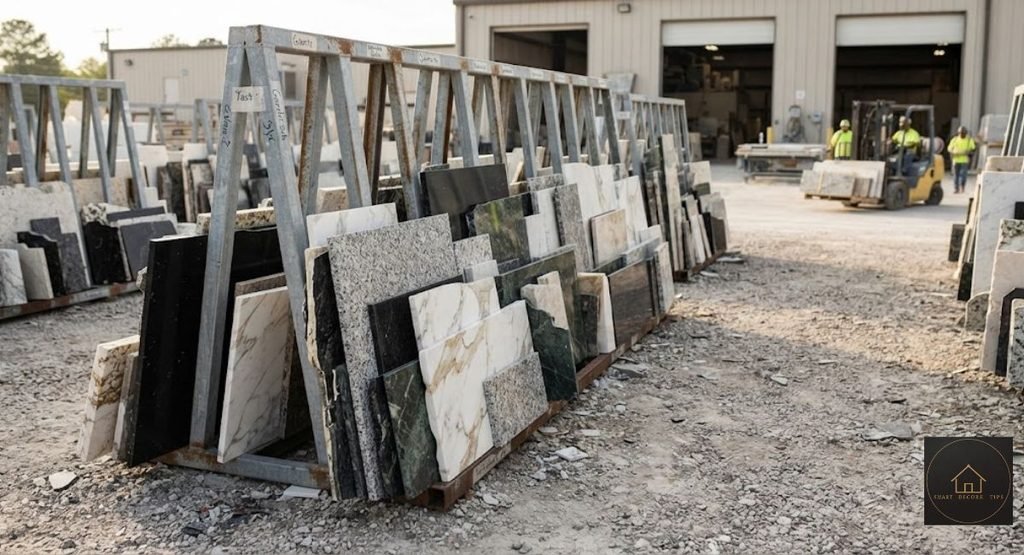
A countertop piece is the offcut left on the shop floor once a fabricator finishes cutting a full slab for someone else’s job. Full slabs of granite or quartz typically yield 55 to 65 usable square feet, and a standard kitchen eats up 35 to 45 of that. What’s left — a strip, an L-shaped chunk, an odd triangle — becomes the remnant.
There’s no industry-wide size rule, but most shops draw a rough line at 10 to 25 square feet. Smaller than that, and it’s usually too limited to justify cutting and edging — shops turn it into samples or toss it. Bigger than that, and a lot of shops stop calling it a “remnant” at all; they treat it as a partial slab and price it closer to full-slab rates instead of the steeper remnant discount. If a fabricator quotes you full price on something they’re calling a remnant, that’s worth asking about directly.
The material itself isn’t lower quality. It’s the same stone, the same batch, the same finish as whatever full-price job it came from. The only thing you’re trading away is choice — you get what’s on the rack, not a custom order.
How Much Do Countertop Pieces Actually Cost?
Prices vary by region, material, and how badly a shop wants to clear its yard, but the ranges are consistent enough to plan around. Last verified September 2026 — call ahead, since fabricator pricing shifts with slab supply.
| Material | Full slab, installed | Remnant, installed | Typical savings |
| Granite (mid-grade) | $50–80/sq ft | $20–45/sq ft | 30–55% |
| Marble (Carrara-style) | $75–120/sq ft | $30–60/sq ft | 35–55% |
| Quartzite | $80–130/sq ft | $35–65/sq ft | 35–60% |
| Engineered quartz | $70–110/sq ft | $35–60/sq ft | 30–50% |
| Soapstone | $70–120/sq ft | $30–55/sq ft | 35–60% |
The material cost isn’t really the story, though. On a remnant, the shop already got paid for that stone on the original job — what you’re paying for now is labor, edging, and installation, and none of that gets cheaper just because the slab is a leftover. A simple rectangular cut runs 30 to 60 minutes of machine time; add a sink cutout and you’re closer to 90. Edge work adds its own line item — a plain eased edge might run $5–12 per linear foot, while a full bullnose or ogee can hit $25–45. On a small 4-foot vanity top, edge work alone can match or beat the material cost.
The “Remnant Discount” Trap Nobody Mentions
Here’s the part every glossy remnant guide skips, and it’s the single biggest thing I’d tell a friend before they go shopping: not every piece labeled “remnant” is actually discounted.
I called around comparing quotes for a small laundry-counter project a while back, and two fabricators gave wildly different numbers for what looked like the same size and material. Turns out one shop still had matching bundle slabs of that exact stone sitting in inventory — so as far as they were concerned, it wasn’t a true leftover, it was just a smaller cut from active stock, and they priced it accordingly. The other shop’s piece genuinely had no mate left. That’s when the real discount kicked in.
My rule now: ask directly whether the fabricator has any matching slabs still in the bundle. If they do, you’re not buying a true remnant — you’re buying a small custom cut, and the price should reflect that. If they don’t, that’s when you actually get the $5–20-per-square-foot break that makes this whole approach worth it.
Watch for shop minimums too. Most fabricators charge a flat $300–600 minimum no matter how small the piece is. I’ve stood in a yard admiring a gorgeous 6-square-foot leathered granite offcut that would’ve been almost free as raw material, then watched the quote land at $550 once the minimum kicked in. Great stone. Terrible deal, for that particular size.
What Size Do You Actually Need?
Most homeowner projects are smaller than people assume, which is good news, because it’s exactly the range remnants cover well.
- Bathroom vanity (single): roughly 4–8 sq ft. Almost any usable remnant covers this.
- Bathroom vanity (double, 60″): around 9–10 sq ft.
- Kitchen island end cap or waterfall panel: 6–15 sq ft, depending on island size and drop height.
- Bar top or laundry folding counter: 8–18 sq ft.
- Full kitchen (U- or L-shaped): 50–70 sq ft — genuinely hard to cover with a single remnant. A partial remodel (swapping just the island while keeping the perimeter) is the realistic remnant use case here, not a full replacement.
If your project needs more than about 25 square feet in one continuous, visually matched piece, you’re fighting the odds. Order a fresh partial slab instead of hunting remnants for a match that probably doesn’t exist.
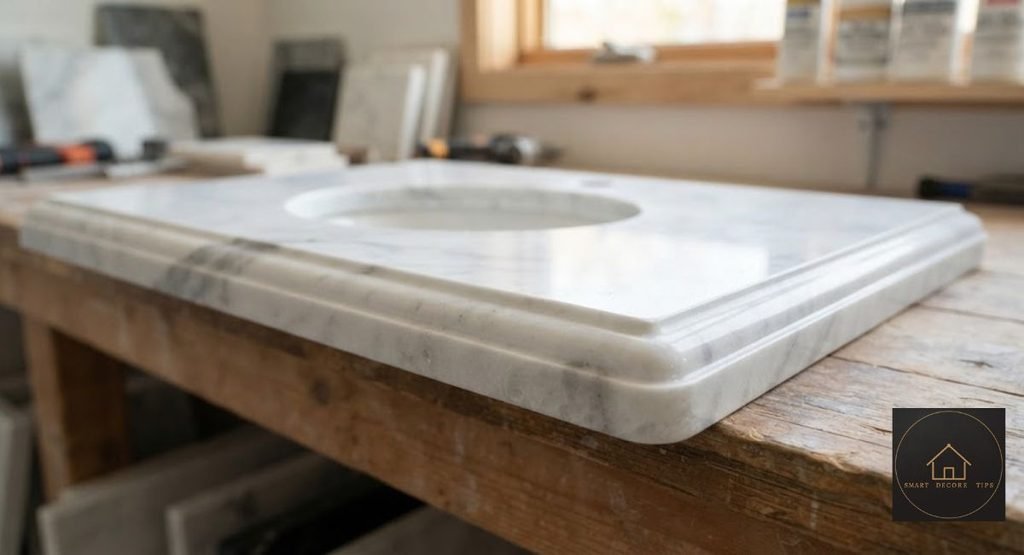
Per-Material Cheat Sheet: Support, Sealing & Weight
This is the part most remnant guides leave out entirely, and it matters once you’re past the “which color do I like” stage. Overhang and support limits aren’t a company opinion — they follow the same fabrication standards the Natural Stone Institute sets for the industry, so a fabricator quoting numbers wildly outside these ranges is worth a second question.
| Material | Max unsupported overhang | Needs sealing? | Weight (approx., 3cm) | Outdoor-safe? |
| Engineered quartz (e.g. Cambria) | Up to 15″ | No | ~18 lbs/sq ft | Limited — UV can fade some colors |
| Granite | Up to 9″ | Yes, periodically | ~18 lbs/sq ft | Yes |
| Marble | Up to 9″ | Yes, more often (softer, stains easier) | ~18 lbs/sq ft | Not recommended |
| Quartzite | Up to 9″ | Yes | ~18 lbs/sq ft | Yes |
| Soapstone | Varies by thickness | Optional (oil, not seal) | ~20 lbs/sq ft | Yes |
That weight figure isn’t trivia if you’re planning to move a piece yourself. A 3cm slab runs roughly 15–20 pounds per square foot, so a modest 10-square-foot remnant is 150–200 pounds — not a one-person, one-trip job. Two people, a proper dolly, and padding, every time.
I judge whether a piece is genuinely a bargain by running the total installed cost against the shop’s minimum charge, not the sticker price per square foot alone — a $15/sq ft “deal” on a tiny piece can lose to a $35/sq ft piece that’s just above the minimum threshold.
Creative Uses Beyond the Obvious Vanity Top
Bathroom vanities get all the attention, understandably — but a remnant piece is small enough to fit into corners of a house that never get a real material upgrade.
- Closet island top. A walk-in closet with a center island gets the same waterfall-edge treatment a kitchen island does, at a fraction of the size and cost.
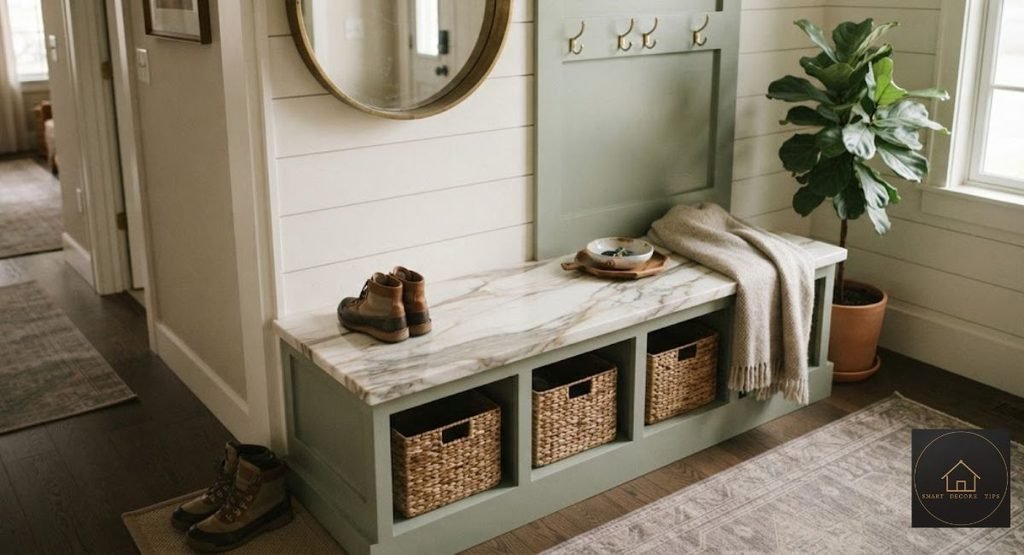
- Mudroom bench seat. Cold to sit on in January, but it shrugs off wet boots and muddy dog paws in a way wood never will.
- Floating shelf ledges. A single narrow remnant strip, bracket-mounted, reads as a designer floating shelf rather than a leftover.
- Pet feeding station top. A small stone slab set into a built-in nook keeps food and water spills from soaking into cabinetry — practical, and it looks intentional.
- Fire pit surround (outdoor-safe materials only). Granite and quartzite handle heat and weather; skip marble and quartz here.
- Window seat or radiator cover top. A remnant too odd-shaped for a countertop can still be a clean, durable surface for a built-in bench.
- Shower niche shelf. Small, moisture-heavy, and exactly the kind of spot where a full slab would be wasteful overkill anyway.
Where to Actually Find Good Pieces
Local fabrication shops are still the best first call — most never post their remnant inventory online, so a phone call (“what do you have in stock right now, roughly this size, in this color family?”) beats browsing a website every time. Stone yards, Habitat for Humanity ReStores, and local Facebook Marketplace listings are the next-best sources, especially for smaller accent pieces some shops give away just to clear space.
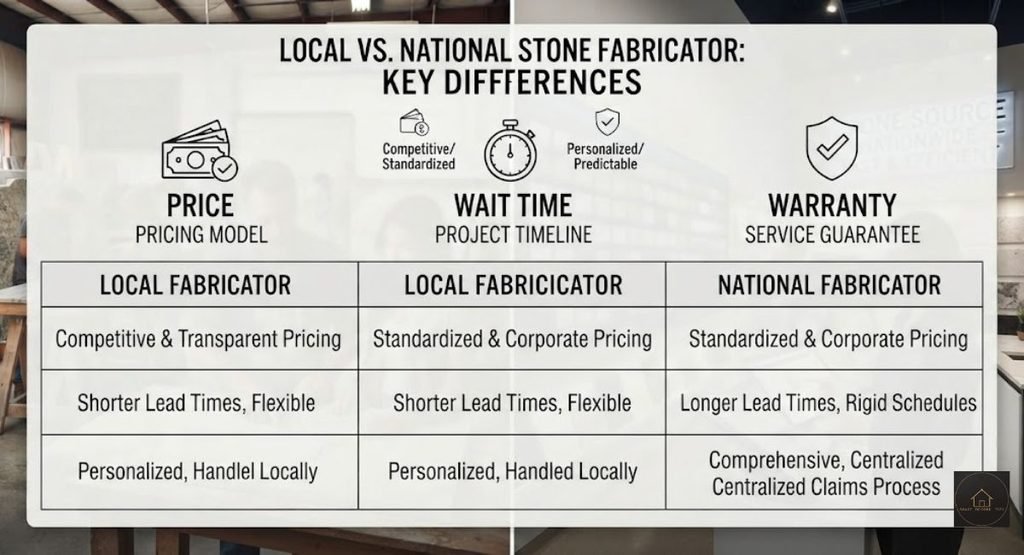
National brands like Cambria, MSI, and Cosentino (Silestone) also generate remnants through their network of authorized dealers — worth asking about specifically if you want a well-known, consistent quartz color rather than a one-off natural-stone find. Whether it makes more sense to work with a small local fabricator or a larger dealer network for this kind of project depends a lot on turnaround time, minimums, and what’s actually sitting in the yard — our local vs. national stone fabricator breakdown walks through that trade-off in more depth.
5 Questions to Ask Before You Buy
- What’s the actual usable square footage — not gross, net? A remnant with an old chipped edge or an already-cut radius loses real usable area you can’t get back.
- What’s your shop minimum? Get this number before you fall in love with a small piece.
- Does the quote include a sink or faucet cutout? A single cutout typically adds $100–200; complex undermount sinks run more.
- What edge profiles are available, and what do they cost? Edge pricing is rarely baked into the remnant’s sticker price.
- Is installation included, or is this pickup-only? Some shops sell pre-cut vanity tops for pickup with no install service — fine if you’re prepared to lift 150+ pounds safely, not fine if you’re not.
Countertop Pieces vs. Full Slabs vs. Laminate
A remnant isn’t automatically the cheapest option — it’s the cheapest way to get real stone on a small project. Laminate still wins on raw price, running roughly $10–40 per square foot installed, and it’s the better call for a full kitchen on a tight budget. Where remnants win is the middle ground: a $50/sq ft stone available for $20–25 installed, on a project small enough that the math actually works in your favor.
If you’re still deciding between materials before you even start hunting for a piece, our quartz vs. quartzite comparison breaks down which one holds up better for your specific project — worth reading before you start calling fabricators, so you know what to ask for.
Countertop pieces aren’t a shortcut that works for everyone. They’re a genuinely good deal for a vanity, a bar top, a closet island, or a bench seat — and a mediocre deal once shop minimums and labor costs eat into a small piece’s savings. Call two or three fabricators, ask the five questions above, and do the math on the whole quote, not just the per-square-foot number on the tag.
FAQs
Installed remnant pricing runs roughly $20 to $65 per square foot depending on the material, compared to $50 to $150 for a full slab of the same stone.
A remnant is typically under 20–25 square feet and priced at a steep discount because the material cost is already recovered; a partial slab is larger, sometimes over 30 square feet, and priced closer to full-slab rates.
Rarely — a full U- or L-shaped kitchen needs 50 to 70 square feet, which is larger than most remnants. A partial remodel, like replacing just the island, is a more realistic use.
No. It’s cut from the same slab and batch as full-price material — the only difference is size and shape, not quality.
It depends on the material, not on the fact that it’s a remnant. Granite, marble, quartzite, and soapstone typically need periodic sealing; engineered quartz does not.
A standard 3cm slab weighs roughly 15 to 20 pounds per square foot, so a 10-square-foot piece can weigh 150 to 200 pounds and needs two people to move safely.
Some fabricators still have matching bundle slabs of that stone in stock. If a match exists, the shop may not treat your piece as a true leftover and will price it closer to a standard custom cut instead of a discounted remnant.
Most fabricators have a shop minimum of $300 to $600 regardless of size, so very small pieces (under roughly 6–8 square feet) often aren’t worth pursuing unless the minimum charge still lands below what a comparable new piece would cost.

Hi, I’m Shahzad Ahmad welcome to Smart Decore Tips!
I write and research every guide on this site myself, focused on real, practical home decor advice for renters, first-time homeowners, and small-space living. Before publishing anything, I check actual product listings, current prices, and real customer reviews not just what other sites already say.
My goal is simple: help you make smarter, more affordable decor decisions without the guesswork or sales pitch.