
Carrara Marble Look Quartz: Brands, Prices, Spotting Fakes
If you’ve been scrolling kitchen photos for more than an hour, you’ve probably typed “carrara marble look quartz” into a search bar at least once. It’s the material everyone wants and almost nobody actually installs in real marble, for good reason, honestly.
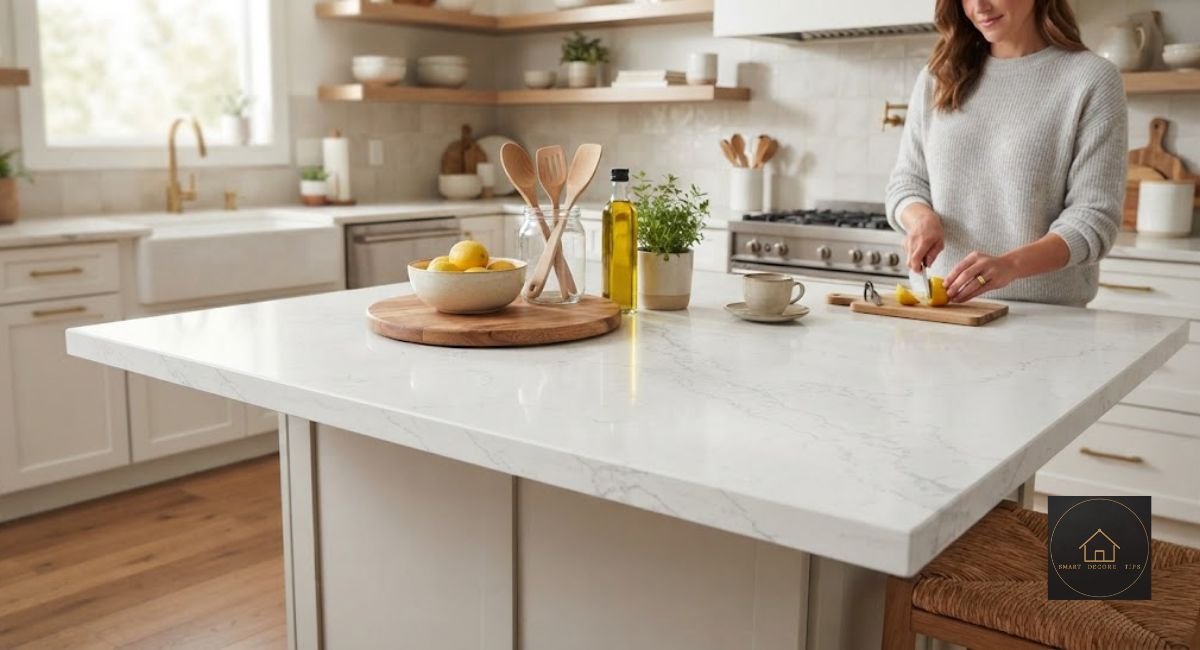
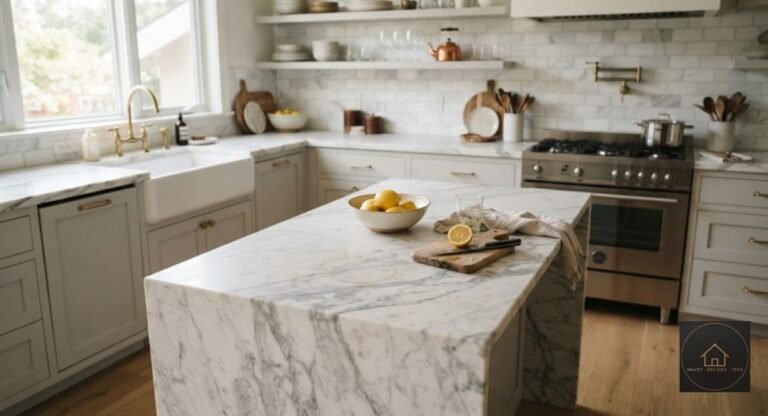
Carrara marble look quartz is engineered stone, roughly 90% ground quartz and 10% resin and pigment, manufactured to copy the soft white background and wispy gray veining of Italian Carrara marble. It costs less to live with than real marble, never needs sealing, and, if you pick the right slab, is genuinely hard to tell apart from the real thing at five feet away.
Quick Takeaways
- Carrara-look quartz runs about $50–$60 per sq ft installed; Calacatta-style (bolder veins) runs $60–$100.
- MSI, Caesarstone, Silestone, and Pental all make a Carrara-pattern quartz. They are not the same slab wearing different labels.
- Vein repetition is the one thing every fabricator brings up and every product page skips. Ask for full-slab photos, not a 4×4 sample chip.
- Quartz can’t take direct high heat the way stone can. A hot pan set straight down can leave a mark.
What Is Carrara Marble Look Quartz?
Real Carrara comes out of quarries in Tuscany and has been the go-to “fancy white counter” for a long time. It’s beautiful. It’s also porous, it etches if a kid leaves a juice box on it overnight, and it needs sealing on a schedule you’ll probably forget.
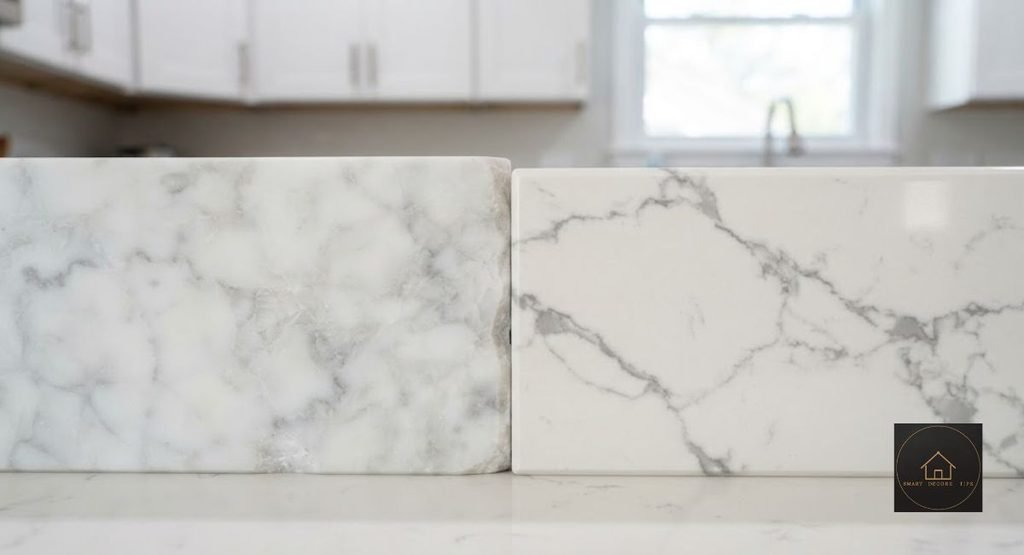
Quartz manufacturers noticed people wanted the look without the babysitting, so they built slabs that reproduce Carrara’s pattern: a cool white or off-white field crossed by soft, feathery gray lines. Unlike marble, the color and veining are printed and layered into the slab during manufacturing. You’re buying a look, not a piece of geology, and that’s not an insult. It’s the whole point.
I’ve stood in three different fabricator showrooms comparing Carrara-pattern samples side by side, and the difference between brands is bigger than most articles let on. Some read cool and crisp. Others lean warm and almost beige under kitchen lighting. That matters more than the marketing photos suggest.
What Quartz Looks Most Like Carrara Marble?
No single slab wins this outright, but a few names come up again and again among fabricators: MSI’s Carrara Marmi, Caesarstone’s Frosty Carrina and London Grey, Silestone’s Lagoon and Yukon, and Pental’s Carrara line. All four aim for the same target, soft linear gray veining on a cool white base, but the vein density and background undertone differ enough to matter once the slab is sitting under your kitchen lights instead of a showroom spotlight.
If you’re also weighing this against quartzite, a natural stone that behaves more like granite than marble, our full quartz vs. quartzite breakdown covers that fork in the road.
Carrara Quartz vs. Real Carrara Marble: What Actually Changes
Here’s the part nobody argues with. I set a lemon wedge on a marble sample and a quartz sample overnight once, mostly out of curiosity. The marble had a faint dull ring the next morning. The quartz had nothing. That’s the etching problem in one sentence.
Marble is soft enough to scratch with a knife dragged wrong. Quartz shrugs off day-to-day kitchen abuse, knives, wine, tomato sauce, all of it. What quartz doesn’t do well is take a hot pan straight off the stove. The resin can scorch or discolor under sustained high heat in a way stone simply doesn’t. Use a trivet. It’s a small habit that saves a very expensive surface.
Cost-wise, the two overlap more than people expect. Entry-level Carrara marble sometimes prices out cheaper than mid-tier quartz. Once you’re comparing premium marble grades to standard quartz, though, quartz almost always wins on price and never needs re-sealing.
Best Carrara-Look Quartz Brands, Compared
I judged these on three things: how convincingly the vein pattern reads as real Carrara from a few feet away, how bad the seam looks where two slabs meet in an L-shaped kitchen, and whether the price actually holds up against a same-tier competitor. A pretty sample that failed on seam-matching didn’t make the cut.
| Brand & Product | Vein Style | Price Tier | Best For |
| MSI Carrara Marmi | Delicate, whispery gray veins, soft white field | Mid-range | Classic white kitchens, easy resale appeal |
| Caesarstone Frosty Carrina | Light gray field, consistent linear veining | Mid to upper | Designer-favorite look, wider distributor network |
| Silestone Lagoon / Yukon | Soft white, restrained movement | Mid-range | Buyers who want minimal veining, not a statement slab |
| Pental Carrara | Close match to natural Carrara’s coolness | Mid-range | Layering white cabinets with white counters |
| Vicostone (regional) | Bolder, more stone-inspired movement | Mid-range | Statement islands, dramatic single-slab looks |
None of these is universally “best.” A tight, small-vein pattern like MSI’s or Pental’s hides seams better in a two-slab L-shaped kitchen. A bolder pattern like Vicostone’s looks incredible on a single island slab with no seam to worry about at all.
How Much Does Carrara Marble Look Quartz Cost in 2026?
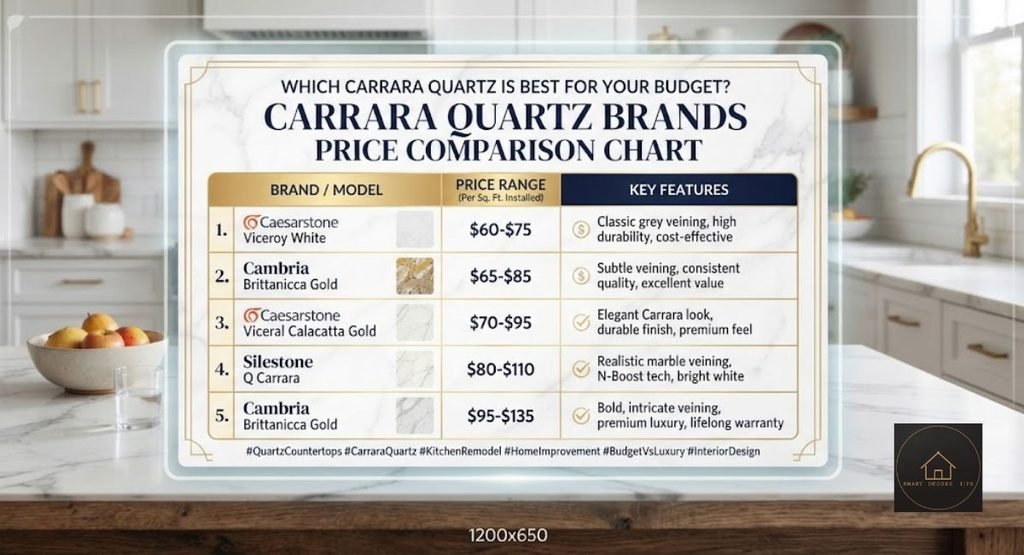
Based on HomeGuide’s national pricing data, Carrara-pattern quartz runs about $50 to $60 per square foot installed, while bolder Calacatta-style quartz runs $60 to $100. For an average kitchen, that lands somewhere between $1,500 and $4,000 total, before cutouts, a thicker 3cm slab, or a waterfall edge.
I got two quotes for a client’s kitchen last spring, one from a big-box installer, one from an independent fabricator, and the difference wasn’t the material. It was the seam count. The fabricator’s cut required one seam; the big-box quote had two, because their slab inventory was smaller that week. That single seam added almost $400 to the bid. Ask about seam count before you sign anything, not after.
How to Spot a Cheap or Fake-Looking Carrara Quartz
This is the section that separates people who love their counter for a decade and people who regret it by year two.
Quartz veining is manufactured from a limited set of templates, which means the pattern repeats. On a single slab you’ll never notice. Across three or four slabs joined in a big kitchen, the repetition becomes obvious, and it looks cheap fast. A friend’s contractor installed her kitchen using leftover cuts from two different production runs, and you can see the mismatch the second you walk in.
A few things to actually do before you buy:
- Ask for full-slab photos, never just a 4×4 sample chip. Samples are chosen to look perfect.
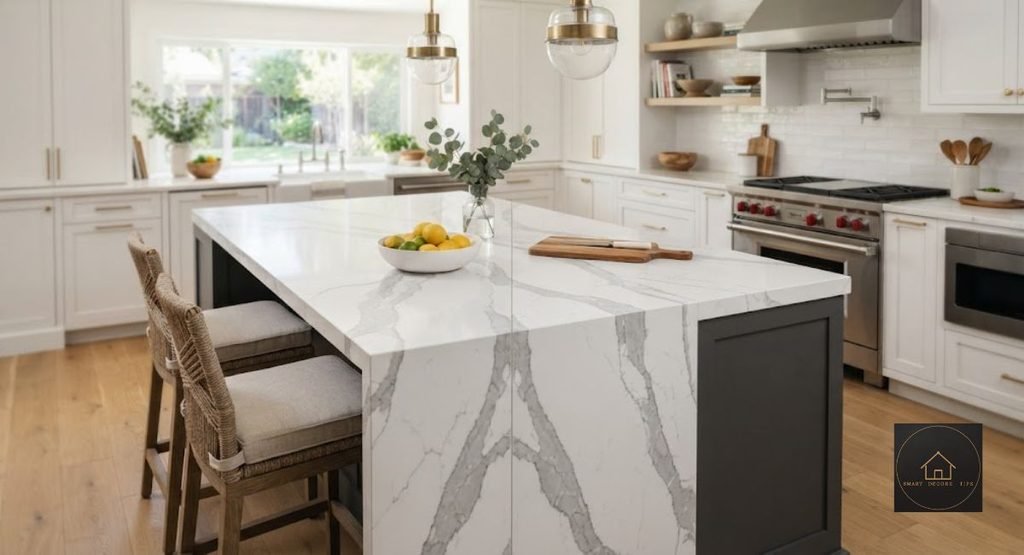
- Request bookmatched slabs for large islands, two consecutive slabs flipped so the veining mirrors across the seam.
- View samples under the lighting you’ll actually cook under, not showroom spotlights.
- If a quote seems unusually low, ask which production lot the slab is coming from.
Where Carrara Quartz Shines (and Where It Doesn’t)
It’s not a fit for everyone, and it’s worth saying plainly. Two trade-offs to know before you commit.
If you cook with cast iron and set pans straight onto the counter, quartz’s heat sensitivity will eventually show. Marble and granite handle that abuse better. And if you’re doing a large kitchen with three or more slabs, budget time to shop matching lots. The repeat-pattern issue above is real, and rushing slab selection is how kitchens end up with a mismatched run down the middle of an island.
Where it shines: rentals and resale-focused remodels, busy households that don’t want to think about sealing schedules, and anyone who loved a Carrara marble photo online but can’t stomach the maintenance in real life.
Carrara Quartz for Bathrooms, Backsplashes & Small Spaces
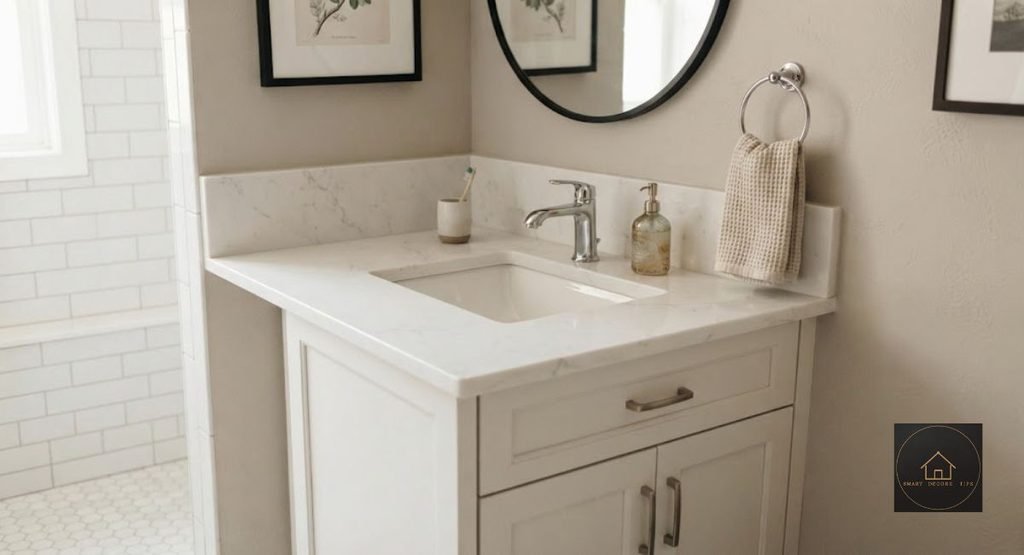
Kitchens get all the attention, but Carrara marble look quartz might actually work harder in a bathroom. Vanity tops take constant contact with soap, toothpaste, and hairspray, all things that stain real marble over time. Quartz shrugs that off with a wipe-down.
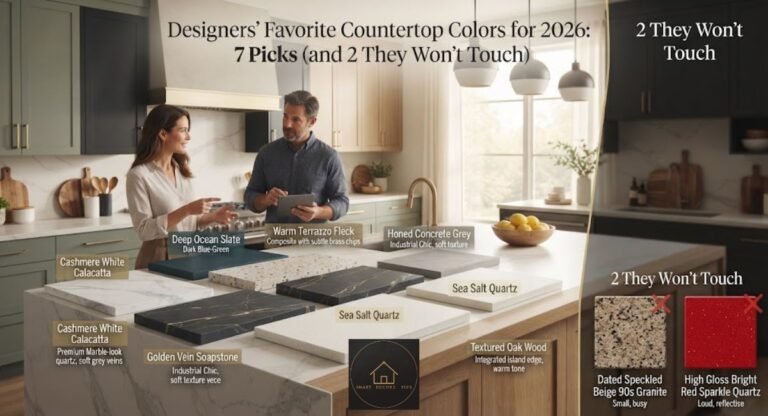
Matching the backsplash to the countertop slab has become one of the more popular small-kitchen moves I’ve seen lately, and our 2026 countertop trends roundup touches on why continuous stone reads bigger in a tight galley kitchen. There’s no grout line to draw the eye, so the whole wall feels like one surface instead of a counter plus a backsplash plus a wall.
For a small powder room, a single remnant slab of Carrara-pattern quartz can often cover the vanity and a short backsplash for under $500 in material, since you’re working with a fraction of a full kitchen’s square footage. It’s one of the more overlooked ways to get the look without the kitchen-sized price tag.
Caring for Your Carrara Marble Look Quartz
Daily care is almost boringly simple, which is the whole appeal. Wipe spills with a damp cloth and mild soap. Skip the bleach-based cleaners and anything abrasive; they won’t stain the surface, but repeated harsh scrubbing can dull the polished finish over years.
Trivets and cutting boards still matter, even on a surface this tough. Heat is the one thing that catches people off guard, since everything else about quartz feels indestructible by comparison. Beyond that, there’s genuinely nothing to schedule. No sealing, no reapplying anything, no annual maintenance call. That’s the trade you’re making for giving up marble’s one-of-a-kind natural veining, and for most kitchens, it’s a trade worth making.
FAQs
MSI Carrara Marmi, Caesarstone Frosty Carrina, and Pental Carrara are the closest matches most fabricators point to, each with soft gray veining on a cool white base.
For daily durability, yes — it resists stains and scratches without sealing. For one-of-a-kind natural veining and resale prestige, real marble still wins.
Expect $50 to $60 per square foot installed for Carrara-pattern quartz, and $60 to $100 for bolder Calacatta-style veining.
No. Quartz is non-porous and highly scratch- and stain-resistant, though it can discolor under sustained direct heat.
Yes, matching the countertop slab to the backsplash is a common way to create one continuous look without visible grout lines.
Quartz veining is manufactured from a limited set of templates, so the pattern repeats slab to slab. Ask for bookmatched or same-lot slabs on large kitchens to avoid a mismatched look.

Hi, I’m Shahzad Ahmad welcome to Smart Decore Tips!
I write and research every guide on this site myself, focused on real, practical home decor advice for renters, first-time homeowners, and small-space living. Before publishing anything, I check actual product listings, current prices, and real customer reviews not just what other sites already say.
My goal is simple: help you make smarter, more affordable decor decisions without the guesswork or sales pitch.


One Comment