
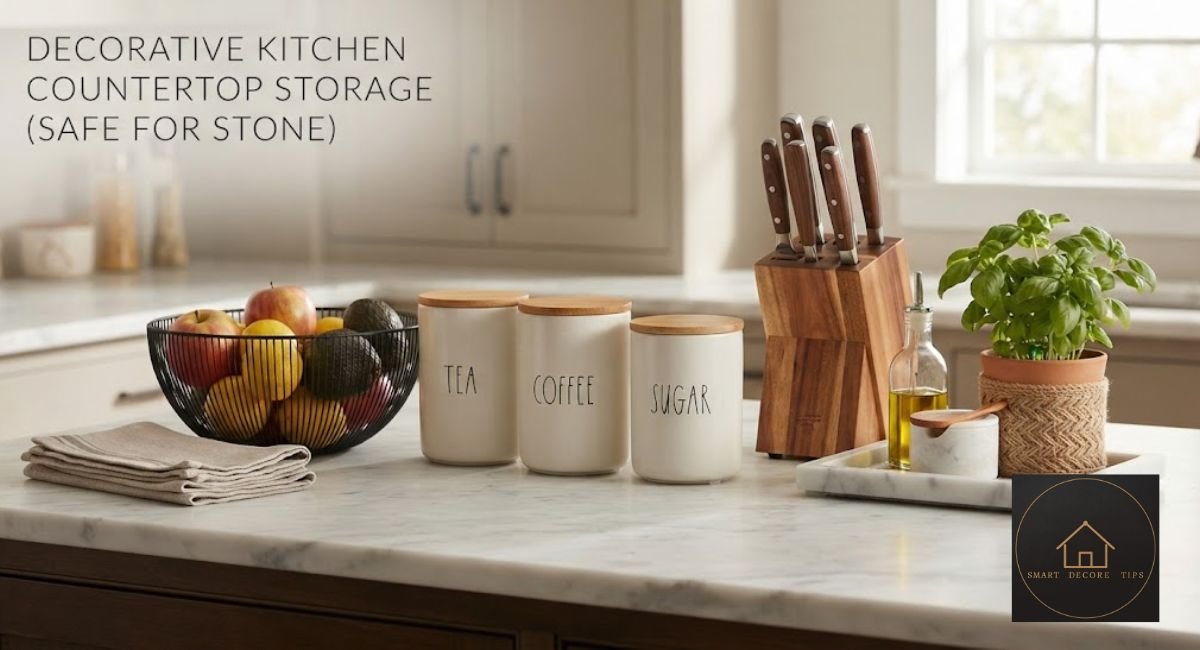
Decorative Kitchen Countertop Storage (Safe for Stone)
Your kitchen counter collects everything. Keys, mail, a coffee setup, three kinds of oil. Decorative kitchen countertop storage can bury that pile or make it look chosen, and the gap between the two is smaller than you’d think.
Still, most guides stop at “buy a tray.” They skip what a canister does to your stone, and how much room you still need to chop an onion. This one covers both, plus a few warnings the top guides leave out.
Quick Takeaways
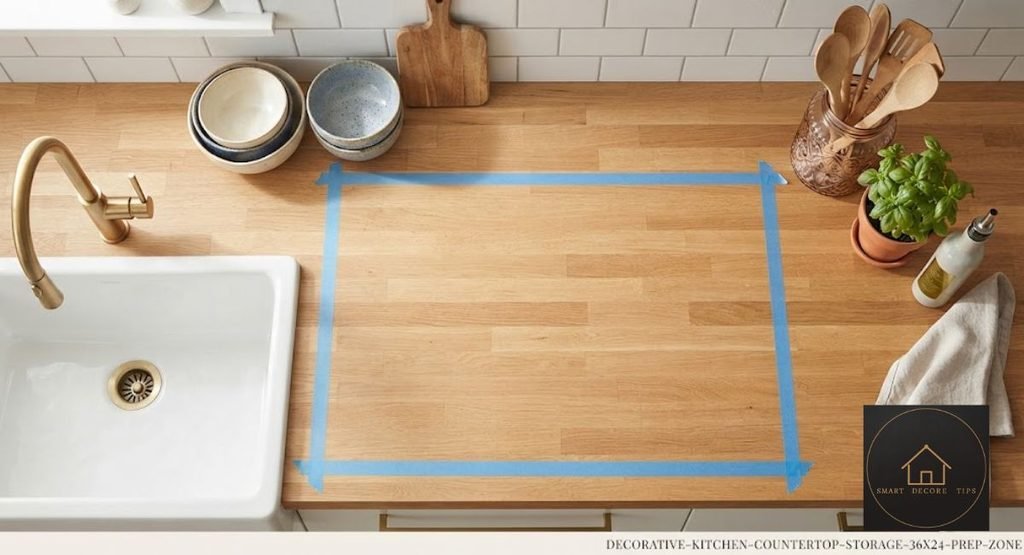
- Keep a 36-by-24-inch prep zone clear beside the sink. That’s 864 square inches that decor never gets.
- Check the base of every piece. Rust and trapped water do most of the damage.
- Move spices off the stove ledge. McCormick says to avoid storing them over the stove, dishwasher or sink.
- Group what’s left on one tray, so it looks chosen and lifts off in a single move for wiping.
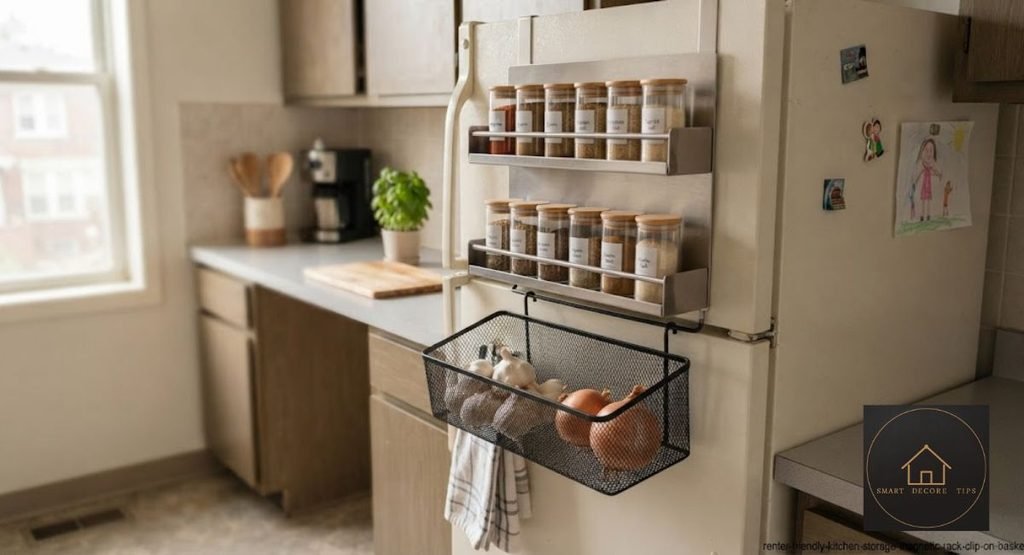
- Renters can go vertical with magnets and clip-on baskets, no drill needed.
What is decorative kitchen countertop storage?
Decorative kitchen countertop storage means any container, tray, rack or stand that holds everyday kitchen items on the counter and looks good doing it. Think canisters, crocks, lidded baskets and tiered stands. It sits in the open, so it has to be both useful and worth looking at.
In practice it does four jobs. It holds daily tools, groups small items, contains staples, and hides whatever you’d rather not see.
That covers a lot of ground. Wayfair’s guide walks through 19 ideas. IKEA’s US page showed 53 products and Crate & Barrel’s showed 67, as of September 24, 2026. The pages I opened sell you the container and stop.
What they skip is the counter underneath. Decorative storage sits on a working surface, so three questions decide whether a piece is worth buying. How much prep room does it leave? What will its base do to your stone or quartz? Can you lift it in one move to wipe underneath? Those are the questions I use to judge every idea below. So a piece that fails one goes back in the cabinet.
How much counter space should you keep clear?
Keep at least 36 inches by 24 inches of continuous counter free beside the sink. That’s the prep area in the National Kitchen & Bath Association (NKBA) planning guidelines, and it comes to 864 square inches that decor shouldn’t touch.
The guidelines go further. They ask for 24 inches of counter on one side of the sink and 18 on the other. Add 12 inches on one side of the cooktop and 15 on the other, plus 15 inches beside the fridge. Those strips are where things land while you cook, so they’re the worst places for a canister.
I taped out the prep rectangle once, before shopping. Two pieces I’d already picked for the sink side didn’t fit outside it, so they moved to a corner. A strip of painter’s tape saved me two returns.
Small kitchens feel this most. The NKBA also recommends 158 inches of counter frontage, 24 inches deep, across the whole kitchen. That’s about 13 feet. If yours is shorter, treat decor as the first thing to go vertical.
Where does everything else go? Up and to the sides. Home Made by Carmona points to the space under upper cabinets for mug racks and wall-mounted holders. Crate & Barrel makes the same case for magnetic racks, since they use vertical space instead of counter room. Then whatever stays on the counter is a short list you chose on purpose.
Which decorative kitchen countertop storage is safe for your counter?
Most pieces are safe if the base is clean, dry and free of metal that can rust. The marks that show up on counters come from rust, trapped water, oil and, on marble, acid. So check the bottom of a piece before you fall for the top.
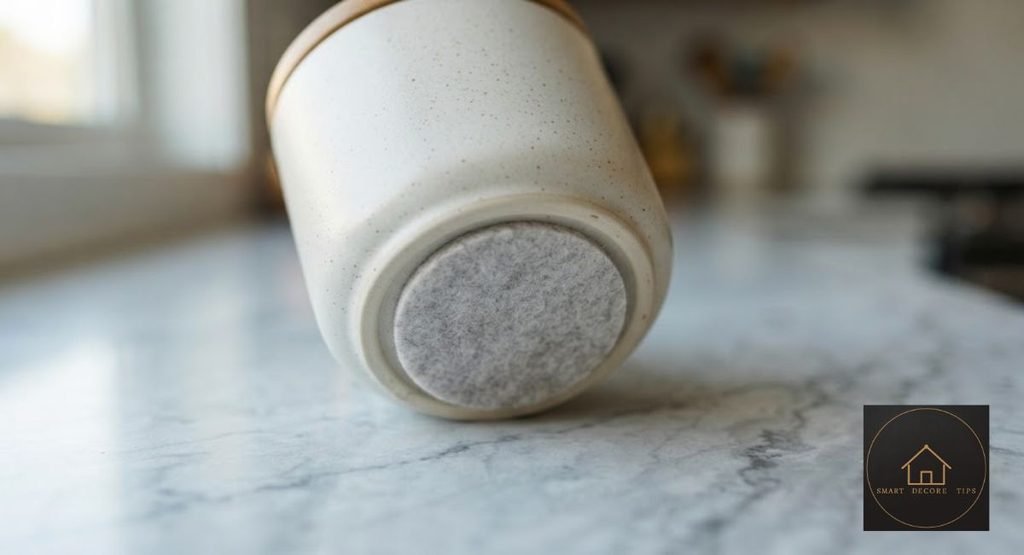
Start with quartz. Caesarstone’s care guide tells owners to wipe up wet spills, keep the surface dry to prevent patina, and set hot cookware on a trivet. It also says honed and concrete finishes show metal marks and fingerprints more than polished ones. So a matte quartz counter earns extra felt pads.
Quartzite is tougher. Use Natural Stone, the Natural Stone Institute’s consumer site, says quartzite is nearly twice as hard as glass and won’t etch from lemon juice or vinegar. Here’s the catch. Some slabs sold as quartzite are really marble, and marble etches. The same site suggests a lemon test, and I’d run it on a hidden spot. If you’re still choosing between the two, our quartz vs quartzite comparison covers the trade-offs.
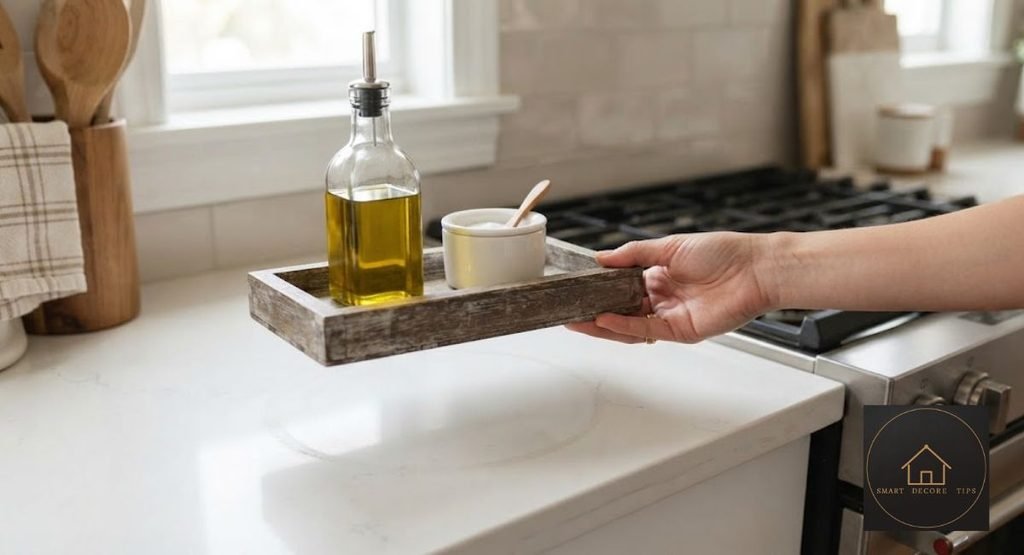
Marble and other calcium-based stones need the most care. The Natural Stone Institute says lemon, vinegar and other acids can dull or etch them, and that oil-based stains, cooking oil included, darken stone. That’s why the oil bottle lives on a tray. A drip lands on the tray, not the counter.
Metal is the sneaky one. The Institute lists rust stains that take the shape of cans, flower pots and metal furniture, and warns that deep ones can be permanent. Skip rusty tins and wire baskets with a worn coating. If you keep potted herbs on a tiered stand, as Wayfair suggests, give the pot a saucer and lift it now and then to let the spot dry.
Before any piece touches a stone counter, I run a fingertip around the base. If it feels gritty or unfinished, it gets a felt pad. No exceptions.
Thinking about a new surface altogether? Our list of new countertop materials for 2026 sorts the ones worth trying from the overhyped.
What should never sit next to your stove?
Spices are the first thing to move. McCormick says to keep herbs and spices away from heat, moisture and direct sunlight, and to avoid storing them over the stove, dishwasher or sink, or near a window.
Some popular advice points the other way. Home Made by Carmona, one of the guides I opened, tells readers to keep spices and oils near the stove. It’s convenient, and I get the appeal. Heat and steam are exactly what McCormick says to avoid, though.
I kept a stove-side spice rack for years. Next to a fresh jar, the old paprika smelled like dust.
So what belongs near the range? A utensil crock, for one, and a tray with the oil you reach for daily. Wayfair recommends a crock beside the stove, and I agree. Spices go in a drawer or on a wall shelf a few feet away. On the counter, keep one small jar for whatever you grab mid-cook and refill it from the drawer.
The dishwasher, the sink and any sunny window count too, since McCormick’s list names them. That rules out the tempting shelf above the range and the sunny sill.
Which pieces earn their footprint?
Pieces that do two jobs in a small footprint earn the space, such as a lazy susan, a tiered shelf, a bread box or a stackable rack. Single-purpose show pieces usually don’t.
| Piece | Real example | Size and price seen | Best for | Watch out |
| Tiered shelf | IKEA NÅLBLECKA, metal and bamboo | 15 x 5 1/8 x 11 in, $19.99 (9 in version, $9.99) | Oils, jars, mugs | The 15-inch size takes half of a 30-inch run |
| Lazy susan | IKEA APTITLIG, bamboo | 11 in, $19.99 | Corner sauces and staples | Add a felt pad under the base |
| Utensil crock | IKEA BRUGDHAJ, stoneware | 5 7/8 in, $14.99 | Beside the stove | Check the base is smooth before it goes on stone |
| Glass jar | IKEA KORKEN | 17 oz $2.99, 34 oz $3.99 | Dry staples | Sold in pairs online; keep spices off the stove ledge |
| Stackable rack | Yamazaki Tosca, wood top | Small $39, large $46 | Mugs and canisters | Wood top, so keep it dry |
| Bread box | Brabantia Roll Top, matte steel | Medium, $92 | Hiding bread, vitamins, snacks | Twice the price of the large Tosca rack |
| Spice organizer | YouCopia SpiceStack | 24 bottles, $39.99 | Cabinet or drawer | About $1.67 per bottle slot |
Prices and sizes last verified September 24, 2026 on IKEA US and Crate & Barrel.
The tiered shelf is where numbers matter. IKEA’s NÅLBLECKA countertop organizer comes in a 15-inch version at $19.99 and a 9-inch one at $9.99. I set the 15-inch size beside a 30-inch stretch of counter to feel it out. It swallowed half the run. At 9 inches it takes 30 percent, and that’s the one I’d keep.
The bread box is the priciest item here. At $92 for Brabantia’s medium Roll Top, it costs twice as much as the large Yamazaki Tosca rack at $46. It’s also the only piece that hides clutter completely, and House Digest notes it works for vitamins and favorite snacks as well as bread.
Two cheaper pieces do more than they look. IKEA’s 11-inch APTITLIG lazy susan is $19.99, the same as the big shelf, but it brings sauces to you instead of making you reach. Then there are KORKEN glass jars at $2.99 for 17 ounces and $3.99 for 34 ounces (IKEA sells them in pairs online), which keeps a matching set cheap.
Skip the spice organizer on the counter. The 24-bottle YouCopia SpiceStack works out to about $1.67 per bottle slot, and it’s better in a cabinet for the reasons above.
How do you decorate kitchen counters without clutter?
Group what’s left on a tray or board, stick to one or two materials, and edit until every item is used daily or worth looking at. A grouped set reads as arranged, and a scattered one reads as leftovers.
Start by editing. Anything you don’t use daily goes back in a cabinet (yes, even the pretty bowl), and that includes the second toaster. Then give the survivors a home. A tray by the stove for oil and salt is the classic, and it works because everything inside the tray looks intentional.
Home Made by Carmona points out another perk: you can lift the whole tray and wipe the counter underneath. The first time I did that, I realized how long that patch had gone untouched. It had been weeks.
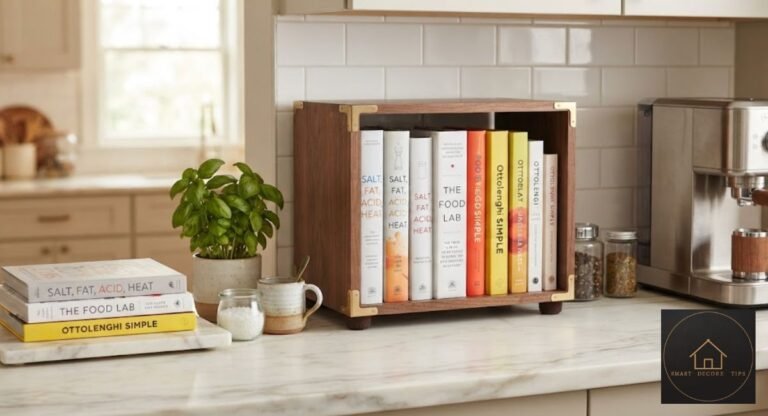
Match your materials. HGTV’s editors argue for coordinated ceramics, because when everything shares a look it’s obvious where things go back. Two finishes are plenty, say warm wood and matte white ceramic. Then stack. HGTV suggests piling a few cookbooks and topping them with a grinder, aiming for a triangle shape, the way you’d style a coffee table.
Hide the ugly stuff. Carmona recommends opaque containers for bread and mismatched tools, and House Digest says a lidded box looks neater than an open one. A lidded jar or basket does the job in seconds.
What can renters do without drilling?
Magnets, clip-on baskets, adhesive hooks and a freestanding countertop cabinet all work without a drill. Test a magnet on the side of the fridge first, because some stainless finishes aren’t magnetic.
House Digest calls magnetic racks damage-free and renter-friendly, and says they can hold small plants, photo frames and cookbooks on the side of an appliance.
A kitchen rail is the other rental-friendly upgrade. House Digest points to IKEA’s HULTARP rail at $6 and says adhesive strips can hold one if you only hang light items. That price dates from mid-2025, so check the current tag. Either way, read the weight rating on the pack before you hang a copper pot from it.
Clip-on options cost little. IKEA’s PÅLYCKE clip-on basket is $8.99 and clips onto a shelf, and its clip-on hook rack is $2.99. A countertop cabinet just sits on the counter, so it needs no hardware at all.
I learned the magnet lesson the hard way, by sticking a rack to the side of a fridge without testing it. It slid down the door. A pocket magnet would have told me in two seconds.
Rental counters belong to someone else, so the felt-pad rule from earlier matters even more here.
Who should skip counter storage altogether?
Anyone with a short counter and a daily cooking habit should keep decor to one tray, or go fully vertical. Storage on the counter has real costs, and it’s better to know them before you buy.
It adds cleaning. Every canister and crock is one more thing to lift and dry. On honed or dark quartz, where Caesarstone says marks and stains show more, that adds up. If you won’t lift it to wipe, don’t buy it.
It’s a poor fit for some households. Marble owners should keep lemons and vinegar on a tray, since acids etch calcium-based stone. Cooks who chop at the counter every night will feel the 36-by-24 rule most. Still, if your counters are already crowded, another basket won’t fix it. Editing will.
Two regrets are easy to avoid: a rust ring from a cheap tin, and dull spices from a stove-side rack. Start small this weekend. Tape the prep zone and pick one tray. Then check three bases. The best decorative kitchen countertop storage is the kind you’ll actually lift and wipe. Prices and sizes in this guide were last verified September 24, 2026.
FAQs
Keep only what you use every day, such as a coffee maker, a utensil crock and a tray with your oil and salt, and store the rest in cabinets.
Leave at least 36 inches by 24 inches of continuous counter beside the sink, which is the prep area in the NKBA planning guidelines.
A rough or unfinished base dragged across the surface can mark it, so add felt pads to each piece and lift it instead of sliding it.
True quartzite doesn’t etch from lemon juice or vinegar, but marble sold as quartzite does, so test a hidden spot first.
Store them in a drawer, cabinet or wall shelf away from the stove, dishwasher, sink and windows, as McCormick advises.
Magnetic racks, clip-on baskets, adhesive hooks and freestanding countertop cabinets all work without drilling.
Yes, lidded baskets and boxes hide clutter better, while trays make the items left in view look arranged.

Hi, I’m Shahzad Ahmad welcome to Smart Decore Tips!
I write and research every guide on this site myself, focused on real, practical home decor advice for renters, first-time homeowners, and small-space living. Before publishing anything, I check actual product listings, current prices, and real customer reviews not just what other sites already say.
My goal is simple: help you make smarter, more affordable decor decisions without the guesswork or sales pitch.




One Comment