Kitchen Countertop Accessories: What Actually Protects Your Counters (2026)
Most kitchen countertop accessories are decoration wearing a disguise. A handful of them are doing real work — protecting the surface you just paid four figures for. Most kitchens have a mix of both, and most people can’t tell which is which until something gets scratched or scorched.
If you just put in quartz or quartzite, this matters more than it sounds. Quartz is engineered and nearly nonporous. Quartzite is natural stone that behaves more like granite. They don’t need the same accessories, even though every decor blog treats “kitchen countertop accessories” as one generic shopping list.
Quick Answer: The 5 Accessories Every Countertop Actually Needs
You need a cutting board, a trivet or two, a corralling tray, a soap dispenser that isn’t the store bottle, and — if you have natural stone like quartzite — a sealant reminder, not a sealant for quartz. Everything past those five is styling, not protection. Buy the styling pieces because you like them, not because a listicle told you your counter needs seventeen items on it.
The Accessories That Actually Protect Quartz and Quartzite
Here’s the split nobody explains clearly: quartz is engineered stone bound with resin, so it’s nonporous and doesn’t need sealing — ever. Quartzite is real stone, and depending on the slab, it can be porous enough to stain from a puddle of olive oil left overnight. I learned this the annoying way, wiping a wine ring off a quartzite sample board that a fabricator let me test — it lifted, but only because I caught it in twenty minutes.
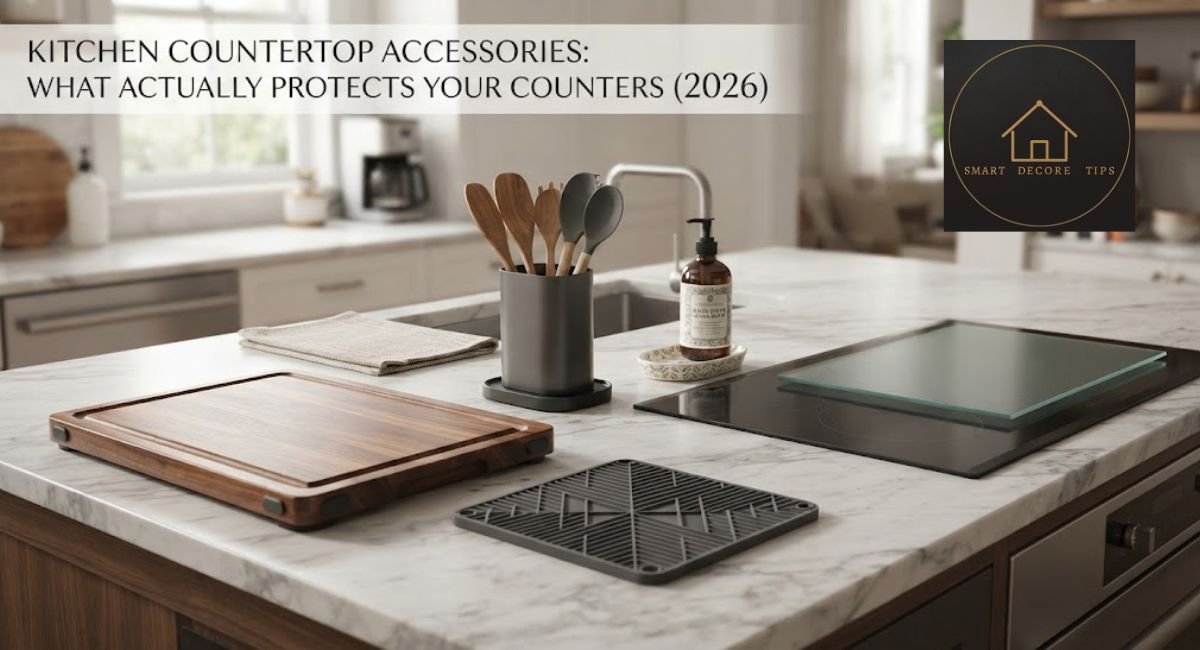
Trivets and hot pads. Quartz resists heat better than most people assume, but the resin binder can scorch or discolor under sustained direct heat from a pan straight off the stove. Quartzite handles heat closer to granite — better than quartz, honestly — but a trivet still saves you from thermal shock cracking, which is real on both.
Cutting boards. Non-negotiable on either surface. Quartz will dull your knives before it shows a scratch; quartzite can actually scratch under a sharp blade pressed hard. A composite board like Epicurean’s — heat-resistant to 350°F and dishwasher-safe — fixes both problems and costs less than the fabricator’s patch kit.
A quartz-safe surface spray. Skip anything labeled a “stone sealer” on quartz — nano-guard sprays formulated specifically for quartz and quartzite exist and are fine, but a traditional penetrating sealer marketed for granite can leave residue on quartz’s resin surface. Read the label before you buy, not after.
Two honest trade-offs here. A decorative wood cutting board left out on the counter needs oiling every few weeks or it dries and cracks — that’s ongoing upkeep, not a one-time purchase. And nano-guard sprays on quartz are mostly insurance, not a fix; they won’t undo an existing wine stain, they just make the next spill easier to wipe.
Sink-Area Accessories Nobody Talks About
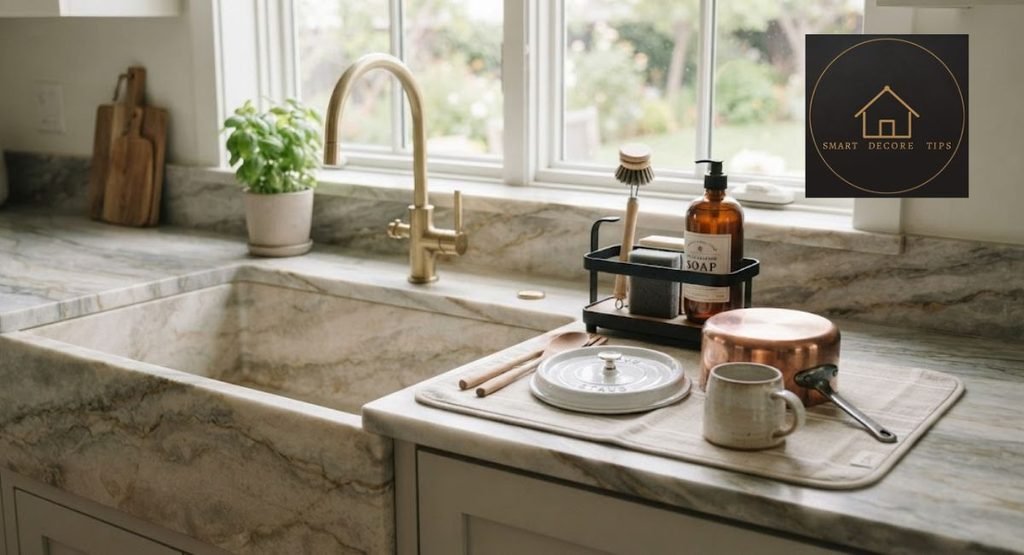
Decor lists love a soap dispenser and skip everything else near the sink, which is odd since that’s the wettest, highest-traffic accessory zone on the whole counter. A dish-drying mat left in one spot for days trapped moisture under itself on a client’s quartz counter — no permanent damage, but a faint water ring took two cleanings to fully lift. Move it, or pick one with a raised grid that lets air underneath.
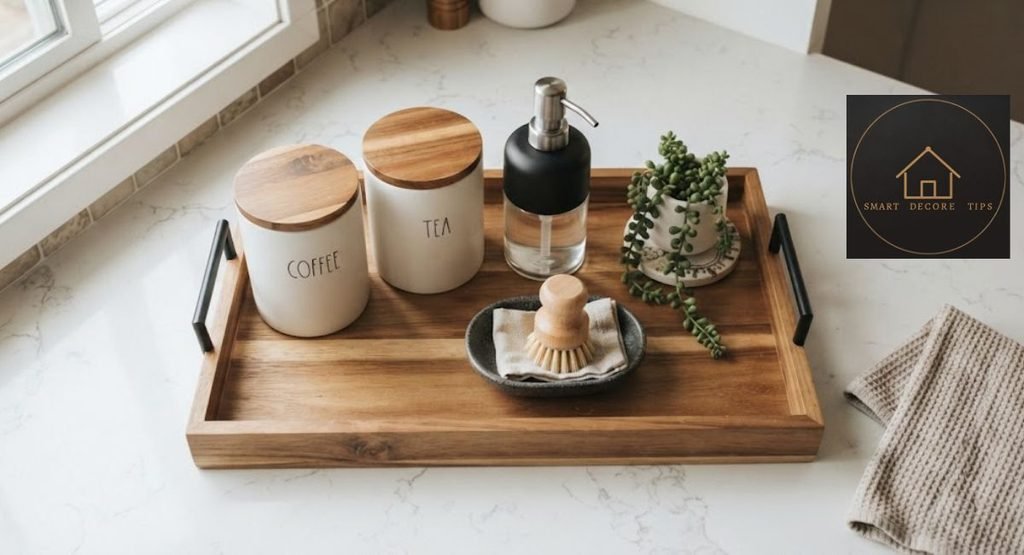
A sink caddy for sponges and brushes keeps wet items off the stone entirely, which matters more on quartzite than quartz. And a proper soap dispenser — glass or ceramic, refillable — isn’t just aesthetic. Store-bottle plastic sweats condensation in humid kitchens, and that ring sits directly on the counter for weeks at a time.
Trays and Canisters: The Trick That Makes Clutter Look Intentional
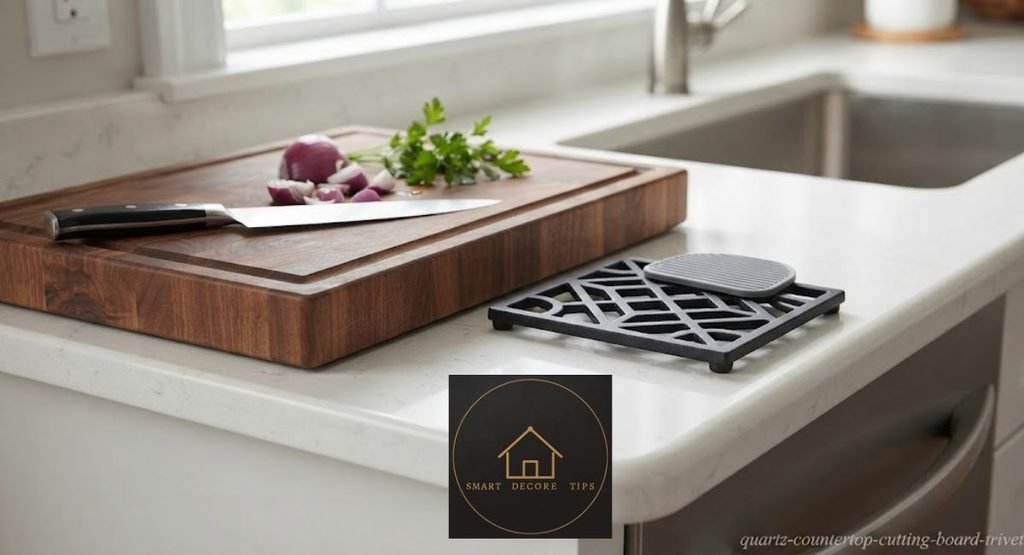
This is the part every decor site gets right, so it’s worth repeating instead of reinventing. Three or four loose items scattered across a counter reads as clutter. The same three or four items grouped on a single tray reads as a display. It’s a strange trick, but it works every time I’ve tried it on a client’s kitchen, including one where nothing else about the layout changed.
Matching canisters for flour, sugar, and coffee do the same job for pantry staples that used to live in ugly plastic bags. A soap dispenser swap is the cheapest win on this whole list — five minutes, under $20, and it’s the single accessory guests actually notice.
Skip the seasonal tray swap trend, though. Restyling counters every month photographs well for content, but it’s not how anyone actually lives, and the constant moving is exactly what leads to scratched trivets and forgotten hot pans.
What to Skip If You Paid for Real Stone or Quartz
A few “accessories” marketed for kitchens actively work against a good countertop. Adhesive-backed organizers and rail systems that mount to the backsplash are fine, but anything that requires drilling into the countertop edge — some spice rack systems do this — can void a fabricator’s warranty outright. I watched a countertop installer explain this to a homeowner mid-install: any hardware penetrating the slab itself, not the wall behind it, is treated as unauthorized modification on most quartz warranties.
Rubber-backed mats left in one spot for weeks can trap moisture underneath and, on quartzite specifically, contribute to staining you won’t see until you move the mat. Small appliances left permanently in one spot are a decor choice, not a protective one, but they belong in this warning too: a slow cooker or air fryer running hot for hours in the same footprint is functionally the same risk as skipping a trivet, just slower.
Budget vs. Splurge: Where the Money Actually Matters
Not every accessory needs to be expensive, but a few are worth the extra cost. A $12 silicone trivet warped and thinned out within a month under a heavy stockpot in my own kitchen; a $40 cork-and-cast-iron one has held up for two years under the same routine. That’s the one category where cheap genuinely costs more over time.
Trays and canisters are the opposite — a $15 bamboo tray from a big-box store does the exact same corralling job as a $90 designer one. Spend where the accessory takes physical abuse (trivets, cutting boards), and save where it’s purely visual (trays, canisters, dispensers).
Buy vs. Skip, by Material
| Accessory | Quartz | Quartzite |
| Cutting board | Buy — protects knives | Buy — protects surface |
| Trivet/hot pad | Buy — prevents scorch marks | Buy — prevents thermal cracking |
| Penetrating stone sealer | Skip — not needed, can leave residue | Use quartz/quartzite-labeled sealer only |
| Nano-guard spray | Optional — insurance layer | Recommended, especially on lighter slabs |
| Drilled/mounted organizers | Skip — can void warranty | Check fabricator warranty first |
| Dish-drying mat | Use one with airflow underneath | Same — move it regularly |
| Decorative tray, canisters | Buy freely | Buy freely |
A Layout That Doesn’t Look Like a Showroom
The method I use with clients is simple: one working zone (cutting board, knife block or crock, trivet) stays permanently near the stove. One display zone (tray with two or three items) sits somewhere it won’t get splashed. Everything else goes in a drawer. That’s it — no complicated zoning system, just two spots instead of counters covered edge to edge.
If your kitchen island is the main gathering spot, keep the display zone there and the working zone against the wall counter. It’s a small swap, but it’s the difference between counters that photograph well and counters that actually function when six people are in the kitchen at once.
If you’re still deciding what your counters should even look like before accessorizing them, check what’s actually trending in 2026 first — it changes which accessories are worth buying.
FAQs
A cutting board and a trivet cover the two most common damage causes — scratching and heat. A quartz-labeled protective spray adds a thin extra layer against staining, but it’s optional insurance, not a requirement.
Mostly the same basics, but quartzite is more porous depending on the slab, so a sealant check and faster spill cleanup matter more than they do on quartz.
Not for long. Quartz tolerates brief contact but sustained heat from a pan straight off the burner can scorch or discolor the resin binder — use a trivet.
Both. Grouping loose items on a tray genuinely reduces visual clutter and makes cleaning faster, since you can lift one tray instead of six items.
No. Quartz is engineered to be nonporous and doesn’t require sealing. A sealer isn’t harmful most of the time, but it’s an unnecessary step on quartz specifically.
Trivets and cutting boards take real physical abuse, so quality matters there. Trays, canisters, and dispensers are purely visual — a cheap one does the same job as an expensive one.

Hi, I’m Shahzad Ahmad welcome to Smart Decore Tips!
I write and research every guide on this site myself, focused on real, practical home decor advice for renters, first-time homeowners, and small-space living. Before publishing anything, I check actual product listings, current prices, and real customer reviews not just what other sites already say.
My goal is simple: help you make smarter, more affordable decor decisions without the guesswork or sales pitch.