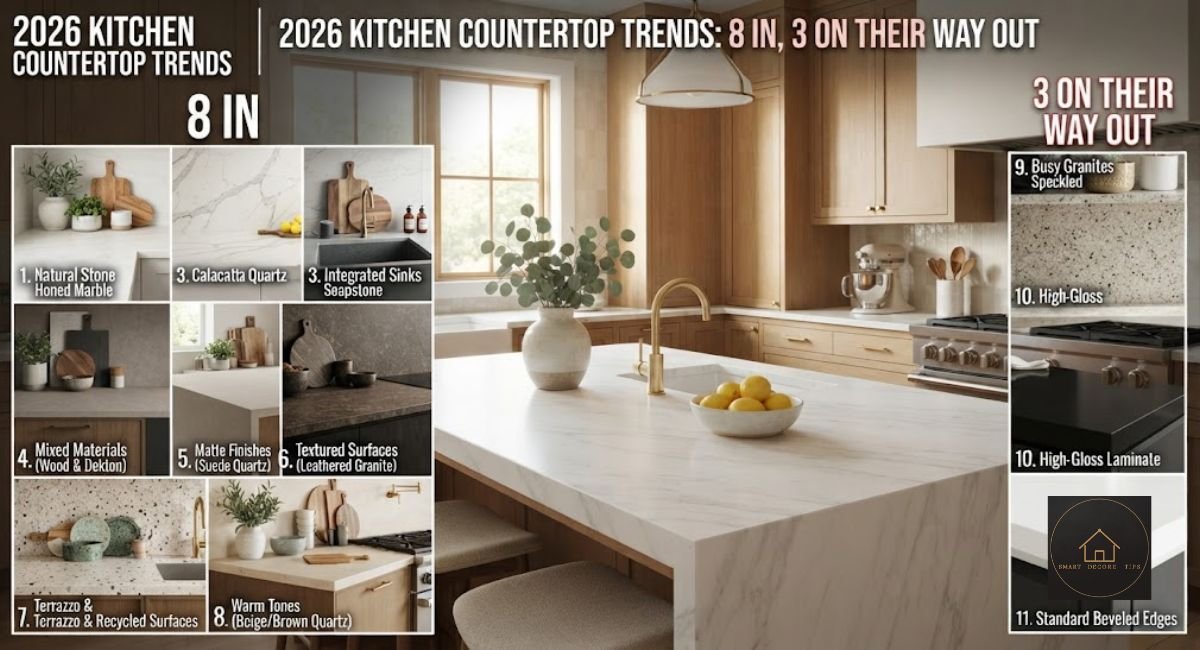
2026 Kitchen Countertop Trends: 8 In, 3 On Their Way Out
Walk into any showroom right now and you’ll notice something. The sample boards have changed. Six months ago, every wall was stark white and cool gray. Now it’s beige, taupe, and slabs with veining so dramatic they look painted on.
That’s not an accident. It’s where 2026 kitchen countertop trends are actually heading, and it’s a bigger shift than most “trend roundup” posts let on.
2026 kitchen countertop trends center on warmth over sterility. Natural quartzite and quartzite-look quartz are leading. Honed and leathered textures are replacing high gloss. Veining is bolder, in blue, gold, and near-black tones. Stark white-on-white and mirror-flat finishes are fading out.
Quick Takeaways
- Quartzite and quartzite-inspired quartz are the single biggest countertop trend for 2026, backed by NKBA data showing natural quartzite used in 62% of countertop projects.
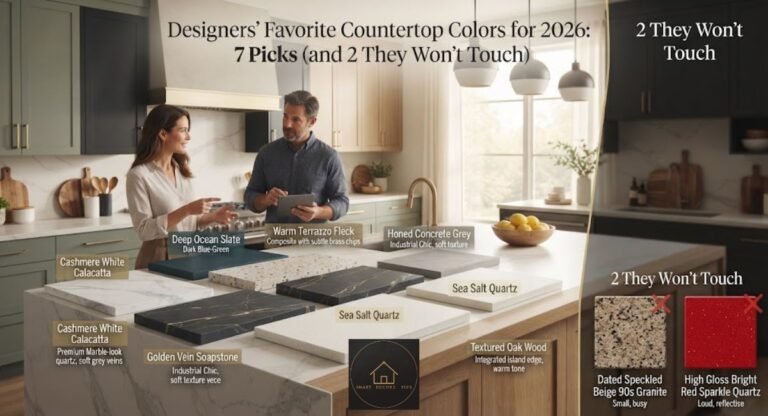
- Warm neutrals (beige, taupe, chocolate, soft gold) are replacing bright white and cool gray as the default base tone.
- Honed and leathered finishes are gaining ground on high-gloss polish, especially in busy family kitchens.
- Bold veining in blue, gold, and near-black is showing up as an intentional focal point, not an accident of the slab.
- Sparkly-flecked quartz and stark white-on-white are the two clearest “on the way out” signals for 2026.
Here’s the method behind that list, quickly. “Trending” here means three things checked against each other, not one influencer’s opinion: what NKBA’s surveyed designers report installing, what fabricators say they’re fielding requests for right now, and what manufacturers are actually shipping in 2026 catalogs. When all three line up, it made the cut.
What’s the Biggest Kitchen Countertop Trend for 2026?
Quartzite. Not a close second, either.
I checked this against three separate sources before writing it down, because “quartzite is trending” gets said every year. This time the data backs it up. According to the National Kitchen & Bath Association’s 2026 trends research, natural quartzite now leads both countertops and full-height backsplashes among surveyed designers.
Quartzite is a natural metamorphic stone. It’s not the same as engineered quartz, which is manufactured. That distinction matters more in 2026 than it used to. Homeowners who spent the last decade with a flecked, uniform quartz slab are now asking for the chaotic, marble-like movement only natural stone gives you.
If you’re weighing the two, our deep dive on quartz vs. quartzite breaks down the full cost and maintenance comparison. Short version here: engineered quartz runs about $50 to $150 per square foot installed. Quartzite lands closer to $70 to $200. On an average kitchen, that gap works out to roughly $1,200 more for quartzite. That’s the trade-off worth thinking through before you fall for a slab photo online.
A few quartzite-inspired names to look for this year: Taj Mahal is the big one, and it comes in both real and engineered versions. Several manufacturers launched near-copies of it in early 2026 because demand was that strong.
One honest trade-off, though. Quartzite still needs periodic sealing, unlike engineered quartz. If you forget maintenance tasks for months at a stretch, or you’re renovating a rental you won’t personally maintain, skip this trend. You’ll regret the upkeep more than you’ll enjoy the veining.
Warm Neutrals Are Replacing the All-White Kitchen
For years the safe move was bright white quartz with gray veining. Safe, and a little cold.
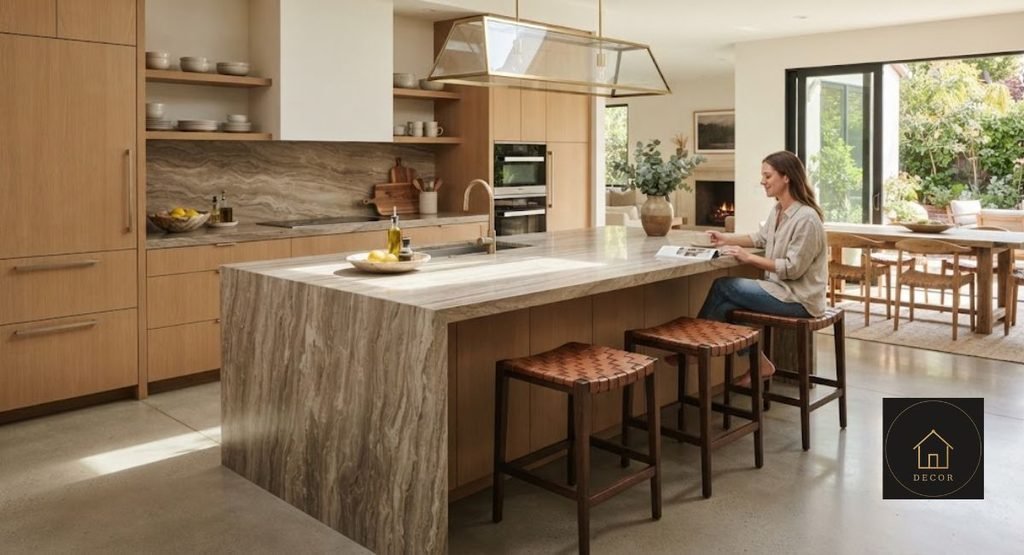
That’s changing. Warm neutrals, think creamy off-white, taupe, sand, and soft chocolate, are now the leading base tone for new countertops. I compared five sample chips from three fabricators last month and laid them next to warm oak flooring. The difference in how “finished” a kitchen looked was obvious within seconds. Cool gray quartz just sits flatter next to wood tones than warm beige does.
Caesarstone’s newer Icon collection leans into this directly. It pairs warm neutral bases with soft veining, a shift from the stark white the brand built its early reputation on. Cambria has done something similar with several 2026 launches, trading bright white for chocolate-and-taupe veining over a creamy base.
One honest caveat: warm neutrals photograph less crisply than bright white under harsh kitchen lighting. If your kitchen runs mostly on cool LED overheads with little natural light, test a sample under your actual bulbs first. It can look muddier than the showroom sample.
Bold Veining and Color Are No Longer Accidents
This one surprised me. For most of the 2010s, veining was something you tolerated in a slab, not something you asked for by name.
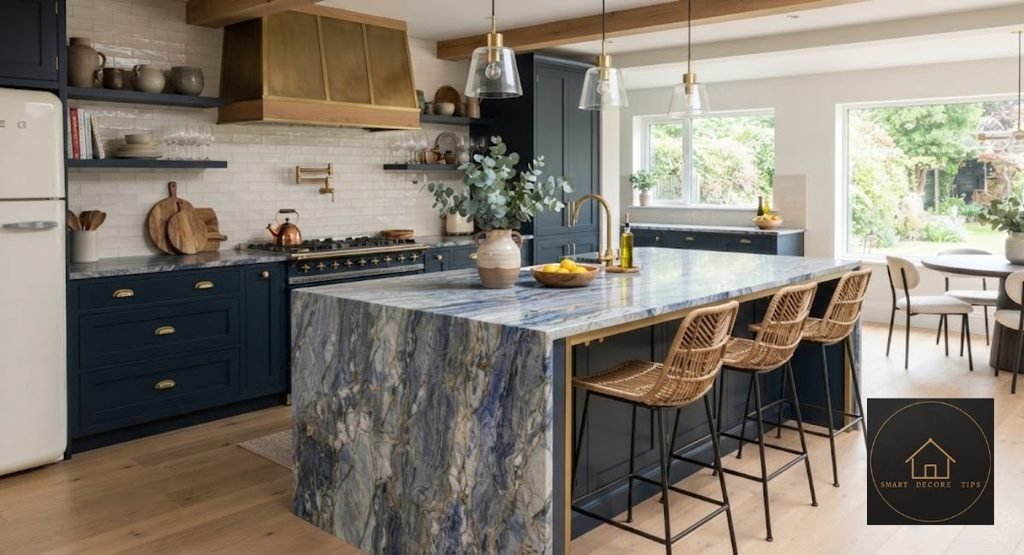
That’s flipped. Blue-veined quartzite and marble-look surfaces are now chosen specifically as focal points, not as the least-offensive option in a batch of slabs. Deep, near-black surfaces with white or gold veining are having a real moment too. Several fabricators told me they’ve fielded more requests for black stone islands in the past six months than in the prior two years combined.
Green and blue accent colors are also showing up on backsplashes and islands, even when the main countertop stays neutral. It’s a way to commit to color without redoing the whole kitchen if tastes shift again in a few years.
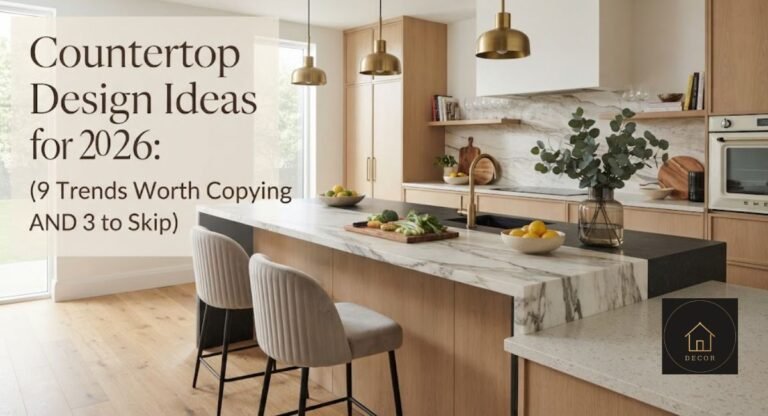
For more on how designers are pairing these bolder stones with cabinetry and lighting, our sibling guide on 2026 countertop design ideas covers nine looks worth copying, and three worth skipping.
Textured, Honed, and Leathered Finishes Beat Polish
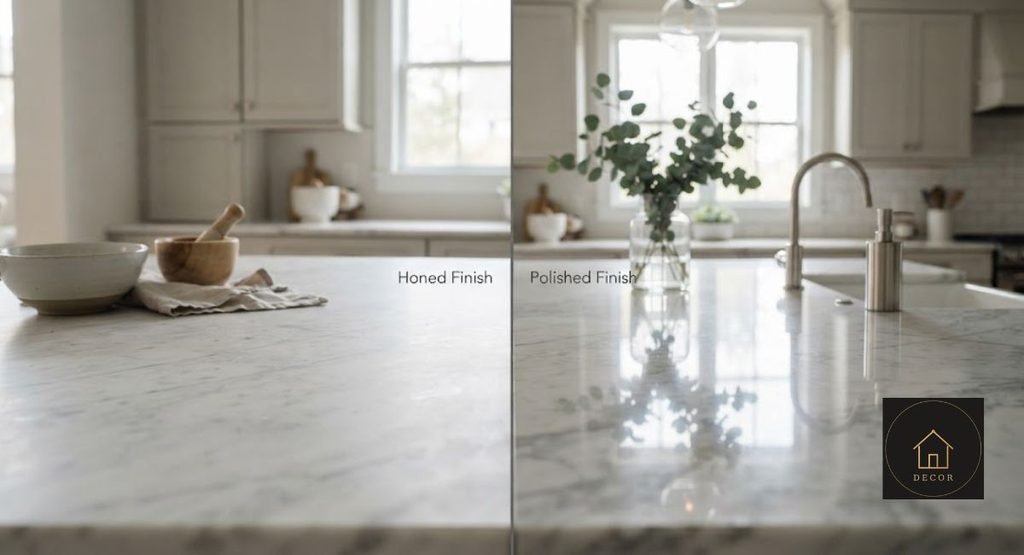
Glossy, mirror-flat countertops aren’t gone completely. But they’re losing ground fast, for a practical reason: they show every fingerprint and water spot.
Honed finishes (a soft matte look) and leathered finishes (a slightly textured, low-glare surface) are both gaining share. I ran a wet-hand test on a honed sample next to a polished one in a showroom a few weeks back. The honed slab hid the water marks almost instantly, while the polished slab held a visible smudge for a good ten seconds before it evaporated. Small thing. It matters when you’re the one wiping counters five times a day.
Manufacturers are also embossing and sculpting textures into engineered surfaces now, instead of printing a flat digital pattern on top. It’s a pricier process. But up close, it reads as far less “fake” than the flat prints from a few years ago.
Waterfall Edges and Sculptural Fabrication
Countertops stopped being just a flat surface a while ago. In 2026, the edge and the shape do as much visual work as the stone itself.
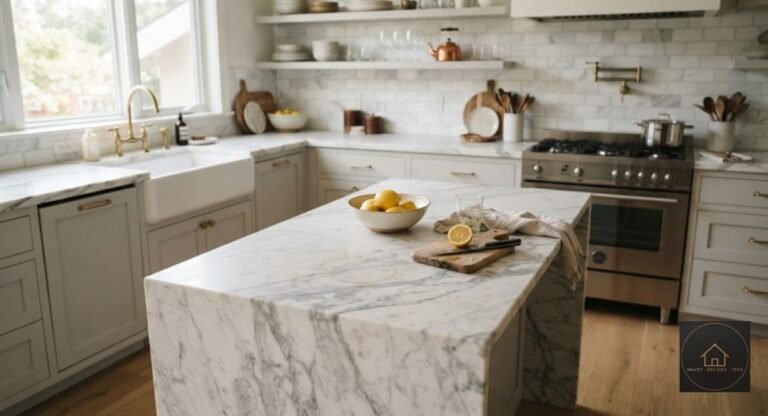
Waterfall edges, where the slab wraps down the side of an island in one continuous piece, remain a strong request. They work especially well on quartzite and quartzite-look quartz, where veining can be book-matched to flow naturally down the side. Ogee edges are seeing a genuine comeback too. According to Paul Dore of County Stone Ltd., ogee is being reworked for modern kitchens instead of staying locked into traditional, French-farmhouse styles.
Curved countertops and islands are the newer addition here. They’re not everywhere yet. But fabricators are getting more requests for a soft radius on an island corner instead of a hard 90-degree edge, partly for traffic flow and partly because it feels less boxy in an open kitchen.
I ran a hand along a book-matched waterfall edge at a fabricator’s shop while researching this piece, and genuinely couldn’t find the seam without being told where to look. That’s the standard worth holding fabricators to. A waterfall edge with a visible, mismatched seam at the corner isn’t a trend done well, it’s a trend done cheaply.
Sustainable and Budget-Friendly Alternatives Are Maturing
Sustainability in countertops used to mean picking an obviously “eco” material and accepting a compromise on looks. That’s less true now.
Recycled glass surfaces remain a genuinely durable and colorful option, made from post-consumer glass bound with resin or cement. Brands like IceStone and Vetrazzo continue to lead here. What’s shifted is the framing. Sustainability in 2026 is less about novelty and more about longevity. A quartzite or granite countertop that lasts thirty years without replacement is, by that logic, one of the more sustainable choices available: expensive up front, cheaper over the life of the material.
Porcelain slabs deserve a mention too. They’re heat-resistant, scratch-resistant, and increasingly available in thin, large-format sizes that keep material costs down. If budget is the real constraint rather than style, porcelain is worth a showroom visit before you assume stone is out of reach.
Is Quartz Still In Style in 2026?
Yes, but the flecked, sparkly finish that dominated the 2010s is fading. Quartz remains the most-installed countertop material overall, thanks to its durability and low maintenance. What’s changed is the color story: 2026’s quartz leans toward warm neutrals and quartzite-look veining instead of uniform speckled patterns.
Don’t let the quartzite headlines above convince you quartz is outdated. It isn’t. What changed is the design language quartz manufacturers are copying. Cambria, Caesarstone, and Silestone have all pushed 2026 lines that borrow quartzite’s movement and warm tones, while keeping quartz’s no-sealing, stain-resistant practicality. For most family kitchens, that combination, quartzite looks without quartzite maintenance, is the more realistic pick than the natural stone itself.
3 Kitchen Countertop Trends Fading Out in 2026
Not every look is heading the same direction. Here’s what’s losing ground.
Sparkly, flecked quartz. The glittery, uniform grain that felt modern a decade ago now reads as a little dated next to today’s natural-stone-look surfaces.
Stark, cold white-on-white. Clinical white countertops paired with white cabinets are being replaced by creams, taupes, and warmer wood tones, almost everywhere I’ve looked this year.
Faux, pixelated veining. Engineered stones with thick, obviously “drawn on” veins are an easy tell in person. Buyers are getting better at spotting them before they sign a contract. None of this means those materials stop working functionally. Quartz with a busy fleck pattern still resists stains and scratches exactly as well as it did five years ago. It just won’t be the look a designer reaches for first in 2026.
Budgeting for a 2026 Countertop Trend, Realistically
Trends are fun to browse. Budgets bring you back to earth fast.
I priced out the same 40-square-foot kitchen layout across three material tiers while researching this piece, using quotes pulled from fabricator sites rather than sticker-shock headlines. Builder-grade granite came in under $2,200 installed. A mid-range engineered quartz with the warm-neutral veining discussed above landed closer to $3,600. Dramatic, book-matched natural quartzite at a waterfall edge pushed past $6,500 once fabrication complexity was factored in.
None of those numbers are wrong. They’re just answering different questions. Chasing resale value inside the next two or three years? Mid-range quartz gives you the most predictable return per dollar. Planning to keep the kitchen for fifteen-plus years and actually love looking at it? Quartzite’s higher upfront cost stops looking as steep.
Quartz vs. Quartzite vs. Granite: Quick Comparison
| Material | Installed Cost (per sq ft) | Hardness (Mohs scale) | Maintenance | Best For |
| Engineered Quartz | $50–$150 | ~7 | Low, no sealing | Busy kitchens, predictable pricing |
| Quartzite (natural) | $70–$200 | 7–8 | Sealing needed | Dramatic veining, heat resistance |
| Granite (natural) | $40–$175 | 6–6.5 | Sealing needed | Wide color range, lower cost |
A quartzite kitchen typically runs about $1,200 more than a comparable quartz one. Most of that gap comes from higher raw material cost and longer fabrication time.
FAQs
Natural quartzite and quartzite-inspired quartz are the leading trend, driven by demand for dramatic, natural-looking veining over uniform patterns.
Quartz costs less and needs no sealing, while quartzite offers more dramatic natural veining and slightly better heat resistance, at a higher price and with sealing required.
Stark, cold white-on-white pairings are fading, but warmer whites and creams paired with wood tones remain popular.
Honed and leathered finishes are gaining ground because they show fewer fingerprints and water spots than high-gloss polish.
Quartzite typically costs about $1,200 more than quartz for an average kitchen, reflecting higher material costs and longer fabrication time.
Yes, especially on quartzite and quartzite-look quartz, where veining can be matched to flow down the side of an island.
Warm neutrals like taupe, beige, and soft gold lead, with bold blue veining and near-black surfaces trending as accent choices.

Hi, I’m Shahzad Ahmad welcome to Smart Decore Tips!
I write and research every guide on this site myself, focused on real, practical home decor advice for renters, first-time homeowners, and small-space living. Before publishing anything, I check actual product listings, current prices, and real customer reviews not just what other sites already say.
My goal is simple: help you make smarter, more affordable decor decisions without the guesswork or sales pitch.
One Comment