

Small White Sectional Couch: Size, Fabric & Fit Guide
A small white sectional couch can give a compact living room more usable seating without making the room feel visually heavy. The hard part is not choosing white. It is choosing the right footprint, chaise depth, fabric, and delivery dimensions so the sectional works after it reaches your room.
A small white sectional couch is a compact sectional in white, ivory, cream, or another light neutral that fits the room without blocking circulation. There is no universal industry cutoff for “small.” Judge it by the sofa’s full width and depth, chaise projection, delivery path, and the usable floor area left around it.
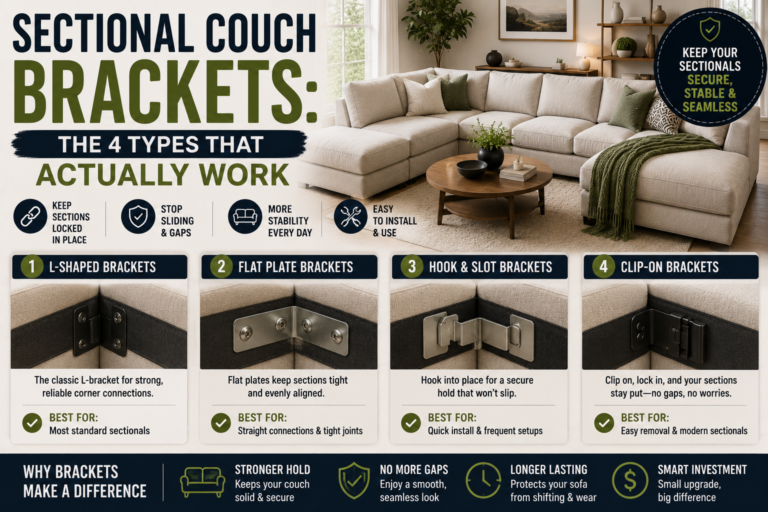
If you’re still comparing layouts, the SmartDecorTips corner and sectional couch guide explains the main shapes. For modular furniture, the sectional couch brackets guide explains why connectors matter in a tight layout.

How Small Is “Small” for a White Sectional?
There is no single width that turns a sectional into a small sectional. Products sold for compact layouts vary significantly, and depth can matter as much as width.
Here’s what stood out while comparing manufacturer specifications. Article’s Riley reversible storage sectional measures 84 inches wide, Sanders measures 85.5 inches, and Nora measures 90.5 inches. Those examples alone show why a universal “under 90 inches” rule is too rigid. (Article)
The useful number is the full footprint, not an invented category cutoff.
For example, the Article Riley 84-inch Reversible Storage Sectional measures 84″W × 61″D × 35″H. Sanders is 85.5″W × 61″D × 32.5″H, while Nora is 90.5″W × 65″D × 34.5″H. A sofa can therefore look compact by width while its chaise still projects deeply into the room.
A Better Sizing Test
Write down four measurements before shopping:
- Maximum wall width available for the sectional.
- Maximum depth you can give the chaise without blocking your normal route.
- Width and height of every doorway, stair turn, hallway, and elevator on the delivery path.
- The dimensions of the largest individual package or sofa piece when the manufacturer provides them.
Pottery Barn recommends marking the planned furniture footprint on the floor with painter’s tape. Its measuring guide also tells buyers to check every doorway, hallway, staircase, and elevator the furniture must pass through. (potterybarn.com)
That is more useful than assuming every apartment needs an 80- or 90-inch sofa.

Which Small-Sectional Layout Works Best?
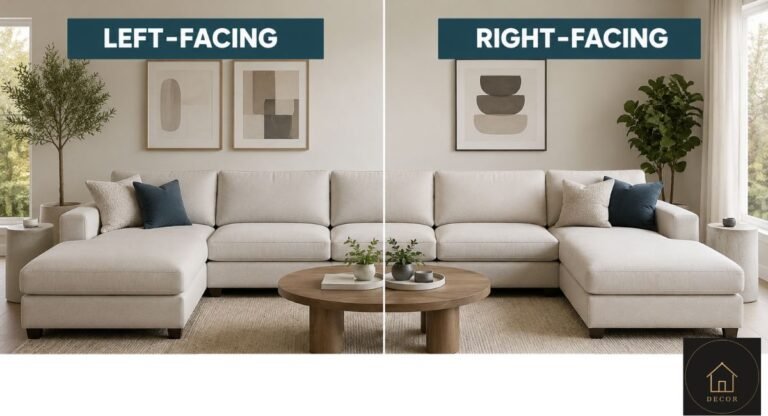
For a tight room, a reversible chaise is often the easiest layout to adapt because the lounge side can move when the room changes. A fixed left- or right-facing chaise can work just as well when the furniture plan is permanent.
| Layout | Best reason to choose it | Main thing to check |
|---|---|---|
| Reversible chaise | You rent, move often, or may switch the layout | How the ottoman and chaise cushion reconfigure |
| Fixed chaise | Your furniture plan is settled | Choose orientation from the room, not the product photo |
| Modular sectional | You may add, remove, or rearrange pieces | Connector system and individual-module dimensions |
| Double chaise | Two people want lounging space | Total depth in a narrow room |
| Corner sectional | You need a true 90-degree seating corner | Both wall runs and delivery-piece dimensions |
Article’s Riley, Sanders, and Nora all use reversible chaise arrangements, so the lounge side can change without permanently locking the sofa into one orientation.
If you want furniture that can perform several jobs in a small home, compare the SmartDecorTips modular loveseat with ottoman guide before paying for extra flexibility you may never use.
Three Real Small White or Ivory Sectionals to Use as Size Benchmarks
These are not a best-of ranking. They are real examples that show how differently compact, light-colored sectionals can be built.
Article Riley 84-Inch Reversible Storage Sectional
Article’s Riley 84-inch Reversible Storage Sectional in Napa White measures 84″W × 61″D × 35″H.
The chaise is reversible, and storage sits beneath the ottoman portion. Article specifies high-resiliency foam with polyester fiber and upholstery made from 92% polyester and 8% linen. Napa White is listed as a performance fabric with a C0 stain-repellent finish.
The important compact-room feature isn’t only the 84-inch width. Reversible orientation and integrated storage let one furniture piece solve several layout problems.
The sofa seat depth is listed at 23 inches, while the chaise seat reaches 60 inches. That difference shows why checking only overall width can give you a misleading idea of how much floor space the sofa needs.
Article Sanders 85.5-Inch Reversible Sectional
The Sanders Ivory Wool Bouclé sectional measures 85.5″W × 61″D × 32.5″H. Its chaise can move to either side, and Article lists polyurethane foam and polyester fiber for the cushion filling.
Its upholstery is 74.5% polyester, 13.5% cotton, 6% wool, and 6% acrylic. Article gives this bouclé its own care instructions and advises against scrubbing the fabric.
That is a useful reminder that “white sectional” does not automatically mean smooth performance polyester. A light bouclé has a different texture and care profile.
Article Nora 90.5-Inch Reversible Sectional
Article’s Nora 90.5-inch Reversible Sectional in Savoy Ivory measures 90.5″W × 65″D × 34.5″H.
Article lists a reversible chaise cushion and ottoman, foam and polyester-fiber cushioning, and Savoy Ivory performance upholstery with a C0 stain-repellent finish.
Its 90.5-inch width shows exactly why the old “under 90 inches equals small” rule was too rigid. Half an inch does not suddenly make a sofa unsuitable. Your usable floor area decides that.
The listed chaise depth is 48.5 inches, and the sofa carries a tested weight specification of 600 pounds. Those are product-specific specifications, not numbers to apply to every compact sectional.
Last verified: August 30, 2026. Product prices, fabrics, dimensions, and availability can change.

What Fabric Makes the Most Sense on a White Sectional?
There is no upholstery category that makes white furniture maintenance-free. The safer choice is the exact fabric whose care instructions match your household.
The earlier version of this guide treated “performance fabric” almost like one material. Manufacturer specifications show why that is too simple.
Article’s Riley Napa White uses a stain-repellent finish and product-specific cleaning instructions. Nora’s Savoy Ivory is also sold as performance upholstery with a C0 finish. Sanders Ivory Wool Bouclé uses a different fiber blend and different cleaning directions.
Before ordering, check:
- exact fiber composition;
- what “performance” means for that specific fabric;
- whether a stain treatment is used;
- whether cushion covers come off;
- whether removable covers are actually machine washable;
- the manufacturer’s cleaning instructions;
- whether physical swatches are available.
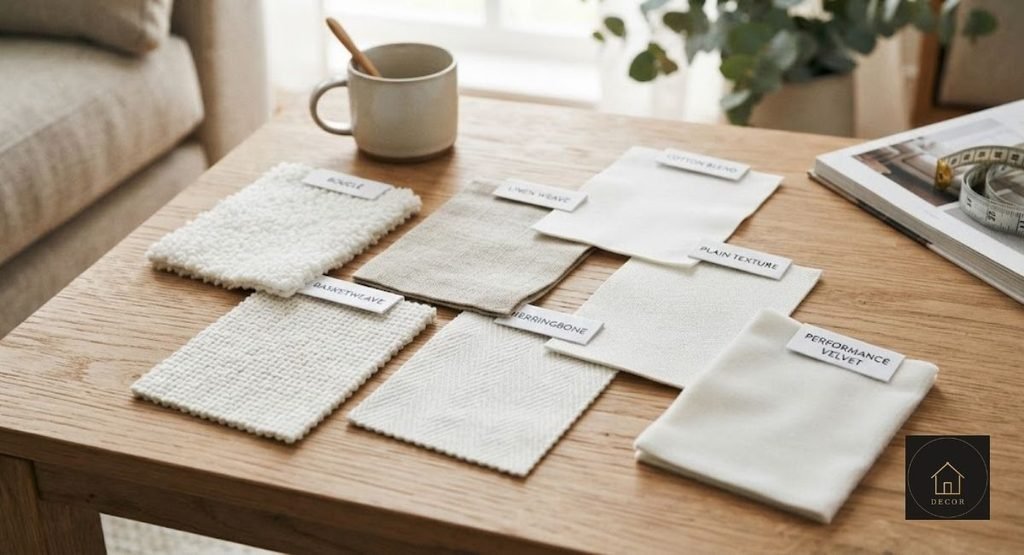
If you’re deciding between white, cream, ivory, bouclé, velvet, and performance weaves, use the SmartDecorTips cloud couch color and fabric guide for a broader fabric-and-color comparison.
Will a White Sectional Look Dirty Faster?
White creates strong contrast with many everyday marks. Crumbs, dark pet hair, denim transfer, and colored spills can therefore become noticeable quickly. That does not mean every white upholstery stains easily.
Maintenance depends on the textile and the manufacturer’s instructions. Do not use one homemade cleaning mixture on every white sofa.
For Riley’s Napa fabric, Article advises blotting a spill with a dry cloth before using water according to its care instructions. Sanders has different guidance for its bouclé, including avoiding scrubbing. Nora’s Savoy fabric also has its own stain-care directions.
That difference is exactly why the sofa’s own care instructions matter more than generic white-couch advice.
For an already-owned sofa, the SmartDecorTips cloud couch cleaning guide can help you understand upholstery-care decisions, but your specific sectional manufacturer’s care instructions should take priority.
One honest trade-off: if visible marks create constant stress and your household deals with frequent food spills, muddy paws, or heavy dark shedding, bright white may simply be the wrong lifestyle match.
Ivory, oatmeal, or light greige can preserve a light overall palette while reducing some of the visual contrast.
What About Kids and Pets?
Don’t choose a white sectional for children or pets based only on the word “performance.”
Start with three checks: the exact cleaning instructions, the cushion-cover construction, and the contrast between the upholstery and your pet’s fur.
A removable cover can make maintenance easier, but removable does not mean machine washable.
Article’s Riley has loose, reversible seat and back cushions, yet the manufacturer supplies upholstery-specific spill instructions rather than telling owners to machine wash the covers.
If your pet scratches furniture, examine looped upholstery such as bouclé in person before ordering. Run your fingers across a swatch and look at how pronounced the loops are.
That is a more useful buying check than assuming every textured fabric behaves the same way around claws.
Pet hair visibility matters too. A cream-colored pet on ivory upholstery creates less contrast than the same fur on charcoal. A dark-haired pet can have the opposite effect.
The right color is therefore partly about what your particular household puts on the sofa every day.
How Much Does a Small White Sectional Cost?
There is no reliable universal price band. Compact sectionals with similar dimensions can have noticeably different prices because construction, upholstery, storage, and branding differ.
When verified on August 30, 2026, Article listed Riley Napa White at $1,599, Sanders Ivory Wool Bouclé at $1,069, and Nora Savoy Ivory at $1,999. These are point-in-time prices for those products, not market averages.
Compare price against what you’re actually receiving:
- frame and suspension construction;
- seat and back cushion materials;
- fixed versus reversible chaise;
- integrated storage;
- upholstery and cleaning requirements;
- warranty and return policy;
- replacement or expansion options;
- delivery and assembly requirements.
A lower price alone does not prove weak construction. A higher price also does not prove the upholstery will suit your household.
The more useful question is: what feature am I paying extra for, and will I actually use it?
Storage can justify a higher price in a small apartment. Expensive custom upholstery may not if your main priority is simply fitting three seats into a narrow room.
How Do You Measure a Small White Sectional Couch Before Buying?
Measure the complete use position, not only the wall behind the sofa.
This is one of the clearest lessons from comparing compact sectionals. Chaise depth can change the practical fit as much as the headline sofa width.
Use this five-step test:
- Tape the sectional’s full width and depth onto your floor.
- Mark the chaise in the exact orientation you plan to use.
- Open every nearby door, cabinet, and drawer to test collisions.
- Walk your normal routes around the taped footprint.
- Measure the delivery route separately, including its tightest turn.
Pottery Barn’s furniture measuring guide recommends marking the furniture dimensions on the floor with painter’s tape before purchase. It also recommends checking whether the furniture can pass straight through an entryway or needs to enter at an angle.
For sofas, Pottery Barn also explains the role of diagonal depth when determining whether a piece can pass through an entrance on its end.
A sectional that fits the wall but blocks a doorway is not a good fit. Neither is one that looks perfect on the floor plan but cannot make the turn into the room.
Don’t Forget the Delivery Route
Measure:
- front or apartment door;
- interior doorways;
- hallway width;
- stairwell width and ceiling height;
- sharp turns;
- elevator door and interior;
- low-hanging lights or railings.
Pottery Barn specifically includes doorways, staircases, elevators, and hallways in its delivery-measurement process.
Separate sectional pieces can make delivery easier than one huge sofa, but the largest individual component still has to reach the room.
Reversible vs. Modular: They Are Not the Same
A reversible sectional lets you change which side the chaise occupies. A modular sectional goes further by using independent compatible pieces that can be rearranged, removed, or expanded.
The distinction matters in small rooms.
A reversible sectional is useful if your main concern is switching between left- and right-side lounging. It may be all the flexibility you need.
A modular sofa makes more sense when you expect to move homes, change room layouts, or add seating later.
More pieces also mean more seams and more connections to manage. If the sofa uses independent modules, check how they connect so the seating does not separate during use.
Storage Can Matter More Than an Extra Seat
Small living rooms usually have another problem besides seating: nowhere to put blankets, remotes, games, or occasional bedding.
That makes built-in sectional storage genuinely useful.
Article’s Riley uses space beneath the ottoman section for storage. The manufacturer lists an internal storage area measuring 6.25″H × 27.5″W × 16″D.
That is the kind of specific feature worth comparing in a compact room.
A sofa that seats the same number of people but replaces a separate storage basket or cabinet can save more usable space than one that is simply a few inches narrower.
Check how the compartment opens before buying. You need enough surrounding room to access it comfortably.
White, Ivory, or Cream: Which Works Best?
Color names are not standardized.
One brand’s “white” can look warm and creamy. Another brand’s “ivory” can appear almost white under bright daylight.
Always order a real swatch if the manufacturer offers one.
Place it beside:
- your wall paint;
- flooring;
- main rug;
- curtains;
- nearby wood tones;
- the room under your evening lighting.
Look at the swatch at several times of day before deciding.
Pure white creates the sharpest, brightest contrast. Ivory and cream add warmer undertones and often sit more naturally beside oak, walnut, jute, beige, and other warm finishes.
Neither option is automatically more stain-resistant. The upholstery construction determines that.
How to Style White Without Making the Room Feel Flat
A white sectional creates a large light surface. The room often benefits more from texture and tonal contrast than from adding more identical white.
Useful combinations include:
- ivory sectional + medium oak + olive textiles;
- white sectional + walnut + rust or terracotta accents;
- cream sectional + black metal + natural jute;
- warm white sectional + muted blue + aged wood.
In a very small room, keep the number of large competing patterns low. Use the rug, cushions, artwork, and wood tones to create separation between the sofa and surrounding surfaces.
Dark floors are not a reason to avoid white.
If the contrast feels too sharp, a rug containing both light and dark tones can visually bridge the floor and sofa.
You also do not need to fill every corner with décor. Leaving some visible floor and wall space helps the sectional feel intentional rather than squeezed in.
What People Get Wrong About Small White Sectionals
They shop by width alone. An 84-inch sectional with a deep chaise can occupy more useful floor area than a slightly longer but shallower sofa.
They treat “small” as an industry standard. Retailers classify furniture differently. Measure the actual product rather than relying on its category label.
They assume reversible means modular. A reversible chaise changes sides. A true modular system uses independent compatible components.
They assume removable covers are washable. Read the exact manufacturer’s care instructions before putting any upholstery cover into a washing machine.
They choose white from a screen. Order a swatch and compare it against your walls, flooring, rug, and evening lighting.
They forget delivery dimensions. A sectional can fit perfectly on your floor plan and still fail to pass through the delivery route.
They ignore chaise depth. The chaise can be the part that actually blocks the room, even when the sofa’s width looks ideal.
They buy for the product photo rather than their floor plan. A sectional photographed in a large studio can look much smaller than it will in an apartment.
Conclusion
A small white sectional couch can be an excellent choice for a compact living room, but the buying decision should start with footprint and care requirements rather than a generic size rule.
Measure width and chaise depth together. Tape the complete shape onto the floor. Check the delivery route. Then compare reversible orientation, cushion construction, storage, and the exact upholstery-care instructions.
White itself is not the deal-breaker. The wrong dimensions or wrong fabric usually create the bigger ownership problem.
If the footprint works and the upholstery matches your lifestyle, a compact white sectional can give you generous seating while keeping the room visually light.
FAQs
There is no universal sectional-width cutoff. Current compact examples include models from 84 to 90.5 inches wide, but depth, chaise projection, circulation, and delivery access matter just as much.
It can be if its upholstery construction and cleaning instructions suit your household. Check surface texture, removable-cover details, care requirements, and how visible your pet’s fur will be against the fabric.
Neither color is automatically easier to clean. Ivory can create less visual contrast with some everyday marks, while actual stain performance depends on the fabric, finish, and care requirements.
A reversible chaise is useful when you rent, move frequently, or expect your furniture layout to change. A fixed chaise is perfectly reasonable when the room plan is permanent.
Not necessarily. “Removable” describes the construction, not the approved cleaning method. Follow the manufacturer’s exact upholstery-care instructions.
Compare the dimensions of the sectional’s delivery pieces with every doorway, hallway, stairwell, and elevator along the route. Pottery Barn recommends measuring the complete delivery path and considering whether the piece needs to enter at an angle.
Yes. Some compact designs integrate storage into a chaise or ottoman. Article’s Riley 84-inch sectional is one example, with storage beneath the ottoman section.
Not automatically. A roughly 90-inch sofa can work in one compact room and fail in another. Full depth, chaise position, doors, walking routes, and surrounding furniture determine the real fit.

Hi, I’m Shahzad Ahmad welcome to Smart Decore Tips!
I write and research every guide on this site myself, focused on real, practical home decor advice for renters, first-time homeowners, and small-space living. Before publishing anything, I check actual product listings, current prices, and real customer reviews not just what other sites already say.
My goal is simple: help you make smarter, more affordable decor decisions without the guesswork or sales pitch.




2 Comments