
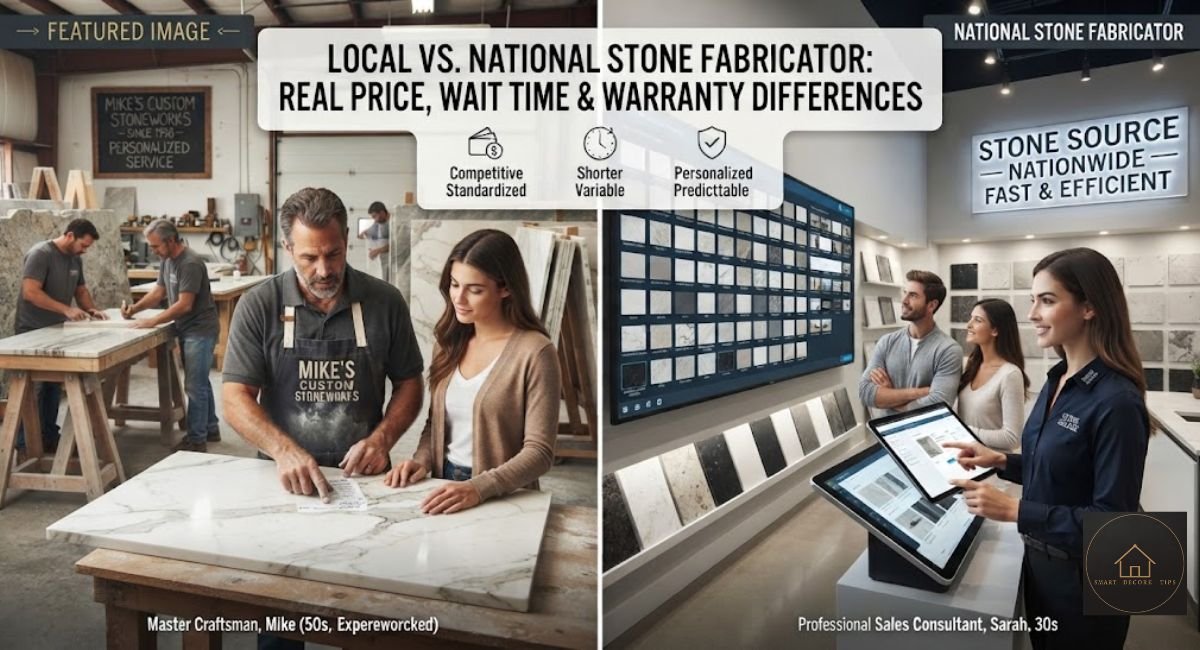
Local vs. National Stone Fabricator: Real Price, Wait Time & Warranty Differences
Quick Takeaways
- National and centralized fabricators usually price stone 15–30% lower on common materials, thanks to bulk slab buying.
- Local shops usually turn a job faster and put one accountable person on your warranty call, not a rotating call center.
- For a single kitchen, local usually wins on total experience. For a 20-plus unit renovation, national almost always wins on math.
- Neither one is automatically the safer pick — vet the specific shop, not the category.
A local vs national stone fabricator decision sounds simple until you’re the one holding two quotes that are $600 apart for what’s supposed to be the same slab. One salesperson tells you national chains cut corners. The other tells you local shops mark up because they can. Both are half right, and neither tells you the part that actually changes your outcome.
Local vs. National Stone Fabricator: What’s the Real Difference?
A local fabricator is usually a small, often family-run shop where the same crew measures, cuts, and installs your countertop from start to finish. A national or centralized fabricator runs large-volume production, often through automated CNC lines, and may hand your job off between different subcontractors at each step.
That single fact, one team versus several handoffs, explains most of what people complain about, and most of what people love, on either side of this decision.
For this guide, “better” is judged on four things: price per square foot installed, business days from signed contract to install, who actually answers when something goes wrong, and whether you get to see your real slab before it’s cut. Everything below ties back to those four.
Local vs. National Stone Fabricator Cost: What You’ll Actually Pay
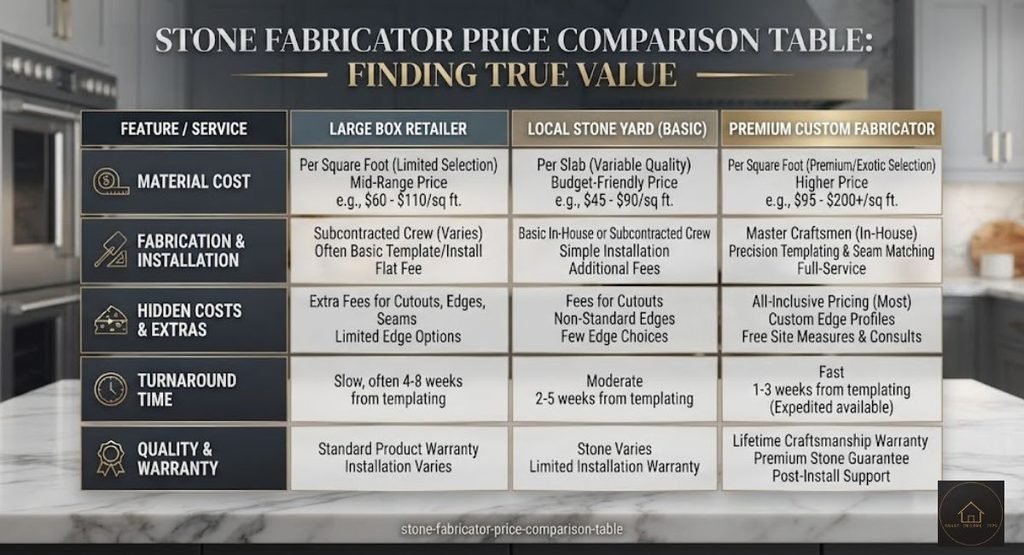
Price is where the two models split hardest, and it depends heavily on what you’re buying.
| Material | National / centralized (installed $/sq ft) | Local shop (installed $/sq ft) |
| Budget granite | $40–55 | $50–70 |
| Mid-grade quartz | $60–80 | $70–100 |
| Premium branded quartz (Cambria, Silestone) | $85–120 | $95–130 |
| Exotic quartzite or marble | $110–180 | $100–170 |
Ranges compiled from industry cost-guide data; confirm current local pricing before budgeting. Last verified September 2026.
Notice the flip at the bottom row. A shop that handles unusual stone every day doesn’t need to slow a production line for it, so local can actually beat national on the rare, book-matched slabs. I measured a friend’s L-shaped kitchen last spring, just under 30 square feet, and the local quote came in $380 lower than the big-box estimate for the exact same mid-grade quartz color. Turned out the national retailer’s quote bundled in a subcontracted install fee the local shop simply didn’t charge as a separate line item.
Here’s a trade-off worth sitting with: local isn’t automatically cheaper. A busy local shop in a hot housing market can quote higher than a national chain, especially if you don’t get multiple bids. Skip that step and you might end up paying boutique prices for a shop that’s only been open six months.
How long will you actually wait for each type?
National and centralized shops typically quote 2–5 weeks from signed contract to install, stretching to 6–8 weeks during peak remodeling season (spring through early fall). Local shops with lower job volume can sometimes template one week and install the next. A busy local shop in a hot market can be just as slow, though, so always ask for a specific day count instead of a general estimate.
When I called around for a bathroom vanity top last year, one local shop offered a Thursday template slot. The national chain’s scheduler couldn’t get a template appointment for seventeen days. If your contractor is holding a tight finish schedule, that gap can matter more than the per-square-foot price.
Who actually wins with a local fabricator?
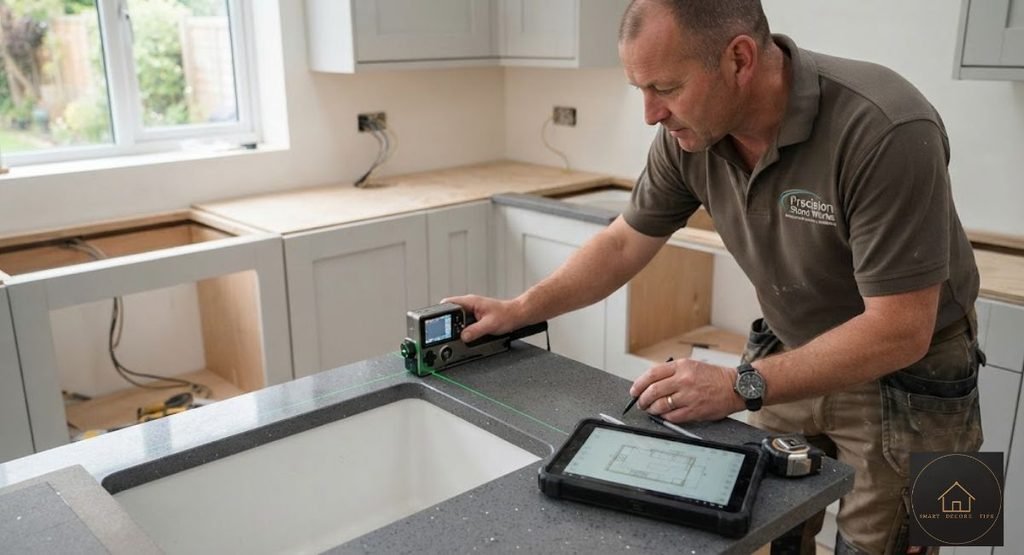
Local shines when the job is custom, the material is unusual, or you want one person accountable start to finish.
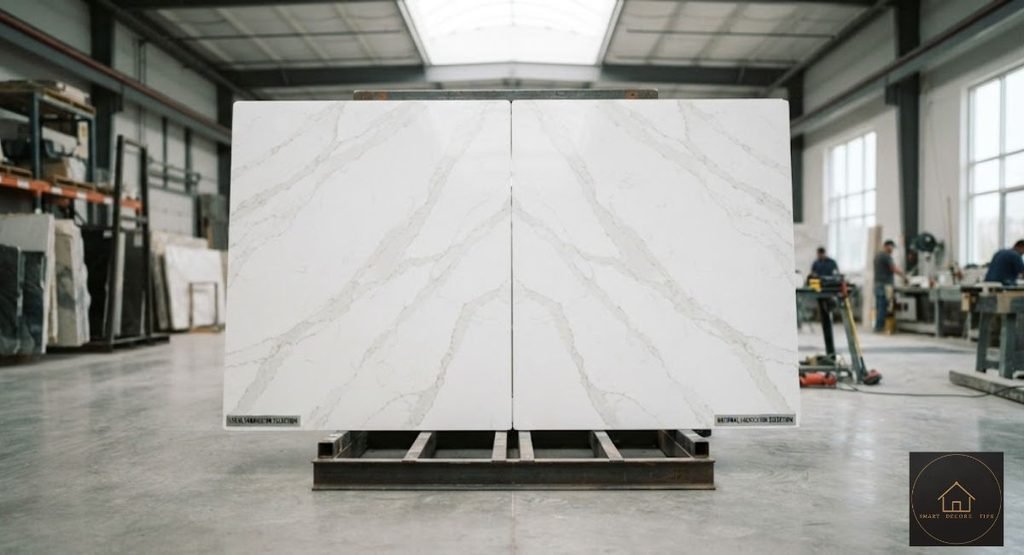
Standing in a slab yard comparing two pieces of the same “Calacatta” quartz, I noticed one slab had noticeably more grey veining than the sample chip in the showroom ever showed. That’s the whole case for local in one sentence: you get to see the actual stone. A curated showroom sample tells you almost nothing about how a full slab will look once it’s cut and seamed in your kitchen. Even a national brand like MSI, which stocks some of the deepest quartz and granite color ranges around, only helps you if the specific shop selling it lets you walk the yard and pick your own piece.
Local shops also tend to keep measuring, cutting, and installing under one roof. That closes the classic gap where the person who measured your kitchen isn’t the person who shows up to install it and has no idea what the templater actually saw.
Who actually wins with a national fabricator?
National wins decisively once you’re outside a single homeowner’s kitchen. Putting countertops in a 40-unit condo build or a hotel renovation is a volume game, and centralized shops are built for exactly that math.
A property manager I spoke with about a 12-unit renovation said the national fabricator’s per-unit price beat every local quote by enough to cover the extra two weeks of wait, several times over. For new construction, tract-home builds, or any project measured in dozens of countertops rather than one, that volume discount compounds fast, and a small local shop often doesn’t have the slab inventory to even bid competitively.
The trade-off cuts the other way, though. National chains often route warranty work through a customer service line and a subcontractor who may not be the crew that installed your countertop. If a seam opens up six months later, getting someone back to your house can take weeks of ticket-routing instead of a same-day phone call.
How do you vet either one before you sign anything?
Whichever side of the local vs national stone fabricator question you lean toward, the category matters less than the specific shop. Ask these before you sign anything:
- Is the same crew doing the measuring, the cutting, and the install?
- Can you physically see the slab going into your job, not just a sample chip?
- What’s the current lead time in business days, not “a few weeks”?
- What’s the written warranty, and who handles the repair call if something goes wrong?
- Is the shop accredited through a body like the Natural Stone Institute, which independently reviews fabrication and installation quality?
I once asked a countertop salesperson who specifically installs the stone, and they had to call someone else to find out. That hesitation told me more about the shop than the glossy brochure did. If a fabricator can’t answer who’s actually doing your job, that’s the answer.
Which one actually fits your project?
Here’s where the local vs national stone fabricator question really comes down to project size. For a single kitchen or bathroom remodel, local usually wins on the full experience: slab selection, one accountable crew, faster fixes if something’s off. For my own kitchen, a single 40-square-foot run of quartz, the volume discount never made up for losing the ability to hand-pick my slab; the savings barely covered gas money to a farther distributor.
Whole-house renovation with eight or more surfaces, either model can work. It really comes down to whether your local distributor can source enough matching material. For new construction, multi-unit buildings, or any project counted in dozens of countertops, national or centralized almost always wins on price and scheduling predictability, and that’s true even for shops with excellent local reputations; the math just isn’t built for that volume.
If you’re still deciding on the material itself before you get to the fabricator question, our quartz vs quartzite comparison walks through durability, price, and maintenance differences that will narrow your fabricator search. Some shops specialize by material, and knowing yours first saves a round of quotes. If you’re leaning toward natural stone specifically, our white marble kitchen guide covers real costs, staining, and etching you’ll want to ask any fabricator about directly.
Frequently asked questions
Not always.
Local shops can sometimes template and install within one to two weeks; national fabricators commonly run 2–5 weeks, extending to 6–8 weeks during peak remodeling season.
Ask whether the same crew measures, cuts, and installs your job, whether you can see the actual slab, the exact lead time in business days, and who handles warranty repairs.
Yes, in structure. Home Depot’s program runs through regional subcontracted fabricators coordinated centrally, similar to other national or centralized models.
Often, yes, for renovations up to roughly ten surfaces, as long as the local distributor can supply enough matching material; larger multi-unit projects usually favor centralized fabricators.
Check the Natural Stone Institute’s accredited-company directory, ask a local kitchen designer or contractor for referrals, and get three to five quotes to understand real local pricing.
Not necessarily better, just different. National retailers may offer consumer financing and standardized warranty terms, but repair calls often route through a call center; local shops typically handle warranty work directly.

Hi, I’m Shahzad Ahmad welcome to Smart Decore Tips!
I write and research every guide on this site myself, focused on real, practical home decor advice for renters, first-time homeowners, and small-space living. Before publishing anything, I check actual product listings, current prices, and real customer reviews not just what other sites already say.
My goal is simple: help you make smarter, more affordable decor decisions without the guesswork or sales pitch.





One Comment