
White Marble Kitchen: Real Costs, Stains & Etching (2026)
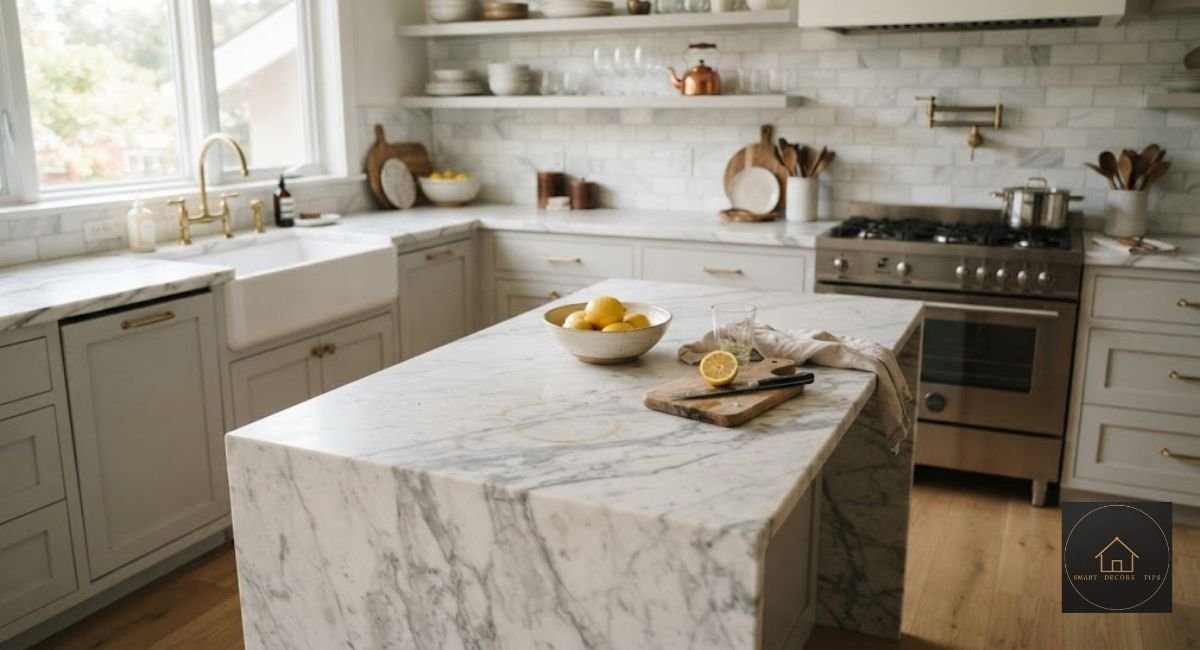
You’ve probably already fallen for the look. A white marble kitchen has a way of doing that. The veining catches the light differently every time you walk past it, and no two slabs ever look quite the same. That’s the easy part. The harder part is figuring out what it actually costs, how it holds up once real cooking happens on it, and whether you’ll regret it by year two.
I’ve spent years writing about kitchen materials, and marble is the one people ask me about the most right after they’ve already fallen in love with a photo online. So let’s skip the sales pitch and get into what a white marble kitchen really involves.
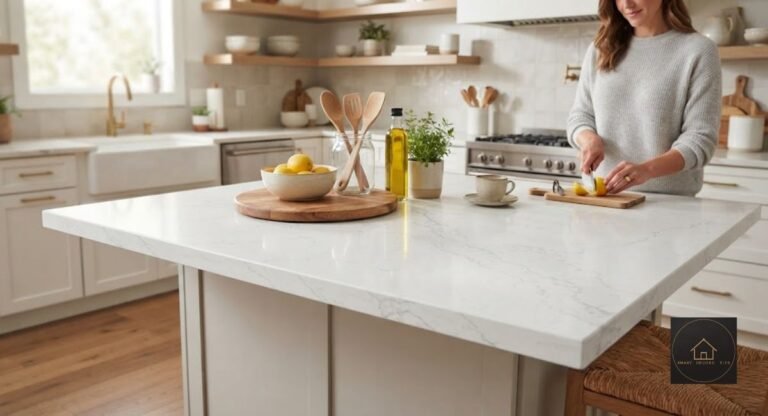
A white marble kitchen is a kitchen where the countertops, and sometimes the backsplash or island, use natural white marble, usually Carrara, Calacatta, or Statuario, instead of quartz, granite, or laminate. It costs more upfront, needs regular sealing, and shows wear differently than engineered materials do.
Quick Takeaways
- A white marble kitchen countertop runs $40 to $200 a square foot for material alone, before installation.
- Carrara has softer, subtler veining and costs less; Calacatta and Statuario cost more for bolder veining.
- Marble sits at 3 to 5 on the Mohs hardness scale versus quartz’s 7, so it scratches and etches more easily.
- Resealing every 6 to 12 months isn’t optional if you want to avoid staining.
- It’s a strong pick for looks and resale value, a weaker one for a busy kitchen full of acidic spills.
White Marble Kitchen Countertop Types: Carrara vs. Calacatta vs. Statuario
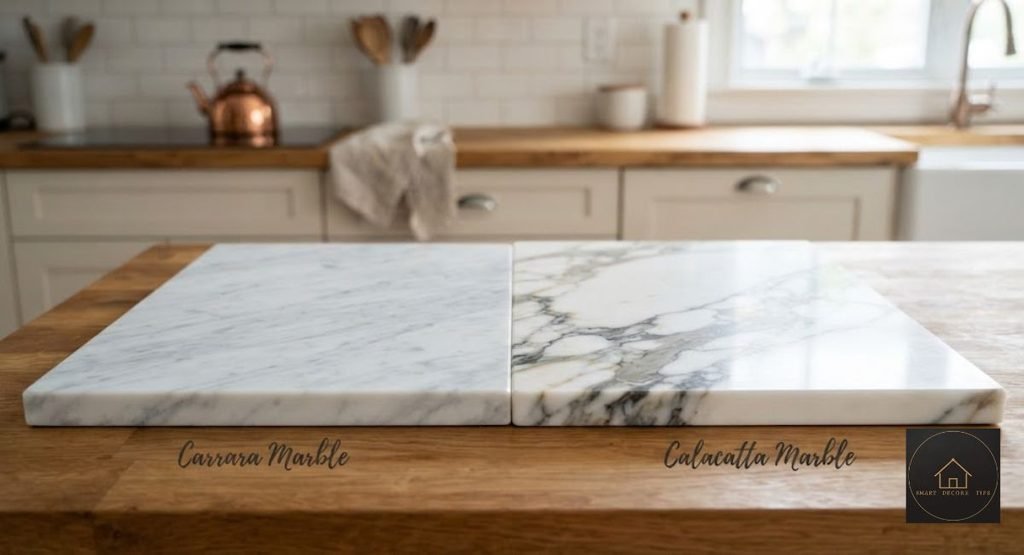
I once held a Carrara sample and a Calacatta sample under the same kitchen light, and the difference showed up within seconds. Carrara’s veining is thin, gray, and almost feathery — it reads calm from across the room. Calacatta is a different animal entirely: thicker veins, often gold or deep gray, spread across a whiter background. It photographs beautifully, but it also costs more, sometimes close to double, because the slabs with the boldest veining are rarer.
There’s also Thassos, a very white, almost vein-free Greek marble that a lot of people mistake for something engineered because it’s so uniform. And Danby, quarried in Vermont, which leans toward subtle veining and slightly better wear resistance than the Italian varieties, which is worth knowing if “domestic” matters to you for sourcing reasons.
A quick note on finish, since it changes how each type behaves day to day. Polished marble is glossy and shows veining at its brightest, but it also shows etch marks more obviously against the shine. Honed marble has a soft matte look instead, and it hides the early stages of etching far better, which is part of why so many working kitchens go honed even when the showroom sample was polished.
None of these are better in some absolute sense. Carrara suits a kitchen that wants calm and understated. Calacatta and Statuario suit one built around a single showpiece surface. Suppliers like Marble.com, Arizona Tile, and Walker Zanger carry all four regularly, so seeing slabs in person before deciding is realistic almost anywhere in the US.
How Much Does a White Marble Kitchen Cost in 2026?
Expect $40 to $200 per square foot for material alone. That’s a wide range, and it’s wide for a reason: Carrara sits near the bottom, Calacatta and Statuario near the top, and thickness, finish, and how much veining match-up the fabricator has to do all shift the number.
When I measured a standard 10-foot counter run for a friend’s kitchen last year, the marble slab alone landed close to the middle of that range, well before a single cut, edge profile, or sink cutout was added. Installation typically adds another chunk on top. Professional installation isn’t optional with marble the way it sometimes is with laminate, since the slabs are heavy and unforgiving of mistakes.
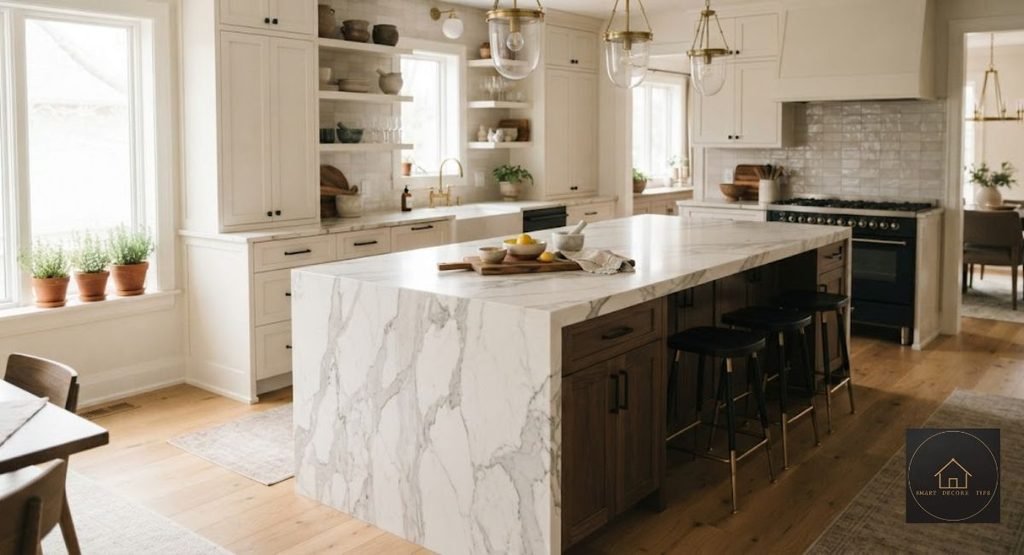
A few things push the price up fast. Waterfall edges, where the marble wraps down the sides of an island, use more slab and more labor. A full backsplash in matching marble adds cost too, even though it makes the room feel more finished. Custom shapes and tight seam-matching on large islands cost more than a straight run against a wall.
Prices and availability above were last verified in September 2026, and they shift with import costs and quarry supply, so treat this as a planning range rather than a quote.
Don’t forget the line items that catch people off guard: template and measuring fees, edge-profile upgrades beyond a standard eased edge, and removal of an old countertop if you’re replacing rather than starting fresh. None of these are huge on their own, but stacked together they can add 10 to 20 percent to a quote that only looked at the per-square-foot slab price.
Marble vs. Quartz vs. Quartzite: How White Marble Kitchen Counters Compare
If you’re weighing marble against the other two stones people usually cross-shop, here’s how they stack up. For a full breakdown of how quartz and quartzite differ from each other, Quartz vs Quartzite: The $1,200 Kitchen Question covers that comparison in more depth than fits here.
| White Marble | Quartz | Quartzite | |
| Mohs hardness | 3–5 | 7 | 7+ |
| Avg. cost per sq ft | $40–$200 | $50–$100 | $60–$120 |
| Sealing required | Yes, every 6–12 months | No | Yes, every 1–2 years |
| Stain/etch resistance | Low | High | Moderate–high |
| Best for | Statement looks, low-acid kitchens | Busy families, low maintenance | Marble look with more durability |
Marble wins on pure aesthetic authenticity, since no engineered material fully replicates the way real veining catches light. Quartz wins on durability and peace of mind. Quartzite splits the difference: it looks closer to marble than quartz does, and it’s genuinely harder, but people often confuse it with marble at the slab yard, so double-check what you’re actually buying.
Figures in the table above were last verified in September 2026 and can shift with regional supply, so use them for planning rather than as a fixed quote.
Does White Marble Stain or Scratch Easily?
Yes. White marble is soft and porous compared to quartz or granite, which means it scratches, chips, and etches more easily, and it shows those marks more visibly because of its light color.
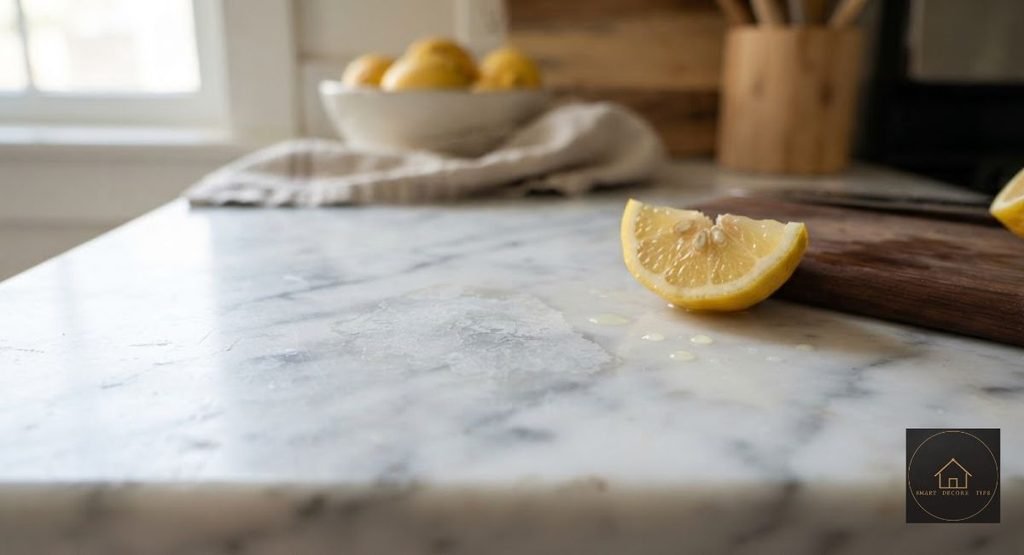
I judge how “high-maintenance” a countertop really is by one simple test: how many things you have to remember to do in a normal week, not just what the brochure says. Marble fails that test a little. Staining happens when liquid soaks into the porous surface. Etching is different — it’s not a stain at all, it’s a dulling reaction where acid eats into the calcium carbonate in the stone, leaving a matte spot that won’t wipe off.
I left a wedge of lemon on a marble sample overnight once, mostly by accident, just to see what would happen. The dull ring it left was still visible a week later, even after buffing with a marble-safe polish. Wine, tomato sauce, vinegar, and citrus are the usual culprits in a real kitchen, and turmeric is a sneaky one that a lot of people don’t expect.
Two honest trade-offs worth sitting with. If your household cooks with a lot of tomatoes, citrus, or wine and you’re not going to wipe spills immediately, you’ll see etching within months, not years. And if you want a countertop that looks identical on day 1,000 as it did on day one, marble will disappoint you — it develops a patina, and whether that reads as “character” or “damage” depends entirely on your taste.
Is White Marble Worth It?
For most homeowners who value the look and are willing to do basic upkeep, yes. A high-traffic family kitchen with little tolerance for visible wear is the one exception.
Marble tends to hold or slightly increase resale value compared to laminate or basic tile, since buyers still associate it with a premium kitchen. It’s also genuinely cool to the touch, which is why pastry cooks have used it for rolling dough for generations. That’s not a marketing claim, it’s just physics: stone conducts heat away from dough faster than most countertop materials.
Where it struggles is daily-use durability. If white marble kitchen ownership sounds appealing but the maintenance list gives you pause, it’s worth reading Marble Alternatives That Hold Up in Real Kitchens (2026) before you commit, since several of those options get within 90% of the look for a fraction of the fuss.
A friend of mine went with honed Carrara on her island and regrets it a little every time tomato sauce splatters across it. She’ll also tell you, without hesitation, that it’s the first thing every guest comments on when they walk into her kitchen. Both things are true at once, and that tension is really the whole decision.
How to Care for a White Marble Kitchen Countertop
Sealing is the single biggest factor in how well marble holds up. Reseal every 6 to 12 months, or sooner in a heavily used kitchen. I run a simple water-drop test on any marble surface before recommending it: a few drops on the counter, and if they’re still sitting on top after 10 minutes instead of soaking in, the seal is doing its job.
Beyond sealing, the daily habits matter more than any product you buy. Wipe up wine, citrus, and tomato-based spills right away rather than letting them sit. Use a cutting board for everything; marble is soft enough that a knife slip can leave a mark. Coasters under glasses prevent the faint rings that show up over time from condensation.
Cleaning itself is simple: mild soap, warm water, a soft cloth. Skip anything acidic or abrasive, including a lot of “all-purpose” sprays that aren’t actually stone-safe. The Natural Stone Institute publishes care guidance that’s worth a quick read if you want the fuller version of what’s summarized here.
If an etch mark does show up despite your best habits, it’s usually not permanent damage the way a crack is. A marble-specific polishing powder, worked gently into the dull spot with a damp cloth, can buff out light etching. Deeper marks, or anything that’s actually stained rather than just dulled, are worth calling in a stone pro for rather than experimenting on your own countertop.
Marble Alternatives That Hold Up in Real Kitchens
If everything above sounds like more commitment than you want, you’re not alone, and you’re not stuck choosing between “real marble” and “nothing that looks like marble.” Marble-look quartz from brands like Caesarstone reproduces the veining convincingly enough that most guests won’t clock the difference, and it skips the sealing schedule entirely. Porcelain slabs do something similar at a different price point, with even better heat and scratch resistance.
Quartzite, mentioned above, is the closest natural-stone alternative: real veining, real stone character, meaningfully better durability. The tradeoff is availability; not every slab yard stocks it in the same volume as marble or quartz, so expect to shop around a bit more.
Is a White Marble Kitchen Right for You?
If you cook often, cook with a lot of acid, or have a household that isn’t going to wipe up spills the moment they happen, I’d steer you toward quartz or quartzite instead, even though I understand the pull of the real thing. A kitchen that sees lighter daily use, or a homeowner who genuinely doesn’t mind a countertop that ages and changes character, is a different story. White marble delivers a look nothing else fully matches.
There’s no wrong answer here, just an honest one, based on how your kitchen actually gets used and not how it looks in the listing photos.
FAQs
It’s a good choice if you value the look and are willing to reseal it regularly and wipe up spills quickly; it’s a poor choice for a busy kitchen that sees constant acidic spills.
Material alone runs $40 to $200 per square foot, with Carrara at the lower end and Calacatta or Statuario near the top, before installation.
Yes, because it’s porous; liquids can soak into unsealed marble and leave dark stains, which is why regular sealing matters.
Most homes need resealing every 6 to 12 months, and sooner in a kitchen that gets heavy daily use.
Carrara has subtle, thin gray veining and costs less; Calacatta has bolder, thicker veining on a whiter background and costs more.
The upfront cost can be similar, but marble usually costs more over time because of sealing, repairs, and etch damage that quartz doesn’t experience.
Marble resists heat better than many materials, but using a trivet is still the safer habit since repeated direct heat can dull the finish over time.
Danby marble tends to hold up slightly better than the Italian varieties, though quartzite is the more durable choice if durability is the top priority.

Hi, I’m Shahzad Ahmad welcome to Smart Decore Tips!
I write and research every guide on this site myself, focused on real, practical home decor advice for renters, first-time homeowners, and small-space living. Before publishing anything, I check actual product listings, current prices, and real customer reviews not just what other sites already say.
My goal is simple: help you make smarter, more affordable decor decisions without the guesswork or sales pitch.




One Comment