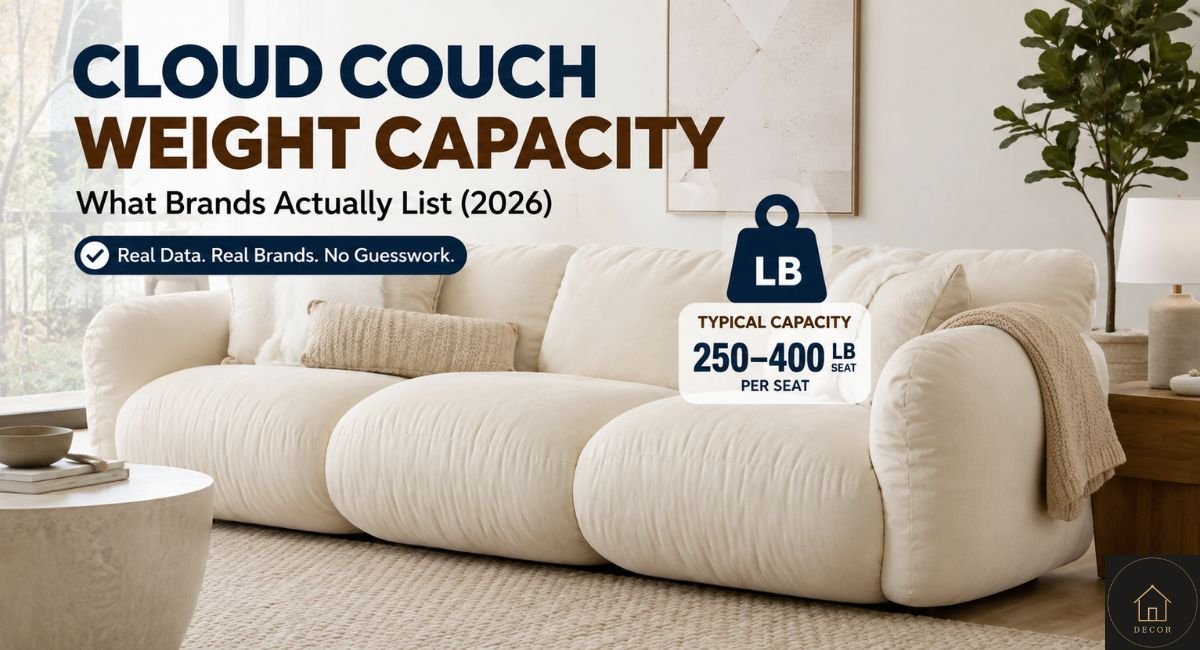
Cloud Couch Weight Capacity: Per Seat or Total?
You are looking at a soft, oversized sectional and the product page says it supports 1,200 pounds. That sounds reassuring until you ask the obvious question: is that for one seat, one module, or the whole sofa?
Cloud couch weight capacity is one of the easiest furniture specs to misread. Current product pages use per-seat, per-module, and total ratings, sometimes without making the unit obvious. The safest approach is to use the exact rating published for the exact configuration you plan to buy, not a number calculated from another model.
Quick answer: Cloud couch weight capacity may be listed per seat, per module, or for the whole sectional. Do not divide or multiply a published number unless the manufacturer explains how the rating is defined. Check the exact SKU, module type, ottoman rating, frame and suspension, then ask the brand for clarification if the listing is vague.
How Is Cloud Couch Weight Capacity Usually Listed?
There are three common formats: per seat, per module, and total capacity. They are not interchangeable.
A per-seat rating tells you the maximum load assigned to one seating position.
A per-module rating is more precise on modular furniture because a corner, armless chair, standard chair, and ottoman can have different structures.
A total rating applies to the complete configuration named on the product page. It does not automatically mean every seat has an equal share of that number.
This is where the old “just divide the total by the seat count” shortcut fails.
A modular sectional can use different components. One manufacturer may rate each part separately, while another publishes only one total figure.
If a listing says “1,200 lb weight capacity” but never says whether that is per seat or total, do not guess.
Ask customer support to confirm the unit in writing.
Real 2026 Weight Ratings From Current Cloud-Style Sofas
Current listings show why there is no single “average” limit you should trust across the whole category.
| Brand / product | How rating is published | Current listed rating |
| WJS Home Deluxe Cloud 3-Seater | Per seat | 400 lb |
| Albany Park Kova | Per module | 350 lb |
| Acanva Vensa Chair | Per module | 440.9 lb |
| Acanva Vensa Corner / Armless / Ottoman | Per module | 330.7 lb |
| Latitude Run 95.4″ Cloud Sofa | Per seat in product copy | 440 lb |
| XIZZI 107.9″ Modular Cloud Couch | Per seat | 285 lb |
The same cloud-style label covers very different designs and rating methods. (WJS Home)
WJS lists several Deluxe Cloud configurations at 400 pounds per seat. Its product pages also identify the configuration and frame material. (WJS Home)
Albany Park takes a module-level approach. Its current Kova Q&A says each Kova piece has a 350-pound capacity. (Albany Park)
Acanva is even more granular.
Its Vensa standard chair is listed at 440.9 pounds, while the corner chair, armless chair, and ottoman are each 330.7 pounds. (Acanva Home)
Here’s what I noticed comparing those live specifications: visually similar modules can carry different published limits.
One headline number is not enough for a modular sofa.

Per-Seat vs. Total Capacity: Which Number Should You Use?
Use the number that matches the exact seating position or configuration you plan to use. If the manufacturer gives a per-seat or per-module figure, that is more useful than trying to reverse-engineer a total.
Do not multiply a per-seat figure and assume the result becomes an official total rating.
Do not divide a total rating and assume every seat gets an equal share.
Current retailer listings use both per-seat and total-style fields on cloud sofas. Even when the math looks neat, the labeling is not always equivalent. (Wayfair)
Read the wording, not just the number.
What Actually Determines a Sofa’s Weight Limit?
The published rating belongs to the whole seating system, not just the cushion.
Several parts work together.
Frame or Structural Body
Traditional sofas may use wood, metal, engineered components, or combinations of them.
Frameless “boneless” couches rely more heavily on large foam structures.
A material name alone does not tell you the final capacity. Design, reinforcement, joints, and testing matter too.
Suspension and Seat Base
Sinuous springs, webbing, pocket springs, slats, platforms, or dense foam can carry and distribute load differently.
The support system sits below the soft surface you actually feel.
Legs and Base
Leg spacing, attachment points, base width, and floor contact affect how force reaches the floor.
A flush-to-floor design is not automatically stronger than a sofa with legs.
Use the published rating instead of guessing from its shape.
Module Connectors
Connectors keep sectional pieces aligned.
They should not be treated as a way to “borrow” unused capacity from another module.
If the brand publishes module-level ratings, follow them.
Cushion Construction
Cushions affect comfort, pressure distribution, and long-term feel.
They do not by themselves define the structural weight rating.
For a deeper look at what’s inside these seats, see the Cloud Sofa Fill Types Guide.
Does Foam Density Tell You the Weight Capacity?
No. Foam density is a cushion specification. It does not establish the sofa’s structural load rating.
Acanva’s Vensa is a useful example.
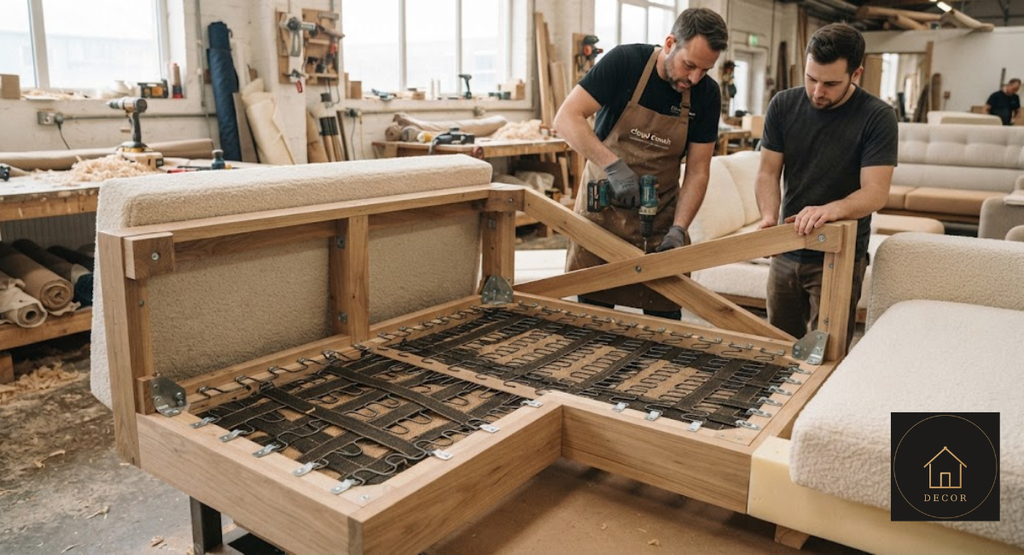
Its specifications include 2.0 PCF seat foam, an aluminum-alloy seat frame, wood armrest and back frames, webbing, sinuous springs, and different limits for different modules.
That is a complete seating system.
A foam-density number cannot replace the manufacturer’s stated limit.
Feather, down, and fiber wraps can also change softness and maintenance without defining structural capacity.
If you are comparing cushion feel too, see the Foam Filled Sofa Guide and Down Sofas Guide.
Do Modular Cloud Couch Sections Share Weight?
Do not assume they do. Use the rating for the specific module carrying the load.
Acanva’s Vensa shows why.
Its standard chair has a higher published limit than its corner, armless, and ottoman modules.
Albany Park takes a different approach and lists the same 350-pound capacity for each Kova piece.
Neither system supports a rule that unused capacity from one module can automatically transfer to another.
This matters when one person always uses the same corner seat or two people squeeze onto one module.
Use the specification for the actual section underneath them.
If the pieces keep shifting or separating, the Sectional Sofa Connectors Guide explains how common connector systems work.
What About the Ottoman Weight Limit?
Check it separately. An ottoman is not automatically rated the same as a sofa seat.
Some brands do give their ottomans substantial seating ratings.
Acanva lists the Vensa ottoman at 330.7 pounds, matching its corner and armless modules.
WJS also publishes a 400-pound capacity for the matching storage ottoman in one Deluxe Cloud family.
Other products may primarily treat an ottoman as a footrest or storage unit.
If you plan to sit on it regularly, find its own specification.
Is a Cloud Couch Suitable for Higher-Weight Users?
Yes, when the exact seat or module has a clearly stated rating above the intended load. A vague total-only figure is a poor choice when capacity is one of your main buying criteria.
Look for:
- a published per-seat or per-module limit
- the exact configuration or SKU
- clear frame and suspension information
- an ottoman rating if it will be used as seating
- warranty terms that fit your intended use
- written clarification if the listing is ambiguous
Do not treat “heavy duty” or “plus-size friendly” as a technical specification.
Avoid planning routine use at or above the published limit.
Choose the product with the clearest documentation, not the biggest unexplained number.
Can Two People Sit on One Wide Cushion?
Only use a shared seat when the combined load stays within the rating for that specific seat or module and the manufacturer treats that area as seating.
A wide cushion can look like two seats while resting over one structural module.
That is common on deep modular sofas.
The visual width of the cushion does not create additional rated capacity.
Follow both the manufacturer’s seating capacity and its per-module limit.
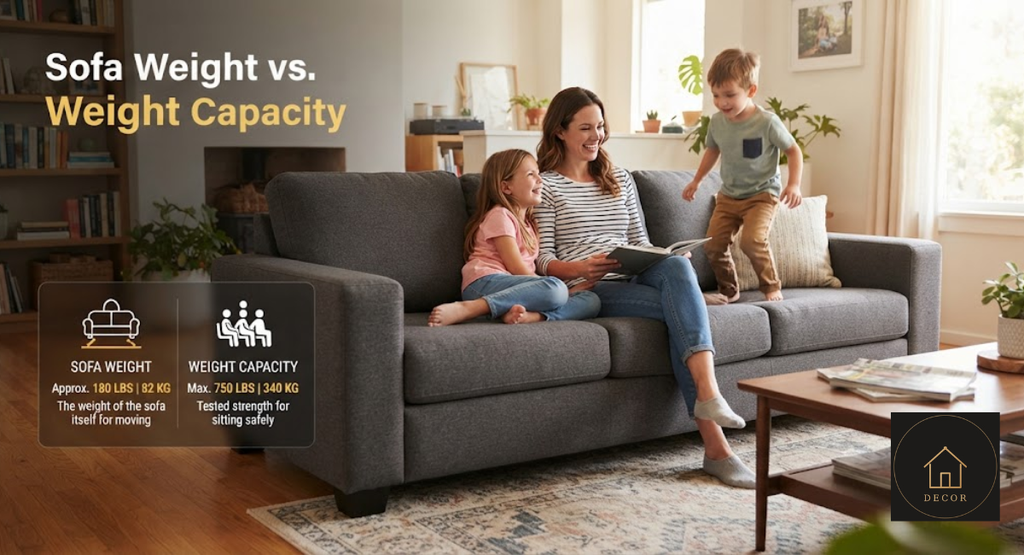
Product Weight vs. Weight Capacity: Don’t Confuse Them
These are completely different specifications.
Product weight tells you how much the sofa itself weighs.
That matters for delivery, stairs, elevators, moving, and handling.
Weight capacity tells you the maximum load the manufacturer publishes for using the furniture.
A 200-pound sectional does not automatically support only 200 pounds.
Likewise, a lightweight frameless sofa can have a much higher published load rating.
This distinction also matters for apartments.
A higher-capacity couch is not automatically heavier or harder to move.
If access is a concern, the Cloud Couch Dimensions Guide covers doorways, hallways, elevators, and room fit.
Does a Published Weight Rating Mean Independent Certification?
Not necessarily. A product page can publish a weight rating without identifying the test method behind it.
Furniture standards do exist for strength, safety, and durability.
For example, BS EN 12520:2024 specifies safety, strength, and durability requirements for domestic seating. Its scope says the requirements are based on adult use up to 110 kg.
That does not mean every cloud sofa sold in the U.S. has been tested to that standard.
Unless a brand identifies its test method, certification, or laboratory, treat the listed capacity as the manufacturer’s published product specification.
That is useful information, but it is different from an independent certification claim.
How to Check the Rating Before You Buy
Use this checklist instead of relying on the biggest number in the listing.
1. Match the Exact SKU
Different sizes in the same collection can have different modules, frames, or ratings.
2. Find the Unit
Look for:
- per seat
- per module
- per chair
- per ottoman
- total
If the unit is missing, ask.
3. Check Every Module You Will Sit On
Corner chairs, armless pieces, chaises, and ottomans can have different limits.
4. Read Frame and Suspension Details
These help you understand construction.
They do not replace the actual published rating.
5. Check the Ottoman Separately
Do this whenever it will be used as a seat.
6. Compare Brand and Retailer Information
If two pages disagree, check the manufacturer’s current specification.
If it is still unclear, ask the manufacturer directly.
7. Save the Answer
Take a screenshot or save the support response before ordering.
This gives you a record if the product page changes later.

What Happens If You Exceed the Listed Limit?
There is no responsible way to promise one failure pattern.
Excess load can stress the suspension, joints, frame, connectors, legs, or base.
Damage can develop gradually, or a component can fail more suddenly.
Treat the published rating as the maximum stated limit for intended use.
If the sofa is already creaking, leaning, separating, or showing a structural dip, do not rely only on the capacity number.
Inspect the furniture.
In my own eight months with a foam-filled model, the cushions softened slightly before I noticed any frame flex or creaking.
That experience reinforced one useful distinction: changes in cushion softness do not prove that the structural rating has changed.
What Buying Mistakes Cause the Most Confusion?
Common mistakes include:
- treating every 1,000-pound rating as equivalent
- dividing totals into homemade per-seat limits
- assuming expensive furniture must support more weight
- using cushion fill as a proxy for structural strength
- assuming the ottoman has the same limit as the seat
- ignoring module-specific ratings on modular sofas
The best cloud couch weight capacity information is simple:
exact model + exact module + exact unit + official published number.
Final Verdict: What Weight Capacity Should You Look For?
Do not shop for one universal number.
Shop for a rating clearly defined for the exact seat, module, or sectional you will use.
If the listing gives only a large total figure with no explanation, ask before buying.
If capacity is a priority, prefer brands that publish module-level or per-seat specifications, frame details, and separate ottoman information.
That is more useful than a bigger headline number with no unit attached.
Frequently Asked Questions
There is no reliable single average for the whole category.
Current products use different structures and rating methods, so compare exact per-seat, per-module, or total specifications instead.
It can be, but the number is incomplete without the unit.
A 1,000-pound total rating means something very different from 1,000 pounds per seat or module.
Current examples vary.
WJS publishes 400 pounds per seat on several Deluxe Cloud models. Albany Park lists 350 pounds per Kova module, while Acanva publishes different limits for different Vensa pieces.
No, not unless the manufacturer confirms that the total is intended to be distributed equally.
Modular pieces can have different structures and different ratings.
No.
Foam density describes the cushion material. Structural capacity depends on the complete product design and its published rating.
Sometimes, but not always.
Check the ottoman’s own specification instead of assuming it matches the sofa.
Only when their combined load fits the published rating for the module underneath and the manufacturer treats that area as seating.
Cushion width alone does not increase the limit.
Ask the manufacturer or retailer for the exact limit and whether it is per seat, per module, or total. If capacity matters to your purchase, get that answer in writing before ordering.

Hi, I’m Shahzad Ahmad welcome to Smart Decore Tips!
I write and research every guide on this site myself, focused on real, practical home decor advice for renters, first-time homeowners, and small-space living. Before publishing anything, I check actual product listings, current prices, and real customer reviews not just what other sites already say.
My goal is simple: help you make smarter, more affordable decor decisions without the guesswork or sales pitch.