
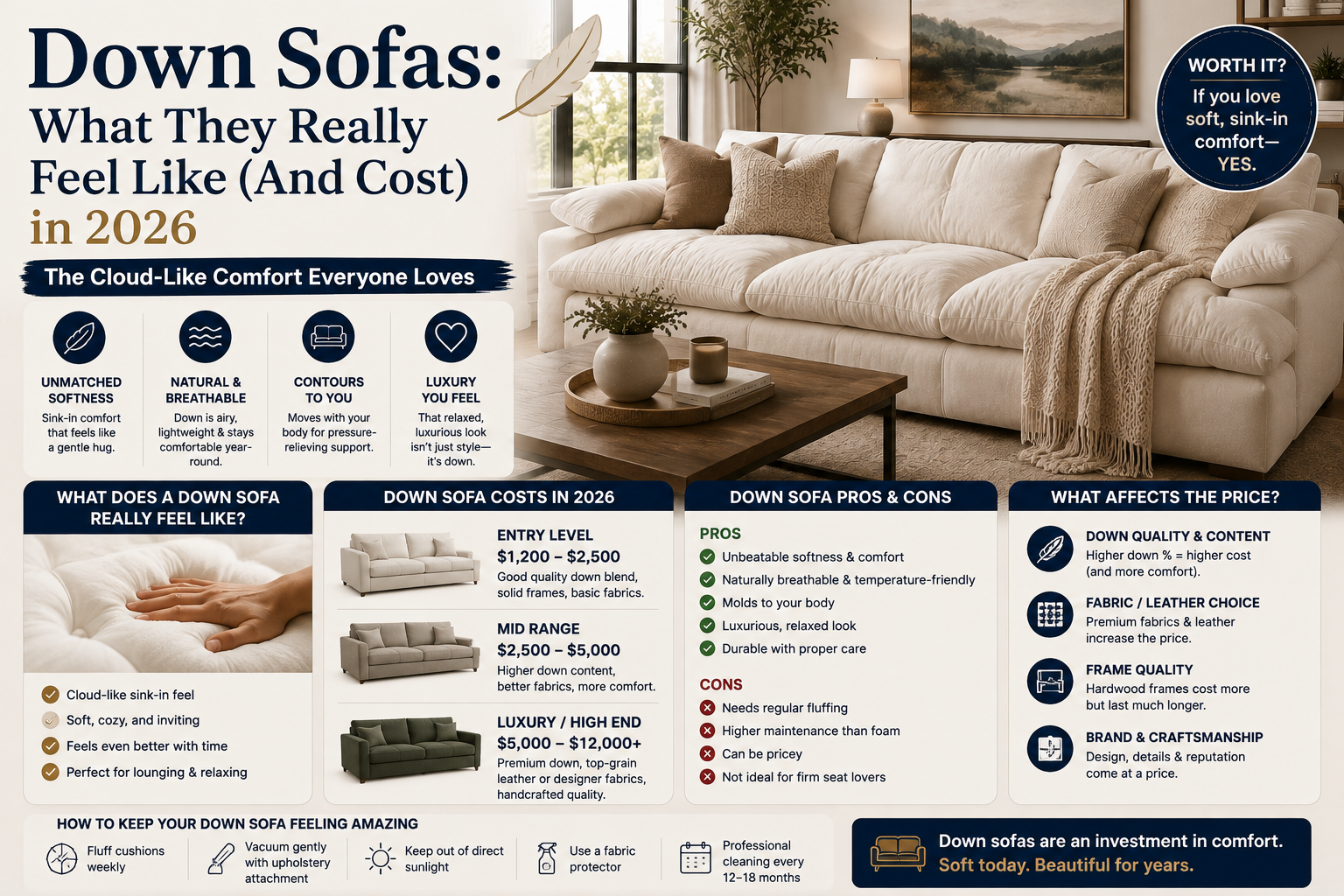
Down Sofas: Comfort, Cost & What to Know in 2026
A soft sofa can feel amazing in a showroom and become frustrating at home. Down sofas give you a deep, relaxed sit, but the exact cushion build matters more than the label.
Some use natural down and feathers. Others use a foam core with a thin down blend around it. Those designs can feel very different after months of daily use.
This guide explains how the common cushion types work, what current U.S. examples cost, how much upkeep to expect, and which product details are worth checking before you order.
Quick answer: Down sofas use natural down, feathers, or a down-feather blend in part of the cushion construction. Many current models combine that soft fill with a foam or fiber core for support. They feel plush and mold around your body, but they need more reshaping than firm foam cushions and usually cost more.
What Is a Down-Filled Sofa?
A down-filled sofa uses natural bird plumage in the seat, back, or cushion wrap.
Down and feathers are not the same material.
Down is the soft undercoating of ducks or geese. It consists of fluffy clusters without a hard central quill shaft. Feathers have a firmer quill and provide more structure.
FTC decisions have historically defined these materials separately, which is useful when reading furniture specifications. (Federal Trade Commission)
Modern sofa listings can still use “down” broadly.
A product may have:
- foam seat cushions
- feather-and-down back cushions
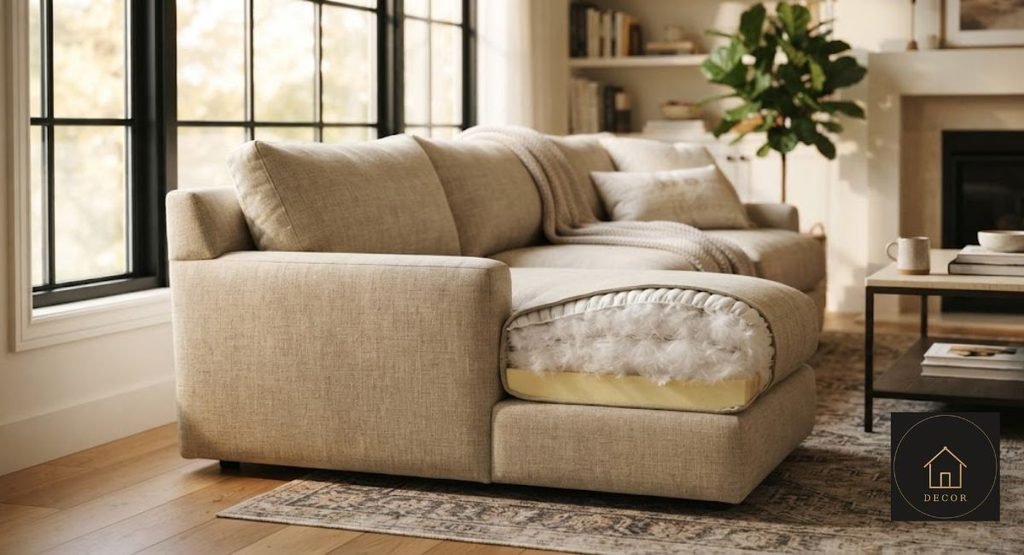
- foam cores wrapped in natural fill
- loose feather/down seat cushions
That is why the specification sheet tells you more than the marketing headline.
| Cushion construction | What is inside | Feel | Shape retention | Upkeep |
| Mostly natural loose fill | Down and/or feathers | Deepest sink | Lowest | High |
| Down-blend wrap | Foam core plus natural fill | Soft with support | Good | Medium |
| Foam seat + feather/down back | Foam seat, loose back fill | Supportive seat, relaxed back | Good | Low to medium |
| Foam or synthetic fiber | No natural down | Firmer and uniform | Usually best | Low |
For many households, down-wrapped foam is the easiest compromise.
Interior designers interviewed by House Beautiful also favored mixed construction because an inner core gives the cushion support while the natural fill keeps the surface soft.
Also read about: Couch Color & Material Guide
Are Down-Filled Sofas Really More Comfortable?
Yes, if you like a soft seat that lets you sink in. A firmer foam sofa keeps you more upright and pushes back against your body.
In our six-week use of a down-wrap sectional, the biggest difference was not softness alone. The cushion adjusted around the body instead of feeling like one solid block.
That felt excellent for lounging and movie nights. The downside appeared when getting back up from the low, soft seat.
Here’s what I noticed most: after a long movie night, the cushion looked visibly more lived-in.
A quick reshape improved it, but that relaxed appearance is part of the ownership experience.
If you want your sofa to look crisp every time somebody stands up, loose natural fill will probably frustrate you.
Down vs. Foam: Which Cushion Is Better?
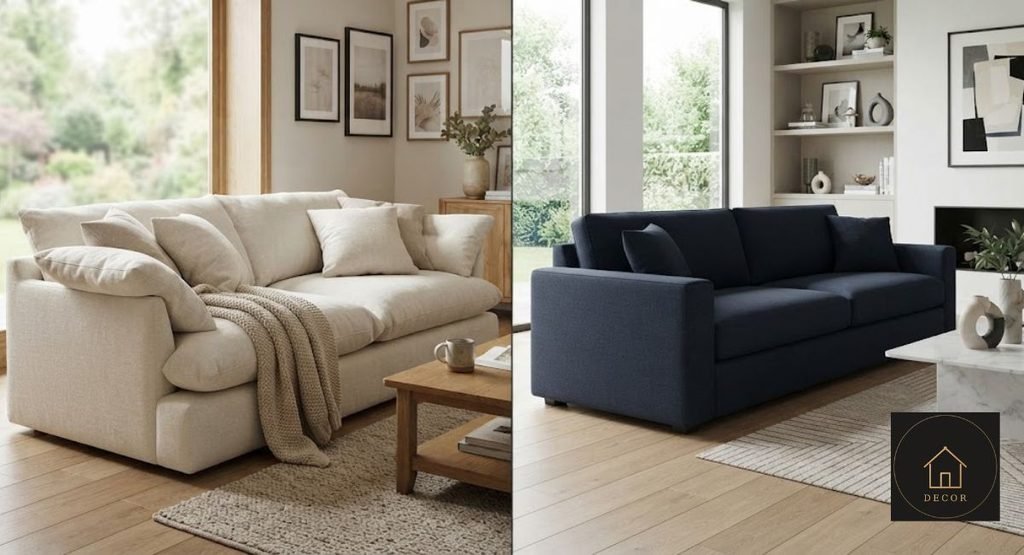
Neither is automatically better. Natural fill is better for deep lounging, while foam works better when shape retention and low maintenance matter more.
| Factor | Down / feather blend | Down-wrapped foam | Firm foam |
| Initial feel | Very soft | Soft with support | Medium to firm |
| Body sink | High | Medium | Low |
| Shape retention | Low | Medium to high | High |
| Reshaping | Frequent | Occasional | Minimal |
| Tailored appearance | Hardest to maintain | Easier | Easiest |
| Best for | Relaxed lounging | Everyday comfort | Busy households |
West Elm’s Harmony shows why the details matter.
Its official specifications list high-resiliency polyurethane foam seat cores. The back cushions contain 50% polyester fiber, 45% duck feather, and 5% duck down. (West Elm)
A shopper could see Harmony included in a “down sofa” roundup and assume the seat itself is filled with down.
It isn’t.
That does not make Harmony worse. In fact, the hybrid construction may be better for somebody who wants a supportive seat and softer back cushions.
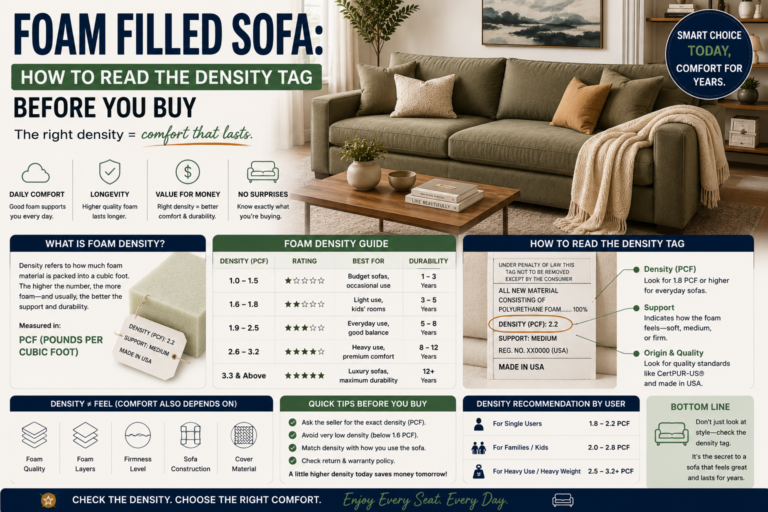
More about Foam: foam-filled sofa guide
How Much Does a Down-Filled Sofa Cost in 2026?
Current U.S. listings range from roughly four figures for mass-market modular sofas to several thousand dollars for premium furniture.
Fabric, width, cushion choice, configuration, and sales can all change the final price.
Prices checked August 27, 2026:
| Current example | Price seen | Why it matters |
| Magic Home 119-inch modular sofa at Home Depot | $1,156.56 | Budget comparison marketed as down-filled |
| Sofatica Cloud Couch 3-Seater | $1,499 | Goose-down layer + polyfiber + support foam |
| Pottery Barn Carlisle | Starts around $1,499 | Down-blend-wrapped cushion option |
| West Elm Harmony | About $1,599.20–$2,799 during current sale | Foam seats; feather/down back blend |
| Crate & Barrel Axis | About $1,799–$2,449 | Listed in current feather-down collection |
These prices can change, so verify the selected fabric and configuration before making a purchase.
At the vintage and collectible end, the market becomes much wider.
1stDibs currently reports an average selling price around $3,800 for down-filled sofa listings, with examples ranging from about $895 to $11,500.
That is not a normal new-sofa benchmark. Age, maker, upholstery, and provenance can outweigh the value of the cushion fill.
That is why two down sofas at the same price can feel completely different.
Price alone does not tell you the down percentage, foam quality, suspension, frame construction, or maintenance burden.
Real Products Worth Comparing Before You Buy
Pottery Barn Carlisle
The Carlisle is useful because Pottery Barn lets buyers select a down-blend-wrapped core for a softer feel.
A polyester-wrapped option is also available for buyers who want a firmer sit. (Pottery Barn)
That choice makes the product a useful real-world example of how one sofa frame can offer different comfort levels based on cushion construction.
The slipcovered version also gives you easier access to the upholstery, although cleaning instructions vary by fabric.
Sofatica Cloud Couch
Sofatica provides more cushion detail than many listings.
The company describes three main layers:
- goose-down filling
- polyfiber comfort material
- high-resilience support foam
Its 3-seater modular version was priced at $1,499 during this research. (Sofatica)
That specification is much more useful than a vague description such as “cloud-soft cushions.”
You know what creates the softness and what provides the structure underneath.
West Elm Harmony
Harmony illustrates another type of hybrid.
The seat uses foam. The back cushions combine polyester fiber, duck feather, and duck down. (West Elm)
That setup suits buyers who want to sink into the back cushions without losing most of the seat’s underlying support.
Crate & Barrel Feather-Down Collection
Crate & Barrel currently groups models including Axis, Gather, Lounge, and Unwind within its feather-down sofa collection.
The retailer also specifically mentions downproof ticking.
That inner casing matters because it helps keep feathers inside rather than allowing quills to work through the cushion covering.
Check the exact chosen model because dimensions, upholstery, and cushion construction vary.
Magic Home at Home Depot
Home Depot currently lists a Magic Home 119-inch modular model marketed as down-filled for about $1,156.56.
It gives shoppers a useful lower-cost comparison against premium furniture brands.
For listings like this, I would confirm four details before ordering:
- exact seat fill
- whether cushions are reversible
- whether replacement inserts are available
- return terms for oversized furniture
The lower price is attractive only if the construction matches what you expect.
What Maintenance Do Down Cushions Actually Need?
The best-looking down sofas still need reshaping.
Natural loose fill compresses and shifts with use. It does not snap back as quickly as firm molded foam.
Use this routine:
- Fluff after heavy use. Push filling back toward compressed areas.
- Rotate reversible cushions. This spreads wear across more than one surface.
- Vacuum seams and crevices. Dirt and grit can wear the fabric.
- Read the care label. Do not assume the entire insert is machine washable.
- Blot spills quickly. Avoid saturating the interior cushion.
- Treat removable covers separately. A washable cover does not make the insert washable.
West Elm’s current Harmony care instructions recommend periodic fluffing and vacuuming. They also advise immediate blotting and professional cleaning when basic spot treatment does not remove a stain.
That is a much safer rule than assuming every feather or down cushion can go into a washing machine.

Do Down-Filled Cushions Sag?
They can look saggy, but visible flattening is not always structural sag.
Loose fill loses loft where you sit. Fluffing redistributes that material and restores some fullness.
True sofa sag is different.
The problem may come from:
- softened foam
- stretched suspension
- a damaged support system
- weakened frame components
A foam-core hybrid usually keeps a more consistent basic shape because the internal core remains in place.
If one cushion keeps collapsing faster than the others, check:
- Is it reversible?
- Has its foam core softened?
- Is loose fill migrating toward the edges?
- Does the seat below the cushion remain level?
- Can the manufacturer supply a replacement insert?
Do not keep adding loose fill if the actual problem sits beneath the cushion.
Who Should Not Buy a Down-Filled Sofa?
Skip one if you want a crisp, tailored sofa with almost no routine attention.
Firm foam will be easier to live with.
A very soft couch is also a poor match if you dislike low, deep seating. Seat height and depth matter just as much as fill.
Families with pets or children do not automatically need to avoid natural fill.
Instead, check:
- outer fabric durability
- removable covers
- cushion reversibility
- fill containment
- cleaning instructions
The bigger question is how much maintenance you’re willing to accept.
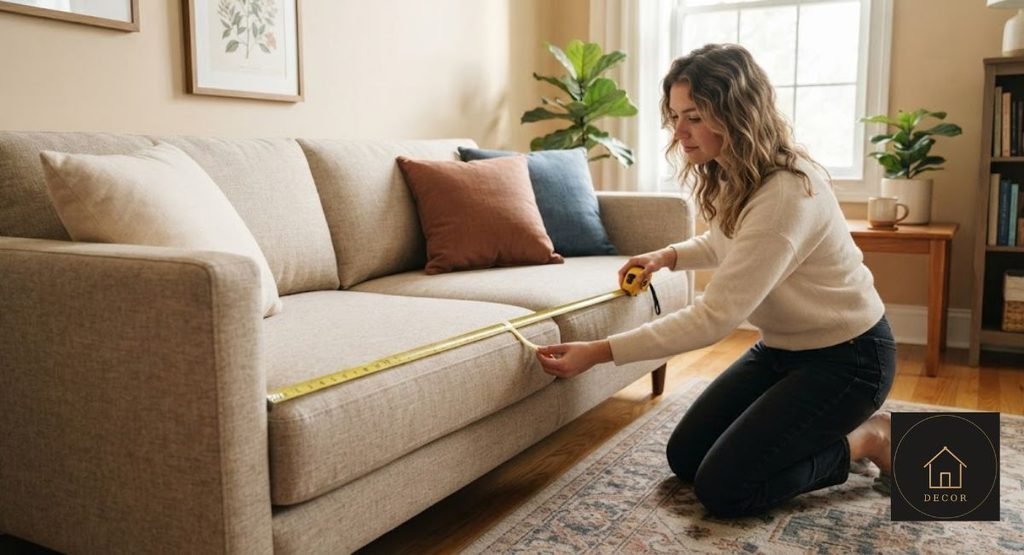
Apartment shoppers should focus more on physical dimensions than fill.
A compressed cushion does not make a 100-inch sofa physically smaller.
Measure:
- full sofa width
- overall depth
- doorway opening
- hallway turns
- staircase width
- elevator dimensions
Deep cloud-style models can take far more floor space than their photos suggest.
If you read about: cloud couch dimensions
How Do You Shop for a Down Sofa Without Getting Misled?
When comparing down sofas, start with the specification sheet, not the product title.
1. Read the seat and back fill separately
A sofa can have foam seats and feather/down back cushions.
That may be exactly what you want, but you should know before paying for it.
2. Ask what “down blend” actually contains
A blend can contain:
- down
- feathers
- polyester fiber
- combinations of those materials
A percentage is far more useful than the phrase “premium down blend.”
3. Look for a support core
A foam or fiber core helps a soft cushion maintain its basic seat height.
It also reduces the amount of reshaping needed after every use.
4. Check for downproof ticking
A tightly woven inner casing helps contain feathers.
Crate & Barrel specifically calls this feature out on its feather-down sofa page.
5. Check seat height and depth
Softness alone does not determine comfort.
A 17-inch-high deep seat will feel very different from a 20-inch-high standard-depth couch, even with similar cushions.
6. Confirm upholstery care
Check whether your exact fabric is:
- removable
- machine washable
- spot-clean only
- professional-clean only
Do not assume every fabric option within one collection has identical care rules.
7. Check the trial or return window
A plush sofa can feel good for two minutes and wrong after an hour.
A meaningful return period gives you protection when buying online.
8. Ask about replacement cushions
Replaceable inserts are a strong long-term feature.
You can refresh the sofa’s comfort layer without buying an entirely new frame.
Common Mistakes When Buying a Down-Filled Couch
The biggest mistake is assuming “down-filled” means the same construction at every retailer.
It does not.
Another mistake is judging comfort by softness alone.
These factors also matter:
- seat depth
- seat height
- back angle
- suspension
- foam quality
- upholstery tension
Do not pay extra for a vague natural-fill claim without seeing the specification.
A clearly described hybrid cushion can be a better purchase than a poorly documented “premium down” seat.
Also avoid shopping from photographs alone.
Relaxed creasing can look inviting online but messy in a room where you prefer straight, tailored cushions.
FAQs
Yes. They provide a softer, more moldable sit than firm foam because the loose natural fill compresses around your body.
A hybrid cushion gives you much of that softness while keeping more structure underneath.
Down is better for buyers who prioritize sink-in softness.
Foam is better for shape retention, firmer support, and lower maintenance. A down-wrapped foam core sits between those two extremes.
Loose fill naturally flattens where you sit, but that is not always true structural sag.
Fluffing can restore loft. If the seat remains uneven afterward, inspect the foam, suspension, and frame.
Down consists of soft clusters without a hard quill shaft.
Feathers contain a firmer central quill. Furniture cushions often combine the two because feathers add structure while down increases softness.
Fluff it whenever heavily used areas stay compressed after you stand up.
Busy family-room cushions may need reshaping several times each week, while lightly used seating may need much less attention.
Do not assume you can.
Follow the furniture maker’s care label. A removable or machine-washable upholstery cover does not mean the interior cushion insert should go into a washing machine.
It is worth paying more when soft, relaxed lounging is one of your main priorities.
If you want a sofa that stays crisp with little reshaping, spend your budget on better foam, upholstery, and frame construction instead.
Are Down-Filled Sofas Worth It?
Yes, when you value a soft, moldable sit and accept regular cushion care. For everyday use, a hybrid with an internal support core is the safer choice for most households.
If maximum softness matters most, choose more loose natural fill and expect more reshaping.
If you want softness without constant maintenance, look for a down- or feather-blend wrap over quality foam.
The best sofa is not the one containing the most down.
It is the one whose construction matches how you actually sit, clean, move, and use your living room.

Hi, I’m Shahzad Ahmad welcome to Smart Decore Tips!
I write and research every guide on this site myself, focused on real, practical home decor advice for renters, first-time homeowners, and small-space living. Before publishing anything, I check actual product listings, current prices, and real customer reviews not just what other sites already say.
My goal is simple: help you make smarter, more affordable decor decisions without the guesswork or sales pitch.




4 Comments