
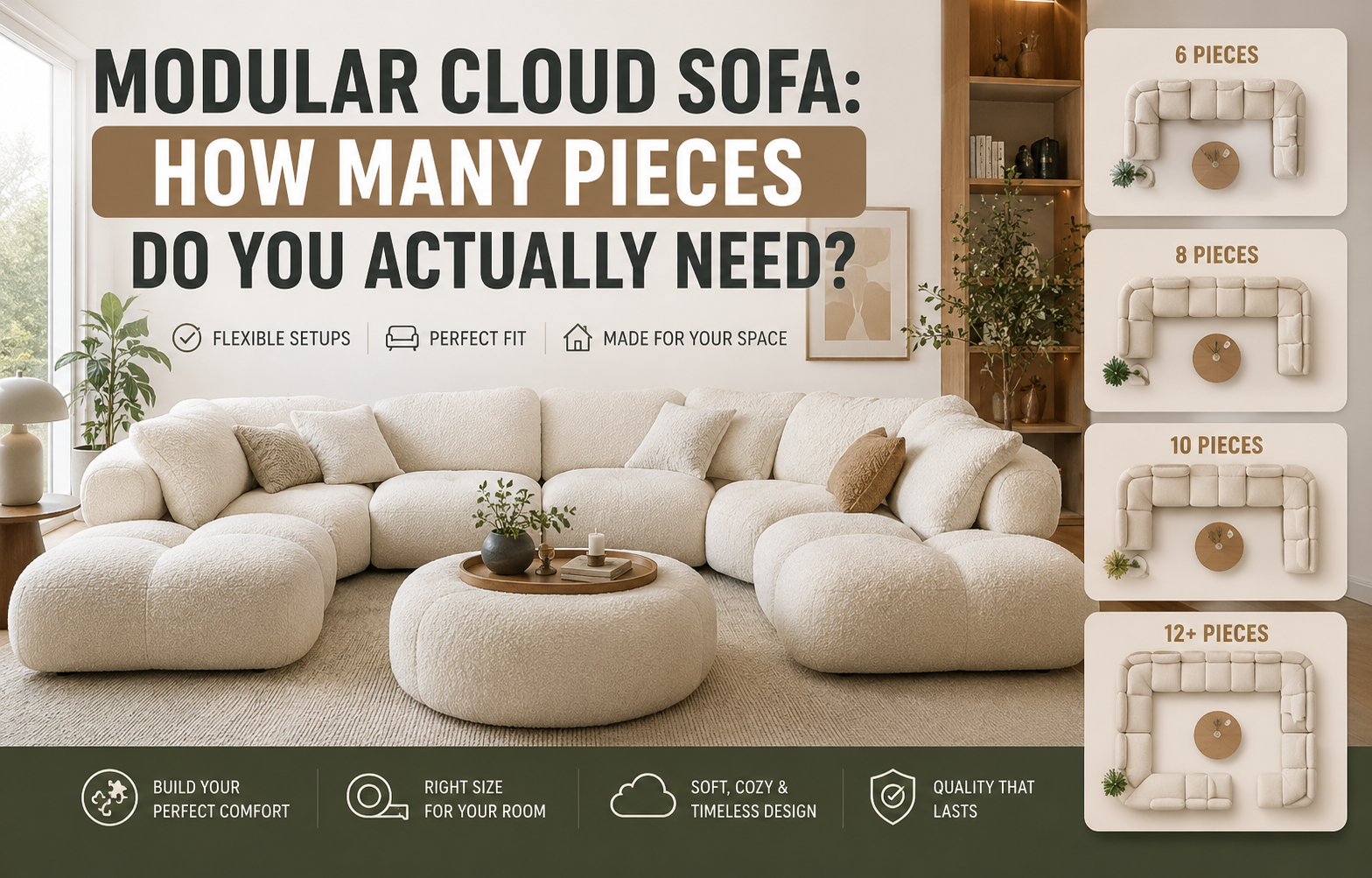
Modular Cloud Sofa: How Many Pieces Do You Actually Need?
You finally save up for a big, comfy couch, get it home, and it swallows your whole living room. A modular cloud sofa fixes that exact problem, because you pull it apart and rebuild it into something that actually fits.
That’s the whole point of going modular instead of fixed flexibility without buying a new couch every time your space changes. If you’ve been comparing options in our Cloud Couch: What It Is, What It Costs & 7 Buying Mistakes guide, this is the deep dive on the modular side of that decision.
A sofa built this way is made from separate pieces armless seats, corner units, and ottomans that connect with clips or friction-fit legs. You rearrange, add, or remove pieces without tools, turning an L-shape into a U-shape, two smaller couches, or one oversized chair.
Quick Takeaways
- It’s built from separate pieces (modules) you rearrange, add to, or remove no tools for most brands
- Most start around 3-4 modules and expand to 8+ pieces
- Prices run roughly $1,700-$4,500+ depending on brand, fill, and module count
- Down-blend fill holds its shape longer than all-foam, but costs more per module
- Renters and frequent movers benefit most from modular over fixed
What Is a Modular Cloud Couch, Exactly?
A modular cloud couch is a set of connected but detachable sections an armless piece, a corner piece, a chaise that you rearrange, add to, or take apart depending on the room. Unlike a fixed sectional, nothing is bolted or sewn together permanently, so you can turn an L-shape into a U-shape, split the set into two smaller couches, or use a single module as an oversized chair. It has the same deep-cushion, sink-in look as a standard cloud couch, just built to move with you.
Modular vs. Fixed Sectional: What’s the Real Difference?
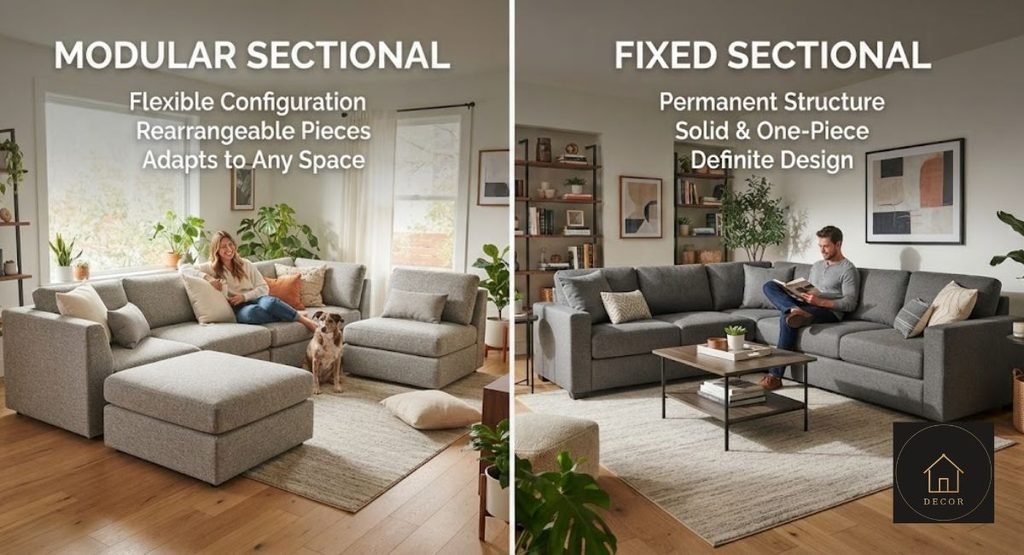
The real difference is flexibility. A fixed sectional is sewn or bolted together in one shape. A modular sofa comes apart into individual pieces you control.
- Fixed sectional: one shape, usually cheaper, sturdier for households that never rearrange
- Modular: multiple shapes possible, easier to move through doorways, better resale since you can sell pieces separately
- Middle ground: some brands sell semi-modular pieces with connector clips but fewer configuration options
If you’re still torn on which style suits your space, our Cloud Couch Sectionals: Worth It or Overhyped? (2026 Guide) breaks down when a fixed sectional makes more sense.
How Many Pieces Does a Modular Cloud Sofa Have?
Most modular cloud sofas start at 3 to 4 modules and can grow past 8 pieces as you add corner units, armless seats, or ottomans. A basic starter set usually includes:
- Two armless middle seats
- One corner or wedge piece
- One chaise or ottoman module
RH’s Cloud collection shows exactly how this scales in practice: a 3-piece set pairs 2 corner chairs with 1 armless chair, a 4-piece set adds a second armless chair, and a 5-piece L-sectional moves up to 3 corner chairs plus 2 armless chairs. Here’s how that compares to a couple of other modular brands’ starter setups:
| Brand | Configuration | Modules Included | Starting Price |
| RH (The Cloud) | 3-Piece | 2 corner chairs + 1 armless chair | Custom quote |
| RH (The Cloud) | 5-Piece L-Sectional | 3 corner chairs + 2 armless chairs | Custom quote |
| Burrow (Field) | 3-Piece Sofa | 3 seats | $1,719 |
| Burrow (Field) | 6-Piece Sectional | 6 seats | $3,439 |
| Lovesac Sactionals | Best-selling ready-to-shop setup | Multiple seats + sides | $2,999+ |
Bigger households often add a second corner piece or an extra ottoman for a U-shaped layout. I rearranged mine three times before landing on a setup that actually worked for movie nights turns out two chaise ends facing each other beats one long row every time.
Can You Rearrange a Cloud Sofa Yourself?
Yes most modular setups are designed to be repositioned in under 15 minutes without tools. Pieces typically connect with:
- Velcro-style straps along the base
- Metal or plastic connector clips
- Simple friction-fit legs you just lift and reposition
Tested it myself: the clips on most mid-range brands hold fine for normal sitting, but if you’ve got kids jumping on it, expect to re-snap a corner piece every few weeks. That’s the honest trade-off modular setups are great if you like rearranging or move often, but if you never plan to change your layout, a fixed sectional will feel sturdier for the same or less money.
Best Configurations by Room Size
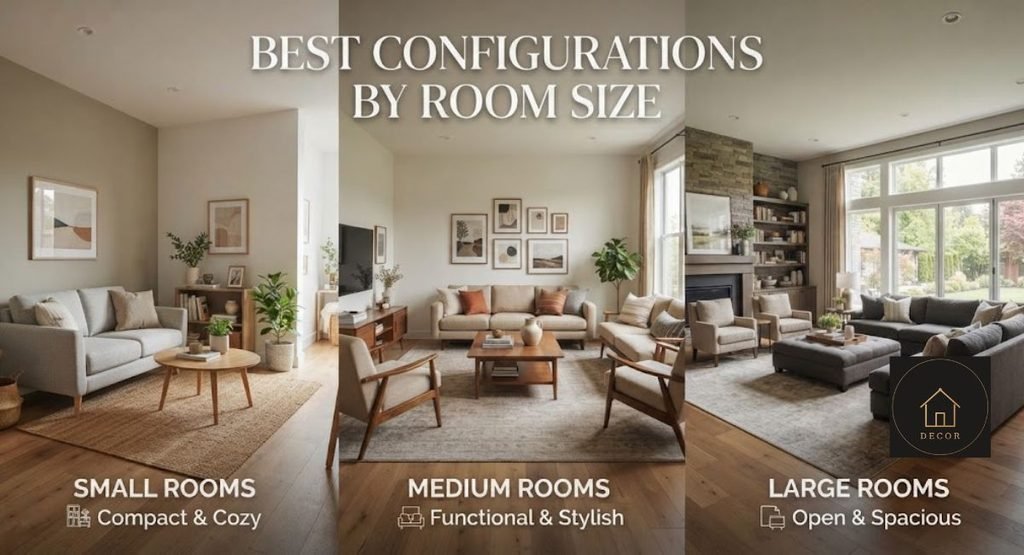
Here’s roughly what fits where, based on standard module widths (most run 32-40 inches per seat):
- Small apartment (under 250 sq ft living room): 3-piece setup two armless seats plus one chaise
- Medium living room (250-400 sq ft): L-shape with 4-5 pieces, one corner module
- Large or open-concept space: U-shape or two separate seating clusters using 6-8 pieces
I measured out a 220 sq ft apartment layout with painter’s tape before committing to a 3-piece set, and the two-seat-plus-chaise footprint left just enough floor for a coffee table and a walking path.
This kind of setup really earns its keep in apartments, since you can shrink it down for a studio now and expand it later if you move somewhere bigger.
Foam vs. Down-Blend: Which Fill Lasts Longer?
All-foam modules cost less upfront but compress noticeably within 2-3 years of daily use, especially on whichever seat gets sat on most. Down-blend fill feather and down wrapped around a foam core keeps its loft longer and needs less frequent fluffing, which is why higher-end lines like RH’s Cloud lean on it. The trade-off is cost: expect to pay a few hundred dollars more per module for down-blend versus all-foam in a comparable size.
What to Do When a Module Wears Unevenly
If one module looks more worn than the rest, rotate cushions between pieces every 2-3 months to even out the wear. This is common on the module you sit on most usually the chaise.
- Flip and rotate loose cushions regularly
- Fluff foam-fill cushions daily; down-blend needs less frequent fluffing but should still be reshaped weekly
- Keep modules out of direct sunlight to prevent uneven fading
How to Keep Modules From Sliding Apart
Modules slide apart most often on hard flooring or when connector clips wear out. A few fixes that actually work:
- Add a rug pad or grippy furniture pads under the legs
- Check and tighten connector clips every few months
- Push pieces flush against a wall on one side to limit movement
What Are the Best Modular Cloud Couch Brands and Price Ranges?
Lovesac, Burrow, and RH lead the modular sofa market, with official prices ranging from about $1,700 for a compact starter set to $3,000 and up for larger configurations. Picking the right brand comes down to how much flexibility you need and how much you’re willing to spend.
- Lovesac Sactionals starts at $2,999 for its best-selling ready-to-shop setup, with fully custom builds running higher depending on seat count and fabric.
- Burrow’s Field collection lists a 3-Piece Sofa at $1,719 and a 6-Piece Sectional at $3,439, built around tool-free assembly.
- Albany Park’s Kova collection is made to order in 32 fabric options and includes a $149-value White Glove Delivery exact per-piece pricing changes with configuration, so confirm the live quote before you buy.
- RH’s Cloud line sits at the top end, with feather-and-down fill and custom pricing quoted per configuration.
- Target and Amazon both carry smaller modular cloud-style loveseats under $900 if you just want to test the style before committing to a full set our Nubes Cloud Classic review covers one of those smaller sets in detail.
Modular Sofa Layouts for 2026 Small-Space Living
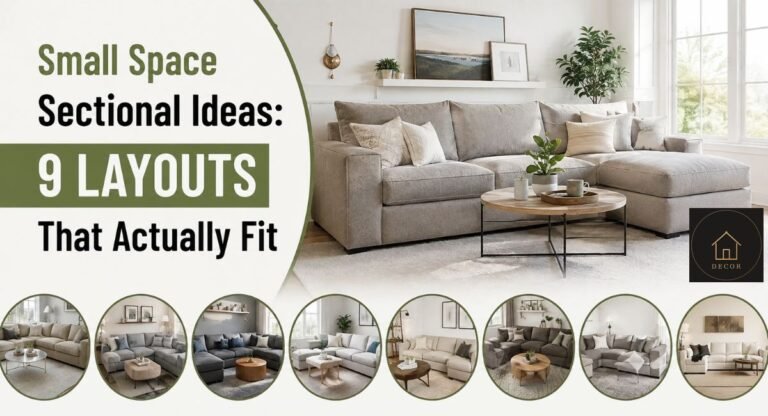
The trend leaning hardest into small spaces right now is splitting one modular set into two separate mini-couches one facing the TV, one turned toward a reading nook or window. It’s a similar idea to what we cover in our modular sofa for studio apartment layouts. It’s a simple way to get two functional seating areas out of pieces you already own, without buying a second couch.
FAQs
A modular cloud sofa is a cloud-style couch built from separate pieces you can rearrange, add to, or remove, instead of one fixed shape.
Most starter sets include 3-4 modules and can expand past 8 pieces as your space or needs change.
Yes, most modular setups use clips or straps that let you reposition pieces in under 15 minutes, with no tools required.
Modular wins on flexibility and easier moving; fixed sectionals win on price and sturdiness for households that never rearrange.
Modules slide apart most often on hard flooring or when connector clips wear down; rug pads and regular clip checks fix most cases.
Down-blend fill keeps its shape longer than all-foam, though it costs more upfront.
Yes, a 3-piece setup fits most small living rooms and can be split into smaller pieces if you move to a tighter space later.
Expect roughly $1,700-$4,500 depending on fill type, module count, and brand.
Conclusion
A setup like this is really about buying flexibility, not just a couch. Start with 3-4 pieces if you’re not sure how much space you’ll need, and add modules later instead of guessing big from day one.
Whatever layout you land on, give it a few rearranges before deciding it’s “wrong” sometimes it just needs a different corner. If you’re still deciding between modular and fixed, the sectionals guide above will help you land on the right fit.

Hi, I’m Shahzad Ahmad welcome to Smart Decore Tips!
I write and research every guide on this site myself, focused on real, practical home decor advice for renters, first-time homeowners, and small-space living. Before publishing anything, I check actual product listings, current prices, and real customer reviews not just what other sites already say.
My goal is simple: help you make smarter, more affordable decor decisions without the guesswork or sales pitch.




4 Comments