Marble Alternatives That Hold Up in Real Kitchens (2026)
Marble is the material everyone wants until they’ve lived with it for a year. Then the lemon-juice ring shows up on the island, and the sealing appointment gets pushed back for the third time.
Marble alternatives are countertop materials — quartz, quartzite, granite, porcelain slab, and a handful of others — that copy marble’s white-and-veined look without the etching and sealing marble demands. Some are natural stone, some are engineered. All of them exist because people want the look without babysitting the surface.
Quick Takeaways
- Quartz and porcelain slab need zero sealing, ever.
- Quartzite is the closest visual match to real Carrara or Calacatta marble, but it’s still natural stone — sealing every 12-18 months.
- Marble scores around a 3 on the Mohs hardness scale. Quartz, quartzite, and porcelain land near 7, so a butter knife barely marks them.
- Skip quartz outdoors. Its resin isn’t UV-stable and will discolor within a couple of summers.
- Marble’s sticker price ($75-$250+/sq ft) isn’t the real cost. Sealing, repolishing, and etch repair can add another $1,500-$4,000 over ten years — a cost most alternatives on this list simply don’t carry.
Marble Alternatives Compared: Price, Hardness, and Heat Resistance
For this comparison, “durability” is judged the way a fabricator would explain it on the showroom floor: Mohs hardness for scratch resistance, a stated heat threshold for scorch resistance, and how often the surface needs sealing — not how it photographs.
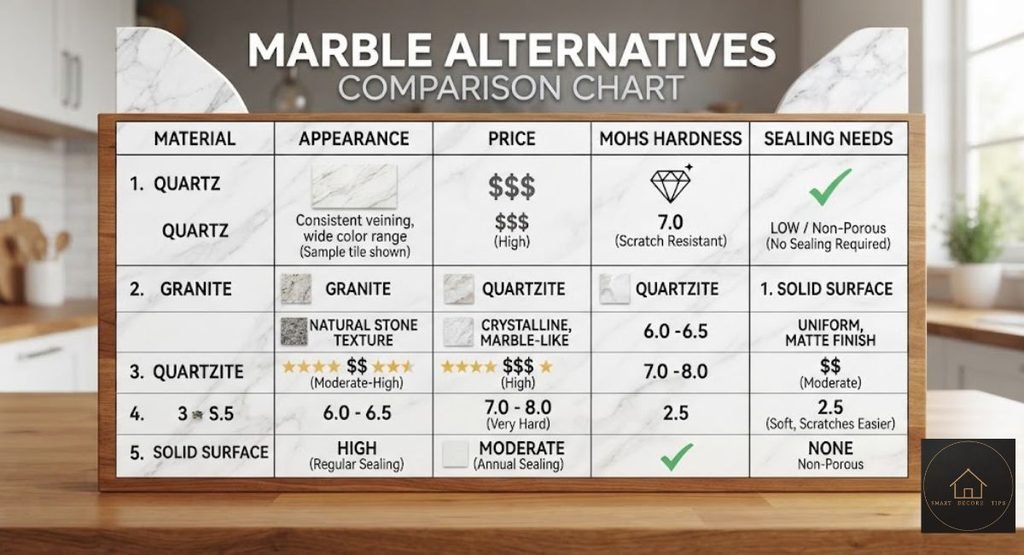
| Material | Mohs Hardness | Heat Resistance | Sealing Needed | Installed Price/sq ft* |
| Quartz | ~7 | Use a trivet — resin softens near 300°F | Never | $50-$150 |
| Quartzite | ~7 | High | Every 12-18 months | $65-$150 |
| Granite | ~6-7 | High | Every 1-3 years | $45-$100 |
| Porcelain slab | ~7-8 | Very high | Never | $55-$120 |
| Sintered stone | ~6-7 | Very high (fired above 1,200°C) | Never | $60-$150 |
| Soapstone | ~2.5-3.5 | Very high, but soft | No sealing, oiled instead | $70-$120 |
| Solid surface | ~3-4 | Moderate — can scorch | Never | $40-$100 |
| Butcher block | N/A (organic) | Low — will scorch | Oiled every 1-2 months | $40-$100 |
| Laminate | ~3-4 | Low | Never | $20-$60 |
| Real marble, for reference | ~3 | Moderate, etches with acid | Every 6-12 months | $75-$250+ |
Quartz: The Easiest Marble Swap
Quartz is where most people land, and it’s easy to see why. It’s engineered from roughly 90% ground quartz and 10% resin, so every slab looks close to the sample you picked — no surprise veining, no odd blotch in a corner.
I measured our own island before getting quotes last spring — 38 inches deep, nothing unusual — and the per-square-foot figure I’d braced for turned out smaller once the fabricator broke down how much of the invoice was edge profile and cutouts, not the slab itself.
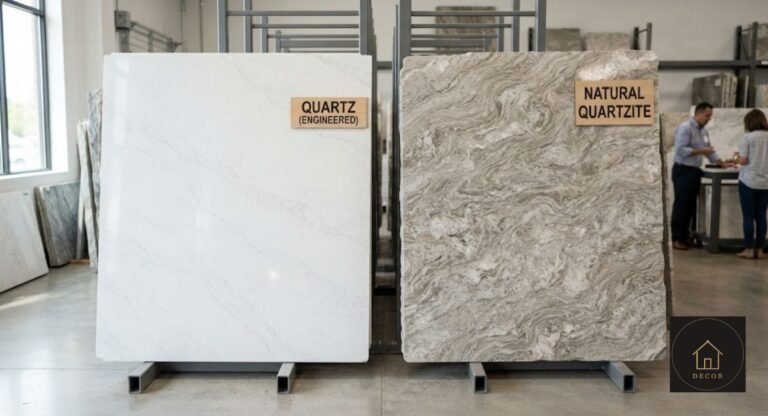
Cambria and Caesarstone both run marble-look quartz lines — Cambria’s Marble Collection and Caesarstone’s Calacatta-style veining are two convincing options. Quartz never needs sealing and shrugs off everyday knife drags cold.
Can you put hot pans on marble alternatives like quartz? No. Caesarstone’s own care guidance puts the safe ceiling at 300°F — anything hotter can scorch or crack the resin, so a trivet stays non-negotiable.
Here’s the trade-off nobody puts in the headline: for an outdoor kitchen, quartz is the one material here I’d tell you to skip outright. The resin isn’t UV-stable. Ignore that and you’ll have a blotchy counter within a couple of summers, not a decade.
Quartzite: The Closest Natural Look
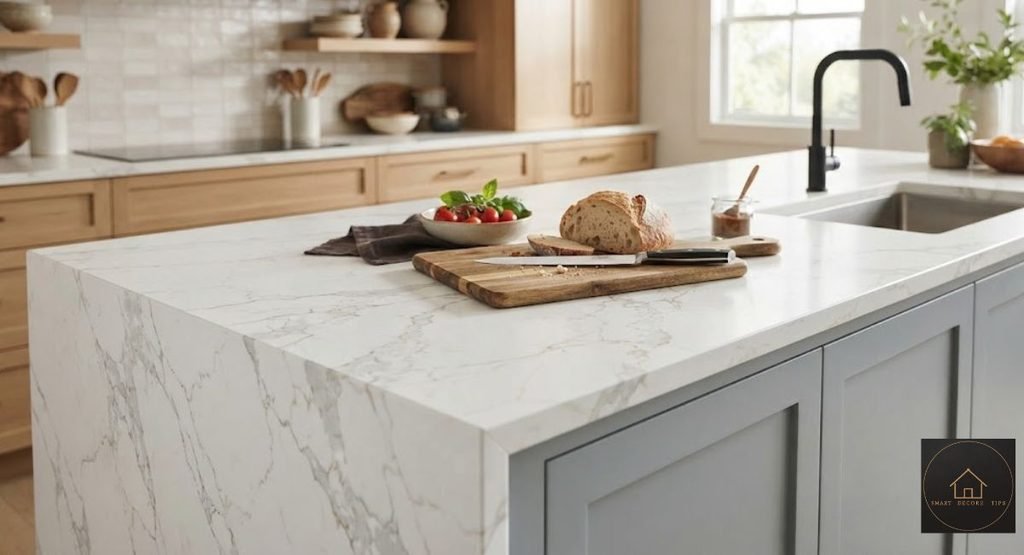
If what you actually love about marble is the movement — a vein trailing unevenly across the slab — quartzite gets closer than anything engineered. It’s sandstone cooked under heat and pressure, and it lands in nearly the same Mohs range as quartz.
I ran a lemon wedge across a quartzite sample and a marble sample side by side at a stone yard once, just to watch it happen. The marble dulled in under a minute. The quartzite didn’t change at all.
Quartzite is still porous rock, though. It needs sealing every 12 to 18 months, and it costs more to fabricate than granite because it’s harder on saw blades. If “natural stone” matters more to you than zero upkeep, this is the pick. If it doesn’t, quartz gets you 90% of the look for less work.
Granite: The Reliable Natural Stone
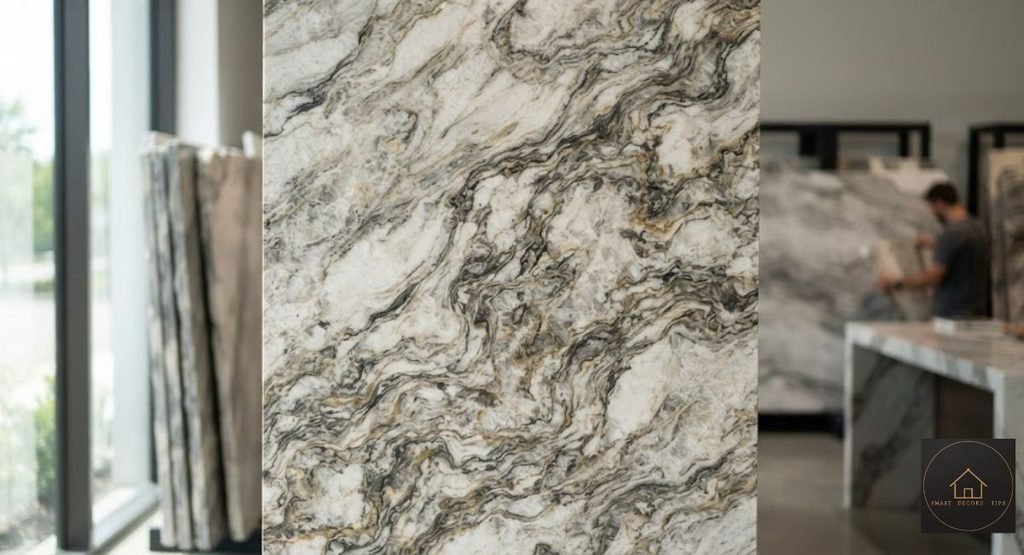
Granite doesn’t actually look much like marble — it’s speckled, not veined — but it’s what homeowners default to when they want natural stone without drama. Comparing slabs in person, I noticed the busier speckled patterns photograph fine online but read a lot noisier once they’re under a small kitchen’s cabinet lighting. See a full slab before you commit, not a 4-inch chip.
It’s also genuinely tough. A dropped pan will bounce off granite in a way it won’t off soapstone, and it takes far more heat than quartz before you’d worry about it.
Porcelain and Sintered Stone: The No-Sealing Slabs
Which marble-look countertops never need sealing? Quartz, porcelain slab, sintered stone, and solid surface are all non-porous, so none of them ever need it.
Porcelain slab is kiln-fired, non-porous, and rated for outdoor kitchens without flinching at sun exposure. A friend’s porcelain island is five years old now, and the seams are still tighter than the quartz counter in my own kitchen — that surprised me more than it should have.
Sintered stone gets skipped in most marble-alternative guides, which is odd, since it’s fired above 1,200°C and comes out harder to scorch than either quartz or granite. It costs about the same as porcelain and handles the same outdoor conditions. The trade-off is fabrication — fewer local shops cut it well, so ask before you fall in love with a slab.
Soapstone: The Moody, Low-Maintenance Option
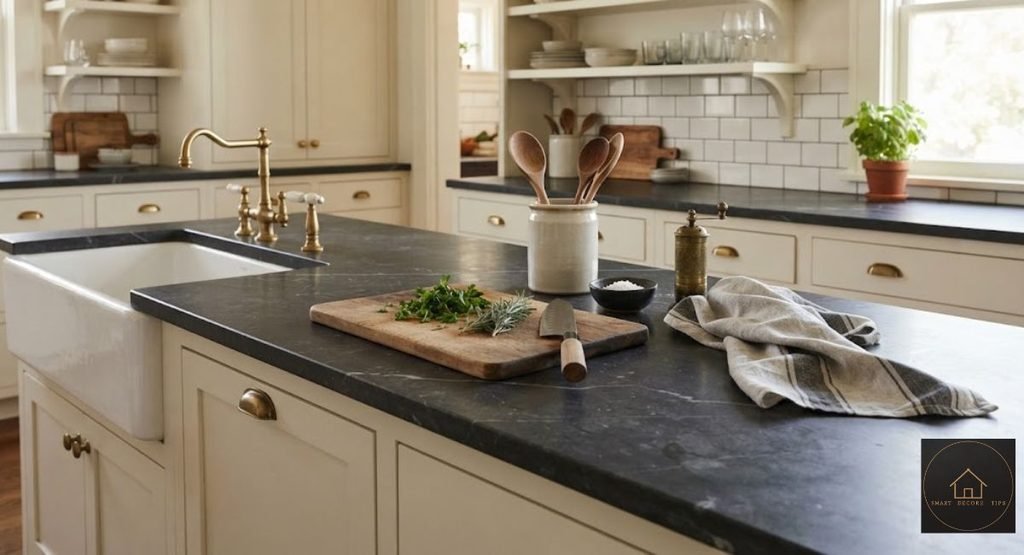
Soapstone is the matte, dark-toned pick, and it’s genuinely soft — softer than marble, not harder. It won’t etch from acid the way marble does, but it scratches easily and needs mineral oil rubbed in periodically or it starts looking chalky instead of moody.
Skip it if you’re not willing to do that upkeep in the first few months especially. Ignore that warning and the counter just looks tired, not intentional.
Laminate, Solid Surface, and Butcher Block: The Budget Route
Not every marble alternative has to be a slab. Laminate has quietly improved. Modern lines from Formica and Wilsonart print convincing white-and-gray marble patterns at $20-$60 a square foot installed instead of $75-plus. It won’t survive a hot pan set directly on it, and the seam gives it away up close — but for a rental flip or a starter kitchen, it does the job.
I priced laminate against quartz for a flip last year, and the gap wasn’t as wide as expected, mostly because quartz fabricators often have a minimum job size that eats into the “quartz is expensive” math on a small kitchen.
Solid surface (think Corian) shapes into a seamless counter with an integrated sink, which stone can’t do. It scratches more easily than quartz and can scorch — but scratches sand out, which is a real advantage over stone.
Butcher block drops the marble look entirely and goes for warmth instead. It’s affordable, feels nothing like a cold slab, and works well as a prep-zone island next to a stone perimeter. Plan to oil it every month or two, and know it will scorch under a hot pan.
So, Which Marble Alternative Should You Actually Pick?
Cook a lot and want zero maintenance? Quartz or porcelain slab. Want the closest natural look and don’t mind sealing once a year? Quartzite. Budget is the deciding factor? Laminate now, upgrade later. Building an outdoor kitchen? Porcelain, granite, or sintered stone — never quartz.
For the full price-versus-durability breakdown between the two most-searched options, see our Quartz vs. Quartzite comparison, which walks through the $1,200 gap in more detail than this guide can. And if metal or compact-surface countertops caught your eye while reading this, our 2026 countertop trends guide covers which newer looks are actually worth chasing.
FAQs
Quartz is the most common pick because it never needs sealing and resists stains, but quartzite is the closest visual match to real marble’s veining.
Quartz and marble overlap in upfront price, both roughly $50-$150 versus $75-$250+ per square foot, but marble’s hidden sealing and repair costs over ten years usually make quartz cheaper long-term.
Quartz, porcelain slab, sintered stone, and solid surface are all non-porous and never require sealing.
Quartzite can handle brief direct heat, but quartz should never take a hot pan directly since its resin can soften starting around 300°F, so use a trivet.
Quartz, quartzite, and porcelain slab all score around a 7 on the Mohs hardness scale, roughly twice as scratch-resistant as real marble.
Granite is more durable and often less expensive than marble, but its speckled pattern looks quite different from marble’s veining, so it suits buyers who want durability over a marble match.
Porcelain slab, granite, and sintered stone all handle sun and heat outdoors; quartz is the one to avoid since its resin isn’t UV-stable.
Most engineered and natural-stone alternatives run $45-$150 per square foot installed, with laminate as low as $20 and premium quartzite reaching $150.

Hi, I’m Shahzad Ahmad welcome to Smart Decore Tips!
I write and research every guide on this site myself, focused on real, practical home decor advice for renters, first-time homeowners, and small-space living. Before publishing anything, I check actual product listings, current prices, and real customer reviews not just what other sites already say.
My goal is simple: help you make smarter, more affordable decor decisions without the guesswork or sales pitch.