Cloud Sofa Cushion Fluffing: Fix Flat Cushions
Your sofa arrived looking full and soft. Months later, your favorite seat has a visible dip and the back pillow leans sideways.
That doesn’t automatically mean the sofa is worn out.
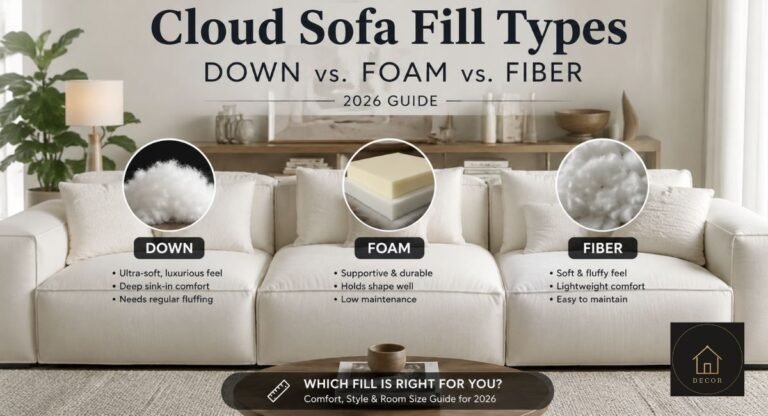
Cloud sofa cushion fluffing works when loose filling has compressed or migrated inside the cushion. The right fix depends on what’s inside. Feather, down, polyester fiber, foam, and hybrid cushions do not respond the same way.
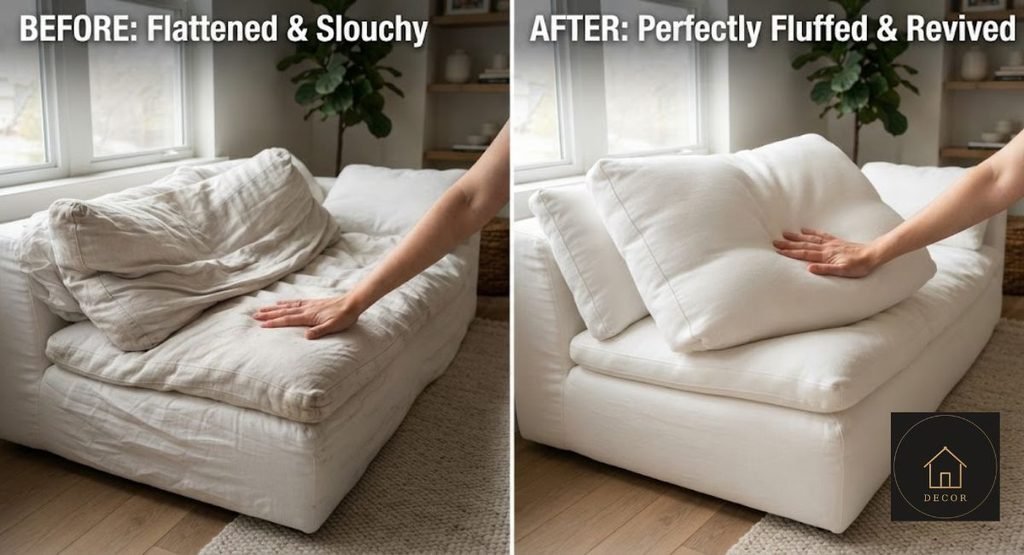
Quick answer: Cloud sofa cushion fluffing is the process of reshaping and redistributing loose cushion fill after it compresses during use. You squeeze, lift, pat, shake, and rotate removable cushions so down, feathers, or fiber spread more evenly. Foam-core cushions need rotation more than fluffing, because compressed foam does not re-loft like loose fill.
Why Do Cloud Sofa Cushions Go Flat?
Most flatten because pressure moves or compresses the cushion materials. The exact cause depends on whether your sofa uses loose fill, foam, or both.
Four different problems can create the same flat-looking cushion.
1. Loose Fill Has Moved
Down, feathers, and polyester fiber can migrate toward edges and corners.
The center then looks empty even though the filling is still inside.
This is the type of problem normal fluffing fixes best.
2. Loose Fill Has Become Compressed
Repeated sitting packs soft material together.
Kneading and shaking can separate some of that fill and redistribute it through the cushion.
3. The Foam Core Has Lost Recovery
Foam works differently.
You can smooth the outer wrap and rotate the cushion, but punching damaged foam does not rebuild its internal structure.
If an indentation remains after the cushion has been unloaded for a while, inspect the core rather than fluffing harder.
4. The Problem Is Under the Cushion
Sometimes the cushion is fine.
A stretched support system, shifted module, damaged spring, or frame problem can make a perfectly usable cushion look saggy.
Remove the seat cushion and inspect the surface underneath before ordering a new insert.
For a deeper explanation of what may be inside your sofa, see the Cloud Sofa Fill Types Guide.
First, Find Out What Is Inside Your Cushion
Don’t start hitting cushions until you know what you’re working with.
| Cushion type | What usually goes flat | Best first action | Can normal fluffing help? |
| Down/feather | Fill migrates and compresses | Shake, knead, reshape | Yes |
| Polyester fiber | Fibers compact and bunch | Squeeze and redistribute | Yes |
| Foam core + soft wrap | Outer wrap shifts | Reshape wrap and rotate | Partly |
| Solid foam | Foam develops indentation | Rotate if allowed | Very little |
| Foam + feather/down hybrid | Outer fill shifts before core fails | Fluff outer layer, rotate | Yes, for the loose layer |
The RH Cloud is a good example of why “cloud cushion” does not mean “bag of feathers.”
Its current construction combines soft feather and down around a premium foam core. See the official RH Cloud Sofa specifications.
That means the outer softness can benefit from reshaping while the internal foam provides support.
If you’re deciding between those constructions, the Down Sofas Guide explains the comfort-versus-maintenance trade-off in more detail.

How Often Should You Do Cloud Sofa Cushion Fluffing?
Use the sofa’s condition and manufacturer instructions rather than one rigid schedule. High-use feather or fiber cushions may need light reshaping several times a week, while foam-heavy seats need much less attention.
A practical schedule is:
| Task | Useful starting point |
| Lightly reshape loose back cushions | After heavy use |
| Full fluff of heavily used loose-fill cushions | About weekly |
| Rotate interchangeable cushions | Every few weeks |
| Vacuum seams and crevices | Weekly or as needed |
| Inspect foam/support | When a dent stops recovering |
| Wash covers | Only according to the care label |
That is a starting routine, not a rule for every brand.
West Elm, for example, recommends periodically fluffing cushions on its Harmony line rather than prescribing daily treatment. It also advises vacuuming crevices and keeping upholstery away from direct sunlight. West Elm Harmony care instructions.
The 5-Minute Cushion-Reset Method
This routine works best for removable cushions containing feathers, down, fiber, or a soft wrap.
You do not need tools.
Step 1: Remove the Cushion
Lift it from the sofa if the design allows.
This lets you reach the lower corners and inspect the support underneath.
Step 2: Stand It Upright
Hold the cushion vertically.
Gravity helps loose filling move away from the compressed sitting surface.
Step 3: Push the Sides Toward the Center
Place both hands on opposite sides.
Compress the cushion gently toward the middle, release, then repeat several times.
You are moving filling back into the center rather than simply hitting the cover.
Step 4: Knead Flat Areas
Use your fingers and palms to work around obvious low spots.
Move dense clumps toward areas that feel empty.
Step 5: Shake the Cushion
Hold it securely by opposite edges or corners.
Give it several firm shakes so loose filling can redistribute.
Avoid pulling hard on seams or zippers.
Step 6: Pat From the Bottom Up
Back cushions often lose filling toward the bottom.
Pat upward from the lower edge, then shape the top corners with your hands.
Step 7: Rotate It If the Design Allows
Move a left cushion to the right, or turn it front-to-back, only if both its shape and upholstery permit that placement.
Step 8: Put It Back and Compare
Set the cushion down and look at it from the front.
A successful reset should look more even rather than simply taller in one spot.
On a three-seat sofa, a quick reset can fit into a few minutes once you know the routine.

Down, Feather and Fiber Cushions Need Different Handling From Foam
This distinction is where many fluffing guides become misleading.
Down and Feather
Loose natural fill moves easily.
Shake, knead, lift, and redistribute it.
The goal is not to make the cushion rigid. A relaxed, slightly lived-in appearance is part of this construction.
Polyester Fiber
Fiber can respond well to squeezing and hand redistribution.
Once it becomes heavily matted, however, reshaping may produce less improvement.
Hybrid Cushions
Hybrid cushions combine a structural core with a softer outer material.
Work on the outer layer first.
Do not mistake a firm center for a failed cushion.
Solid Foam
Foam is not truly “fluffed.”
Rotate it if the manufacturer allows rotation. Give compressed foam time unloaded from body weight.
If the same deep indentation remains, the issue is no longer loose filling.
For more on foam behavior and support, see the Foam Filled Sofa Guide.
Real Brands Show Why One Fluffing Rule Doesn’t Work
A useful care guide needs to reflect how different current sofas are built.
RH Cloud
RH describes the Cloud as feather and down construction around a premium foam core.
That construction combines a reshappable comfort layer with structural foam.
West Elm Harmony
The current Harmony uses fiber-wrapped high-density polyurethane foam for the seat cushions.
Its back cushions contain polyester fiber, duck feather, and duck down.
So the back cushions benefit much more from fluffing than the seat foam does.
My Comfy Couches
The brand currently describes its cushions as a blend of 40% memory foam, 20% down feathers, and 40% polyester fiber.
Its own initial care method includes kneading, shaking, patting, and pulling the corners into shape. (My Comfy Couches)
This is another hybrid where reshaping affects the loose components rather than magically renewing the foam.
Lovesac Sactionals
Lovesac shows another reason to check the manufacturer before opening anything.
Most Sactionals covers can be machine washed, but the company says inserts should not be opened or machine washed. Lovesac Sactionals care information.
A zipper on a cover does not automatically mean you should open the cushion insert inside it.
What Should You Not Do to Flat Cloud Cushions?
Several internet fixes are riskier than ordinary hand reshaping.
Don’t Wash the Insert Unless the Brand Says You Can
A washable cover and a washable insert are completely different things.
Water can affect foam, feathers, adhesives, batting, and drying time.
Don’t Put Cushions in a Dryer Without Care Instructions
Heat can shrink covers and damage some materials.
Lovesac, for example, tells owners to line dry its washable covers rather than put them in a dryer.
Don’t Leave Upholstery in Direct Sun to “Restore Loft”
Sunlight is not a universal cushion-restoration method.
West Elm specifically advises protecting its upholstery from direct sunlight to reduce fading. (West Elm)
Don’t Add Random Foam Before Diagnosing the Problem
Stuffing an egg-crate topper or loose foam inside an already balanced cushion can distort the cover and change seat height.
First determine whether the issue is loose fill, the foam core, or the support system.
Don’t Punch Seams and Zippers Hard
Use your palms across broad surfaces.
Concentrated force around stitching can create a new problem while you are trying to fix the old one.
What Should You Do When Fluffing Stops Working?
If reshaping makes little or no difference, inspect the cushion rather than repeating the same routine harder.
Start with four checks.
Check 1: Does the Cushion Feel Empty in One Area?
If yes, loose filling may simply have migrated.
If the manufacturer permits access to the insert, redistribution or professional restuffing can help.
Check 2: Does the Foam Stay Deeply Indented?
That points toward core wear rather than a fluffing problem.
Measure the existing insert before ordering a replacement.
Check 3: Is the Cushion Fine on the Floor but Saggy on the Sofa?
Then inspect the support underneath.
The seat deck, spring system, or modular alignment may be contributing to the dip.
Check 4: Is Only the Cover Loose?
A stretched cover can make a healthy insert look deflated.
Remove and refit a removable cover according to the manufacturer’s instructions before replacing the core.
Some manufacturers sell replacement inserts rather than forcing owners to replace the entire sofa. Eden Home, for example, currently sells replacement INFINITY+ inserts with different feather/poly ratios and notes that its cloud-style cushions require regular redistribution of the feather fill.

Can You Flip Every Cloud Sofa Cushion?
No. Only flip a cushion when both sides are designed to be used.
Look for:
- identical upholstery on both faces
- no fixed Velcro or attachment panel
- no directional wedge shape
- reversible construction in the product specifications
If you cannot flip it, you may still be able to rotate its position.
West Elm’s current Harmony modular cushions, for example, are specifically described as reversible.
Do not assume another brand works the same way.
Daily Habits That Reduce Uneven Flattening
You don’t need a complicated maintenance routine.
A few habits distribute pressure more evenly.
- Avoid using the exact same seat every night.
- Reshape very soft back cushions after long lounging sessions.
- Rotate interchangeable cushions before one becomes visibly different.
- Vacuum crumbs from seams before they work deeper into upholstery.
- Keep sofa modules correctly aligned.
- Follow the exact cover-cleaning instructions.
- Inspect a persistent low spot rather than hiding it with a throw pillow.
In my own two years with a feather-fiber sectional, a skipped week of reshaping was visible in the most-used seat.
What stood out more was the difference after longer gaps: the favorite cushion took noticeably more hand redistribution before it looked even again.
That is a better reason for regular care than an arbitrary calendar rule.
Is It Normal for Cloud Couch Cushions to Lose Shape?
Yes, some visible compression is normal with soft loose-fill cushions. A permanent deep dip is different and deserves inspection.
The relaxed appearance is partly created by the same materials that move under your body.
RH’s current Cloud is intentionally built around soft feather and down comfort rather than a rigid tailored seat.
What you want to see is recoverable compression.
If light reshaping restores an even surface, normal maintenance is working.
If the cushion quickly collapses to the same deep spot, investigate the insert and sofa support.
Who Is a High-Maintenance Cloud Sofa Not Great For?
If you want your sofa to look perfectly tailored after every person stands up, a feather-heavy design is probably the wrong fit.
That is the honest trade-off.
The softest cushions usually show body impressions faster than firm structural foam.
A foam-heavy or hybrid sofa can give you a more consistent shape with less hands-on maintenance.
The updated Cloud Couch Guide can help if you are deciding between different cloud-style constructions rather than fixing one you already own.
Final Verdict: Does Fluffing Really Fix Flat Cloud Cushions?
Cloud sofa cushion fluffing works when the problem is movable or compressed loose fill. It cannot rebuild damaged foam or repair a failing seat support.
Start by identifying the fill.
Then reshape soft material, rotate reversible cushions, and follow the manufacturer’s care instructions.
If the cushion stays deeply flat afterward, stop punching it.
Check the insert and support system instead.
That distinction saves more time than any viral cushion hack.
Frequently Asked Questions
There is no universal schedule.
High-use down, feather, or fiber cushions may benefit from light reshaping every few days and a fuller reset around weekly. Follow your manufacturer’s instructions first.
Loose fill may be moving away from the center, fibers may be compressing, or the internal foam may be losing recovery.
A problem underneath the cushion can also create a visible dip.
You can reshape its soft outer wrap and rotate the cushion if allowed.
You cannot restore worn foam by shaking or punching it the way you can redistribute loose feathers or fiber.
Only when the cushion is designed to be reversible.
Check for matching fabric on both sides and manufacturer confirmation before flipping it.
Consider replacement when a persistent indentation remains after unloading and reshaping, the foam feels damaged, or the cushion no longer provides even support.
Check the sofa support underneath first.
Only if the insert is designed to be opened and the manufacturer allows it.
Adding random fill can change the seat height, firmness, cover fit, and pressure on the seams.
Do not do this unless the care instructions specifically allow it.
Heat can damage or shrink some covers and cushion materials.
Back pillows often contain more loose feather, down, or fiber than seat cushions.
Gravity and repeated leaning move that filling downward, so hand redistribution can make a larger visible difference.

Hi, I’m Shahzad Ahmad welcome to Smart Decore Tips!
I write and research every guide on this site myself, focused on real, practical home decor advice for renters, first-time homeowners, and small-space living. Before publishing anything, I check actual product listings, current prices, and real customer reviews not just what other sites already say.
My goal is simple: help you make smarter, more affordable decor decisions without the guesswork or sales pitch.