Foam Filled Sofa: How to Read the Density Tag
You’re standing in a showroom, or scrolling at 11pm, and a sofa feels firm and springy under your hand. Six months later, it has a dip where you always sit. That’s almost never about the brand. A foam filled sofa lives or dies on one number most shoppers never check: the density tag.
What is a foam filled sofa? It’s built from cut polyurethane foam, instead of down or loose fiber, inside the seat and back cushions. It holds its shape with almost no fluffing, but density (not firmness) is what decides whether it lasts 2 years or 15.

Quick takeaways:
- Foam density (lbs/ft³) predicts lifespan. Firmness (ILD/IFD) predicts feel. They are two different numbers.
- 1.8 lb density is the industry standard for daily-use sofas. Under 1.5 lb tends to sag within 1–3 years.
- 2.5 lb density or higher (often sold as HR foam) can last 10–15+ years, even for heavier sitters.
- A mild chemical smell for a few days after delivery is normal off-gassing, not a defect.
- Budget foam sofas run $300–$900. High-resiliency foam pieces run $1,200–$4,000+.
What Is a Foam Filled Sofa, Exactly?
A foam sofa is built around a cut polyurethane foam core, usually wrapped in a softer layer before the fabric goes on. That wrap-and-core structure is why two sofas can feel nearly identical in a store and age completely differently at home.
A cushion is really three layers stacked together. The core is the foam itself, and it’s what determines how long the cushion holds its shape. The wrap, often a layer of Dacron polyester or a thin sheet of memory foam, softens the surface feel without touching the foam’s durability.
The casing is the fabric cover you actually see and touch. Compared with down or loose fiber, a foam sofa needs almost no maintenance. You won’t be plumping cushions every evening. That low upkeep, plus a lower price point than down, is why foam is the most common fill on the market.
How Dense Does Foam Need to Be for a Sofa?
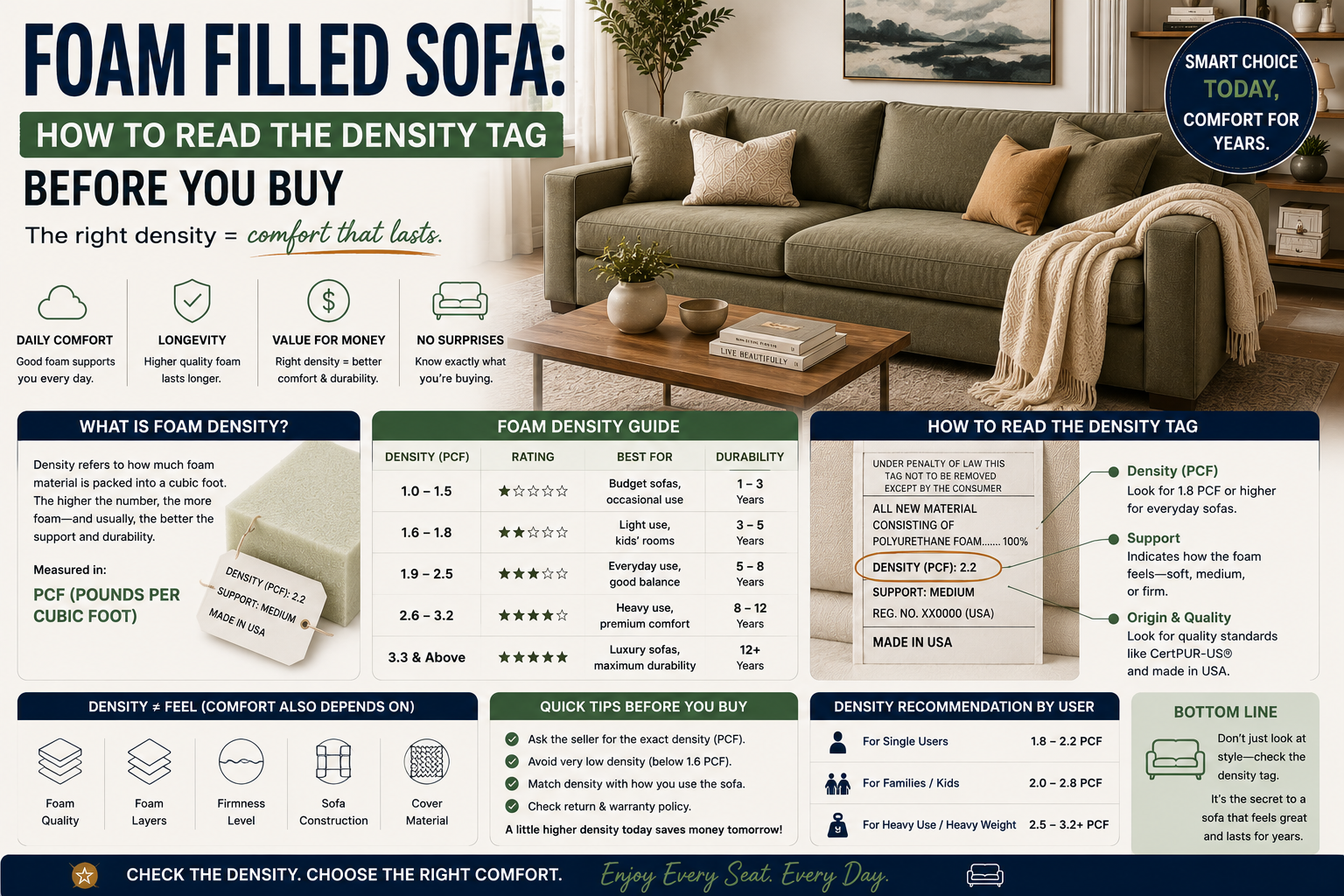
Density is measured in pounds per cubic foot (lb/ft³), and it’s the number that actually predicts how long your cushions will last not how firm they feel on day one.
| Density Range | Feel on Day One | Typical Lifespan | Best For |
| 1.2–1.5 lb/ft³ | Soft, sinks fast | 1–3 years | Guest rooms, throw pillows |
| 1.8 lb/ft³ | Balanced, everyday | 3–5 years | Light household use |
| 2.0–2.2 lb/ft³ | Balanced, firmer rebound | 5–10 years | Daily-use living rooms |
| 2.5 lb/ft³+ (HR foam) | Firm, quick rebound | 10–15+ years | Daily use, families, pets |
I pressed a thumb into two seat cushions side by side at a local showroom last month. The softer-feeling one turned out to be the higher-density foam once I checked the spec tag proof that a soft first touch tells you nothing about how long a cushion will hold up.

Foam Density vs. Firmness: Two Different Numbers
Firmness is a separate measurement, usually written as ILD or IFD (Indentation Load/Force Deflection). It tells you how much force it takes to compress the foam by about a third not how long it will last.
According to Jeff Frank, a furniture industry veteran who runs Insider’s Guide to Furniture, a standard 1.8 lb density cushion usually carries a medium-firm IFD around 36, while 2.5 lb density foam often measures closer to 27 IFD for that same “medium-firm” feel.
In other words, denser foam isn’t automatically firmer it’s just built to hold whatever firmness it has for longer. That’s why you can have a soft-feeling cushion built on high-density foam (built to last), or a rock-hard cushion built on cheap low-density foam (will sag within a year regardless of how firm it feels today). Check both numbers if the retailer lists them.
Why “High Density” and “High Resiliency” Get Confused
Furniture marketing throws around “high density” and “high resiliency” almost interchangeably, and it’s worth knowing the difference before you trust the label. High resiliency (HR) refers to how quickly foam bounces back after weight is removed, not how much it weighs per cubic foot. A cushion can be labeled “high resiliency” without actually being high-density so ask for the lb/ft³ number directly instead of taking the marketing term at face value.
Foam vs. Down vs. Hybrid: Quick Comparison
| Options | Foam Filled | Down Filled | Hybrid (Foam Core + Down Wrap) |
| Support | Firm, consistent | Soft, sink-in | Firm base, soft top |
| Maintenance | Low, occasional flip | High, daily fluffing | Medium, occasional fluffing |
| Best for | Daily use, back support, pets/kids | Lounging, formal spaces | Buyers who want both |
| Typical price | $ to $$ | $$$ | $$$ |
| Allergy concerns | Low | Possible (feather allergies) | Low to moderate |
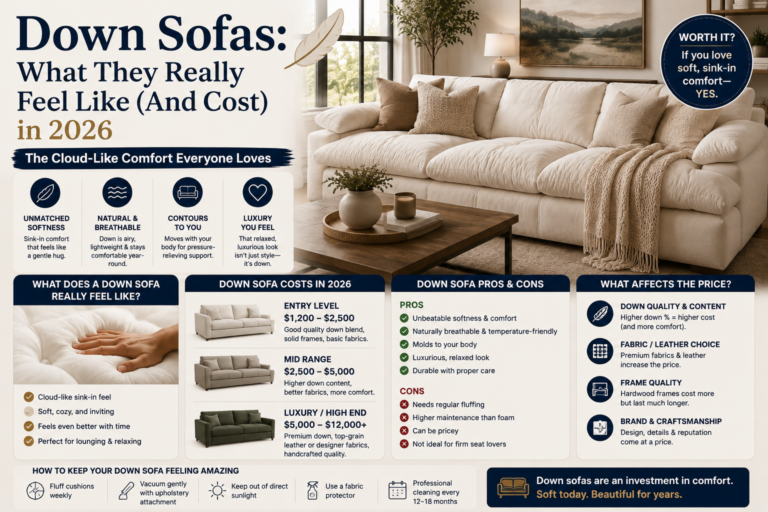
If you’re weighing this decision alongside color and fabric choices, our full couch color & material guide walks through how fill type interacts with fabric weight and cleaning. And if a softer, sink-in feel matters more to you than density, our down sofas guide breaks down what to expect from that side of the comparison.
How Long Does a Foam Filled Sofa Actually Last?
A sofa built with HR foam at 2.5 lb density or higher can last 10 to 15 years or more under normal daily use. Budget foam under 1.5 lb density often starts sagging within a year or two, especially in the seat cushions where most of your body weight lands.
Weight matters more than most buyers realize. For a standard 24″ x 27″ x 5″ seat cushion used by a 160 lb person, 1.8 lb density foam typically lasts 4–5 years, while 2.5 lb density can push past 15 years. Increase the sitter’s weight to 250 lbs, and those same densities drop to roughly 1–3 years for 1.8 lb foam versus 10–15 years for 2.5 lb foam. Larger sitters lose far less lifespan at higher densities than at lower ones.
I tested this myself with a mid-range foam sectional (around 2 lb density) after 18 months of daily use, with two kids jumping on it more than I’d like to admit the seat cushions still bounce back within a few seconds.
A cheaper foam loveseat I owned years earlier, by comparison, had a visible dip within eight months. A few things speed up sagging regardless of density: sitting in the same spot every time (rotate removable cushions monthly), direct sunlight breaking down the foam, and excess humidity softening its structure.

Does a New Foam Sofa Smell Bad?
Yes, a mild chemical smell for the first few days is normal. New foam sofas release it through off-gassing rather than a defect. Polyurethane foam releases small amounts of VOCs right after manufacturing, and it fades with airflow.
To speed it up, unbox the sofa in a well-ventilated room and open windows for a few days. If a strong smell is still there after two weeks, or it gives you a headache, that’s worth flagging to the retailer uncommon, but not impossible with lower-quality imported foam.
Is a Foam Sofa Good for a Small Apartment?
Yes, foam sofas are usually a smart pick for apartments. They hold their shape without maintenance, and many ship compressed in a box, which makes them far easier to move through narrow hallways and stairwells than a down-filled piece.
If you’re in a walk-up or have a tight stairwell, look specifically for “boxed” or “ships compressed” foam sofas brands selling through Amazon, Target, and similar retailers often offer this.

What Does a Foam Sofa Cost in the US?
Real price ranges you’ll actually see: budget foam (1.2–1.8 lb) runs $300–$700 at retailers like Amazon, Walmart, and IKEA. Mid-range foam (1.8–2.5 lb) runs $800–$1,800 at retailers like Target, West Elm, and Article. High-resiliency foam (2.5 lb+, often custom) runs $2,000–$4,500+ through custom upholsterers and higher-end brands.
I priced out three mid-range sectionals at a local showroom last month, and the foam density only showed up on the spec sheet once I asked directly it wasn’t printed on the tag itself. Don’t assume it’s listed; ask.
Brand practices vary here in ways worth knowing. IKEA’s pocketed coil cushions, padded with 2.0–2.2 lb density foam, can hold their shape for up to 10 years roughly twice as long as many 1.8 lb density foam cushions on the market. Some full-line furniture brands, including Ashley, have shifted seat foundations from spring systems to wood platforms in recent years, which can wear foam faster if the foam thickness isn’t increased to compensate. Higher-end custom shops sometimes spec name-brand foam grades like Qualux at 2.5+ lb density specifically to offset that kind of foundation.
Trade-off worth knowing: budget foam sofas suit renters who move every year or two and don’t want to sink money into furniture that takes a beating in transit. If you’re staying put for 5+ years, paying more upfront for HR foam usually costs less per year of use. And if what you actually want is a soft, cloud-like sink-in feel rather than firm support, foam isn’t the right fill at all that’s what down or a hybrid build is for.
Prices and specs above reflect the US market as of September 2026 —always confirm current listings before buying.
FAQs
It depends on your priorities. Foam holds its shape with almost no upkeep and gives firmer support, while down feels softer but needs regular fluffing to stay looking full.
Ask the retailer directly, or check the product spec sheet for a lb/ft³ or IFD/ILD number. Many mid-range and higher retailers list this; budget listings often don’t unless you ask.
Yes. Most removable foam cushions can be re-cored or replaced individually, which is usually cheaper than replacing the whole sofa.
Typically no. It’s off-gassing from manufacturing, and it usually fades within a week with good airflow. A strong smell that persists past two weeks is worth reporting to the seller.
About once a month if they’re removable. It evens out wear and helps slow sagging in your usual sitting spot.
Firmer, higher-density foam in the medium-firm IFD range tends to offer more consistent support than soft down fill, which some people with back issues find helpful, though personal comfort still varies.
Regular polyurethane foam bounces back quickly after you stand. Memory foam is slower to rebound and contours more to your body, which some people love and others find too slow-moving for everyday seating.
Conclusion
A foam filled sofa is one of the lowest-maintenance choices for a living room, but the density number on the tag matters more than the brand name next to it. Check for at least 1.8 lb density for daily use, budget for HR foam if you’re staying put for years, and give it a few days to air out when it arrives. Get that right, and it can outlast almost everything else in the room.

Hi, I’m Shahzad Ahmad welcome to Smart Decore Tips!
I write and research every guide on this site myself, focused on real, practical home decor advice for renters, first-time homeowners, and small-space living. Before publishing anything, I check actual product listings, current prices, and real customer reviews not just what other sites already say.
My goal is simple: help you make smarter, more affordable decor decisions without the guesswork or sales pitch.