
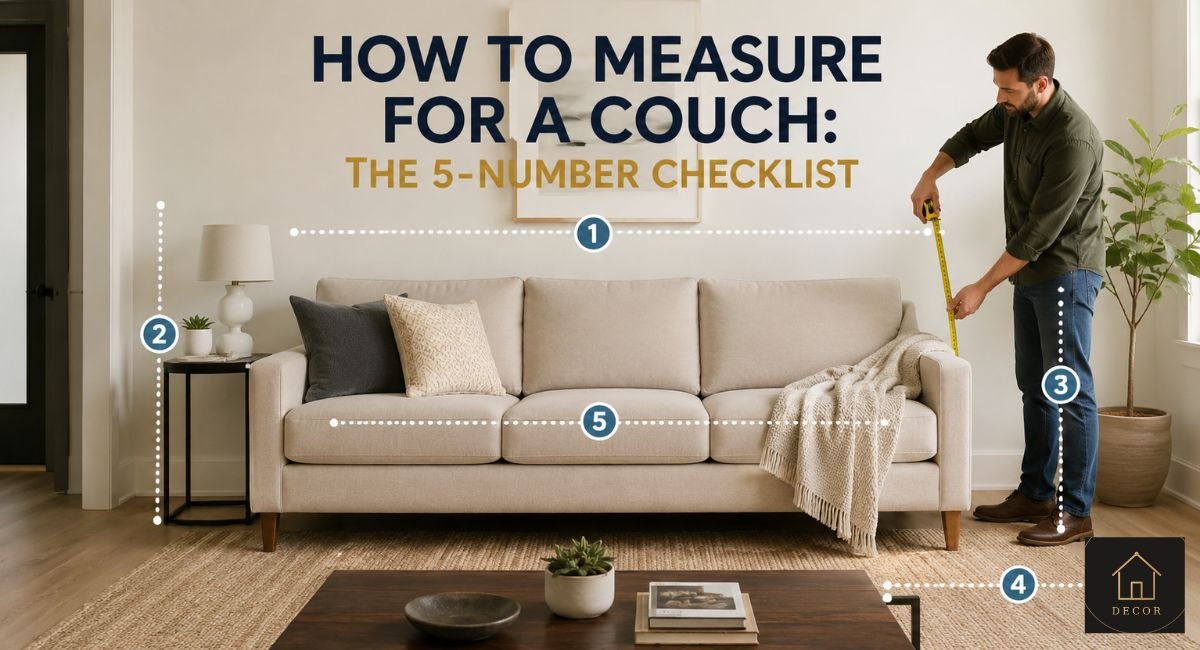
How to Measure for a Couch: The 5-Number Checklist
You measured the wall, fell in love with an 86-inch sofa, and now it’s stuck sideways in your hallway. This happens more often than furniture stores like to admit, and it’s almost always avoidable.
Knowing how to measure for a couch properly takes about 15 minutes with a tape measure and it’s the single biggest reason returns happen or don’t. This guide is part of our Custom vs. General Couches: What They Really Cost in 2026 series, where we cover the full decision budget, sizing, and fit before you order anything.
Quick Takeaways
- You need 4 sofa numbers (width, depth, height, diagonal depth) and 3 space numbers (room, doorway, delivery path) nothing else.
- Diagonal depth, not width, is what actually decides if a sofa clears a tight doorway at an angle.
- Leave 30″ of walking space around a sofa and at least 18″ between it and a coffee table.
- A sofa should take up roughly two-thirds of the wall it sits against not the whole wall.
- If your entry points are under 30″, modular or boxed sofas (built in pieces) are the safer buy.
What Does “Measuring for a Couch” Actually Mean?
Measuring for a couch means recording two sets of numbers the sofa’s own dimensions (width, depth, height, diagonal depth) and your space’s dimensions (room, doorway, hallway, stairs) then comparing them before you buy. Get both sets right and the sofa fits your room and makes it through your front door on delivery day.
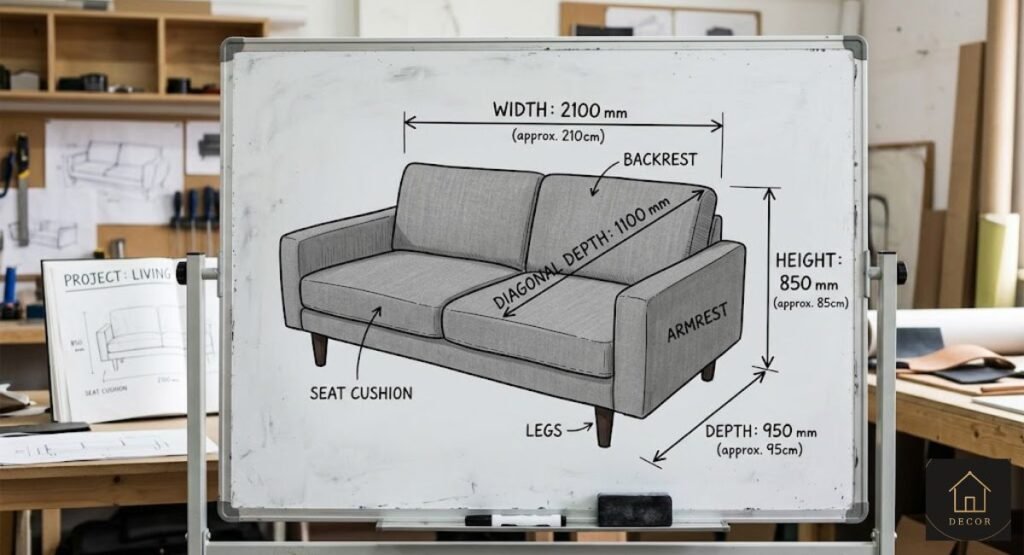
The 5 Measurements You Actually Need (Quick Cheat Sheet)
Most guides scatter these across five different pages. Here’s everything in one table so you can screenshot it and go measure.
| Measurement | What It Tells You | How to Take It |
| Width | Side-to-side fit against your wall | Arm outer edge to arm outer edge, widest point |
| Depth | Front-to-back footprint in the room | Front cushion edge to back of frame |
| Height | Whether it blocks a window or looks squat | Floor to the highest point of the backrest |
| Diagonal Depth | Whether it clears a tight doorway at an angle | Top-back corner to bottom-front corner |
| Seat Depth | Comfort how far back you sink in | Front cushion edge to the back cushion |
A standard three-seat sofa runs about 78–90 inches wide, 36–40 inches deep, and 32–36 inches high but “standard” varies a lot by style, so always measure the actual listing, not a rule of thumb.
How to Measure Your Couch’s Width, Depth, and Height
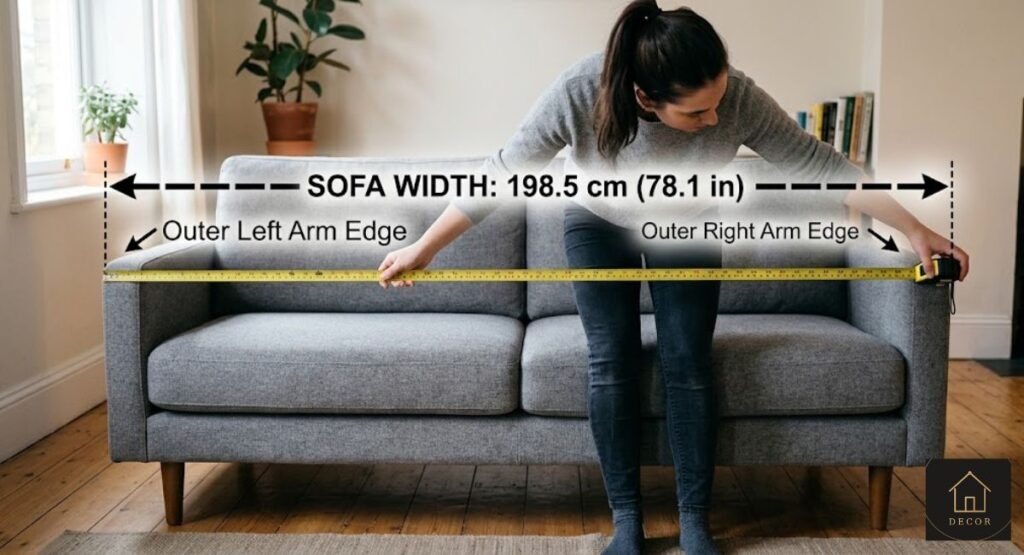
Here’s what people get wrong: they measure the cushions instead of the frame, and the number comes out smaller than reality. Always measure to the outer edge of the sofa, cushions included, unless the listing specifies otherwise.
- Width — Run the tape from the outermost point of one arm to the outermost point of the other. This is the number that decides if the sofa fits your wall.
- Depth — Measure from the front edge of the seat cushion to the back of the frame. Include any pillows that are permanently attached.
- Height — Measure straight up from the floor to the tallest point of the backrest. If the sofa has loose back pillows, measure with them in place since that’s how you’ll actually see it.
I’ve measured more secondhand sofas off Facebook Marketplace than I can count, and the mistake I make most often is forgetting the arms flare out wider than the cushions look always measure at the widest point, not where your eye lands first.
What Is Diagonal Depth and Why It’s the Number Everyone Skips
Diagonal depth is the distance from the top-back corner of the sofa to the bottom-front corner, measured on a slant. It tells you whether a sofa can be tilted through a doorway that’s narrower than the sofa itself.
Here’s the rule: if your doorway width is greater than the sofa’s diagonal depth, the sofa can pass through at an angle even if it wouldn’t fit straight on. This is the exact number delivery crews use, and it’s the one most buyers never check before ordering.
Example: A sofa with a 30″ diagonal depth will pass through a 32″ doorway at an angle, even though the sofa itself is 84″ wide. That’s the whole trick width almost never matters at the doorway, diagonal depth does.
How to Measure Your Room So the Couch Fits Right
Once you know the sofa’s numbers, check them against your room — this is the part people skip and regret.
- Wall length: Measure the wall where the sofa will sit. Designers use the two-thirds rule your sofa should fill about 66% of that wall, not the whole thing.
- Walking space: Leave at least 30 inches of clear floor space in front of and around the sofa for normal foot traffic.
- Coffee table gap: If you’re adding a coffee table, keep 18 inches between it and the sofa so drinks and plates are still within reach.
- Outline it first: Use painter’s tape to mark the sofa’s footprint directly on your floor before you buy. Walk around it for a day. If it feels tight on the floor, it’ll feel tight in real life.
For a wall around 12 feet wide, an 86-inch sofa is the classic proportional fit a number worth remembering since 86″ is also the most common sofa length sold in the US.
How to Measure a Couch for Doorways, Hallways, and Stairs
This is the step that actually prevents a stuck-in-the-hallway disaster on delivery day. Walk the exact path your sofa will travel from the truck to the room, and measure every pinch point along the way.
- Measure the width and height of your front door, from the inside of the frame not the door itself.
- Measure every hallway width the sofa will pass through, especially at corners.
- Measure interior doorways the same way, including any door handles or hinges that stick out.
- If stairs are involved, measure stair width, ceiling height at the turn, and landing depth.
- Note the tightest point on the whole path that single number is your real limit.
- Compare your sofa’s width, height, and diagonal depth against that tightest number.
- If even one of the three (width, height, or diagonal depth) is smaller than the tightest doorway, the sofa can be angled through.
- When numbers are within an inch or two, ask about removing legs or taking the door off its hinges before delivery day.
“furniture delivery standard or moving industry guide on doorway clearance”
Seat Depth and Height Measuring for Comfort, Not Just Fit
Fit isn’t only about doorways. Seat depth (front cushion edge to back cushion) usually runs 21–23 inches, and it matters more than people expect. If you’re under 5’6″, a deep 24-inch seat can leave your feet dangling short of the floor when you sit back. If you’re over 6 feet, a shallow 20-inch seat will feel like perching on the edge.
Quick Q&A: Should I measure with cushions on or off? Measure with cushions in place for how the sofa will actually look and sit but if you’re comparing to a listing’s “frame dimensions,” check whether the retailer measured with or without them, since that’s a common source of mismatched numbers.
What Brands Do When Your Space Is Tight
If your entry points test out under 30 inches, a standard one-piece frame sofa is going to be a gamble no matter how carefully you measure. This is where modular and boxed sofas earn their reputation.
Burrow and Interior Define both build sofas in separate sections specifically so each piece clears a narrow stairwell or apartment door on its own, then locks together in the room. IKEA’s modular systems work the same way you carry pieces, not one giant frame.
Article ships most pieces mostly assembled but publishes precise carton dimensions so you can check the box size against your doorway before it ships, not after. None of this replaces measuring it just gives you more room for error if your numbers come out tight.
What to Do If Your Couch Doesn’t Fit
If your measurements come back tight or negative, you have more options than “return it.”
- Remove the legs — most sofas have detachable legs that shave 4–6 inches off the height.
- Take the door off its hinges — a 10-minute job that can add an inch or two of clearance.
- Check for a modular version — the same sofa may be sold in a version that breaks into smaller pieces.
- Recheck the diagonal depth — a sofa that fails on width often still passes at an angle.
- Ask about the return policy before you buy — a lenient window is cheap insurance if your measuring was off by an inch.
Frequently Asked Questions
A: Measure the sofa’s width, depth, height, and diagonal depth, then compare those numbers against your room, doorway, hallway, and any stairs along the delivery path.
A: Measure with cushions in place for a real-world number, but check whether the retailer’s listed dimensions include cushions that mismatch causes most sizing surprises.
A: It’s the distance from the top-back corner to the bottom-front corner, measured on a slant. It tells you if a sofa can pass through a doorway narrower than the sofa itself, tilted at an angle.
A: Leave at least 30 inches of walking space around the sofa and 18 inches between the sofa and a coffee table.
A: A room around 12 by 14 feet comfortably fits an 86-inch sofa, following the two-thirds wall rule designers use for proportion.
Conclusion
Measuring for a couch isn’t complicated it’s just five numbers most people never write down. Get the sofa’s width, depth, height, and diagonal depth, then check them against your room and your delivery path before you buy. Fifteen minutes with a tape measure now beats a returned sofa and a restocking fee later. Grab that tape measure, run through the checklist above, and shop with actual numbers instead of a guess.

Hi, I’m Shahzad Ahmad welcome to Smart Decore Tips!
I write and research every guide on this site myself, focused on real, practical home decor advice for renters, first-time homeowners, and small-space living. Before publishing anything, I check actual product listings, current prices, and real customer reviews not just what other sites already say.
My goal is simple: help you make smarter, more affordable decor decisions without the guesswork or sales pitch.





2 Comments