
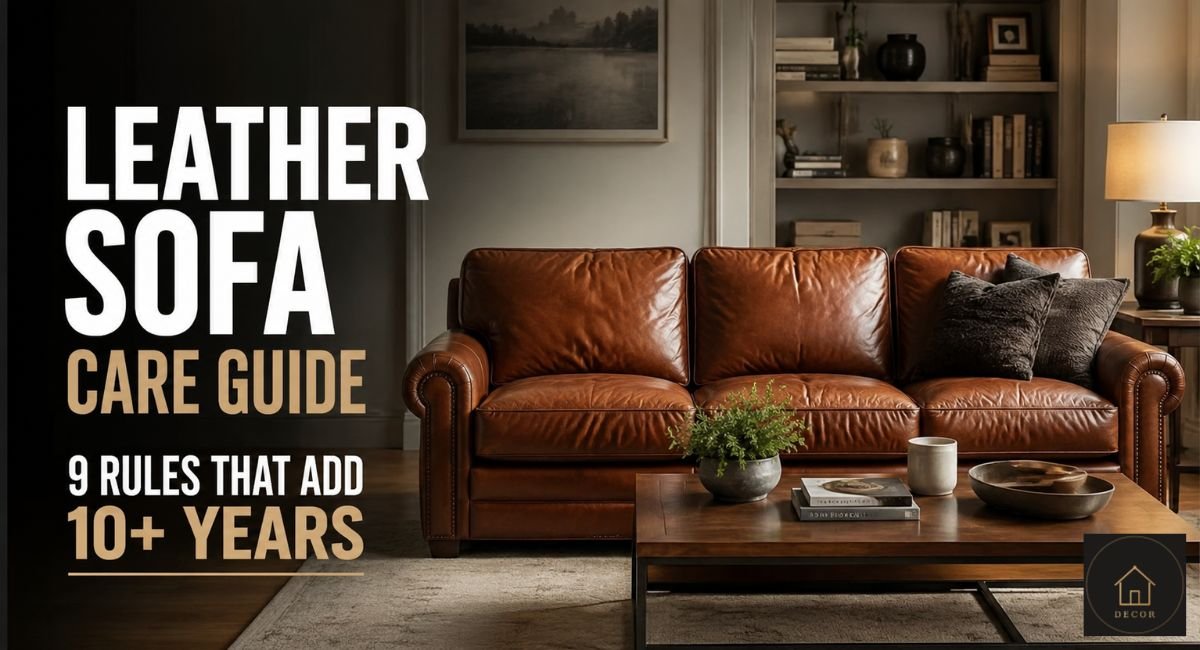
Leather Sofa Care Guide: A Schedule That Stops Cracking
Ask five leather-care sources how often to condition a sofa and you get three different answers. Leather Honey says at least every six months. Klaussner, a sofa maker, says every 6 to 12 months, or every 3 to 6 if the sofa sits in the sun. Furniture Fair says once a year and warns that too much conditioner leaves leather gummy.
The schedule in this leather sofa care guide settles the argument. It also marks where the experts split, and which products to keep away from the armrests.

What Does Leather Sofa Care Involve?
Leather sofa care means dusting and vacuuming weekly, deep-cleaning with a pH-balanced leather cleaner every month or quarter, and conditioning every 6 to 12 months. Sun, heat vents and dry air do the most damage, so keep the sofa away from all three. Skip a step and the leather dries out and cracks.
The routine at a glance:
- Dust weekly, deep-clean monthly (daily-use sofas) or quarterly (light use)
- Condition every 6 to 12 months, or every 3 to 6 in sun, dry air or heavy use
- Blot spills, never rub them
- Keep the sofa two to three feet from radiators and vents
What Kind of Leather Is Your Sofa?
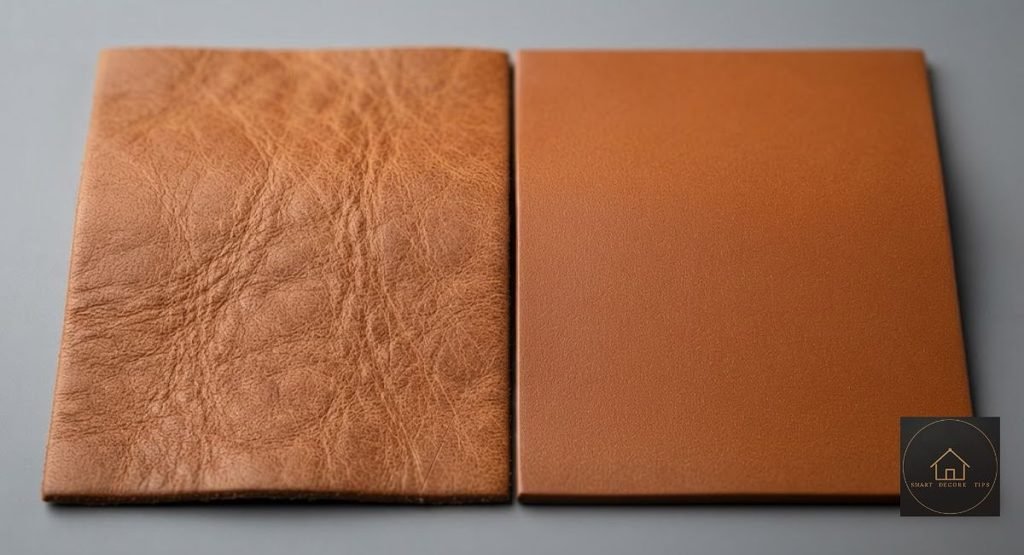
Check the tag under a seat cushion: the finish (aniline, semi-aniline or pigmented) sets how gentle you need to be. No tag? Call the maker before you use any product, which is what Leather Honey suggests.
Castlery’s care guide sorts upholstery leather into six groups. These are the ones you’ll meet on a sofa:
| Type | What it is | How to treat it |
| Aniline | Little or no protective coat, so it shows every spill | Gentle cleaning, frequent conditioning, spot-test everything |
| Semi-aniline | A thin protective topcoat, between aniline and pigmented | Follow the schedule below |
| Pigmented | A heavier protective coat, the most forgiving for families | Follow the schedule below |
| Bonded or faux | Leather scraps or plastic coating on a backing | Damp cloth and mild soap only; conditioner won’t save it |
| Nubuck | Buffed, suede-like surface | Nubuck-only products, no liquids |
White leather is its own case. Klaussner says it yellows through oxidation, so clean and condition it every six months.
How Often Should You Clean a Leather Couch?
Dust or vacuum weekly, deep-clean monthly if the sofa gets daily use (quarterly if it rarely gets sat on), and condition every 6 to 12 months. Leather Honey recommends a light weekly clean and a deeper monthly one, while Klaussner puts the deep clean at every 3 to 6 months.
That’s the routine this leather sofa care guide uses:
| Task | How often | What to use |
| Dry wipe and vacuum seams | Weekly | Dry microfiber cloth, soft brush attachment |
| Deep clean | Monthly (daily use) or every 3 months (light use) | pH-balanced cleaner such as Lexol or Leather Honey |
| Condition | Every 6 to 12 months; every 3 to 6 in sun, dry air or heavy use | Leather conditioner |
| Visual check | Monthly | Your eyes, near seams and armrests |
I’ve kept a semi-aniline sectional in a sunny apartment for four years, conditioning it every 3 to 6 months because of the sun. The only wear is a slight sheen on one armrest. No cracking, no fading.
What Is the Best Thing to Clean a Leather Sofa With?
A pH-balanced leather cleaner on a microfiber cloth is the best choice for a deep clean. For light cleaning, a barely damp cloth is enough. A few drops of mild soap in water work as a last resort for stains.
Lexol says its cleaner matches the natural pH of leather and has no silicones, alcohols or waxes. You can read that on the Lexol cleaner page. Lexol’s own page suggests a cleaning every six months, so treat the monthly deep clean as a rule for daily-use sofas.
How to Clean a Leather Sofa in 6 Steps
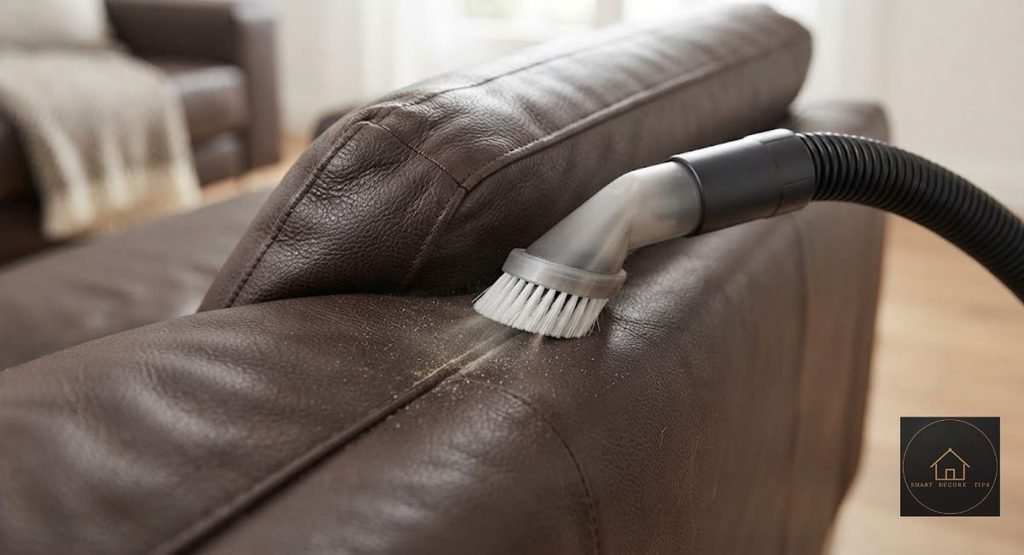
- Vacuum first. Pull off the cushions and run the soft brush attachment along seams and underneath. Grit scratches leather, which is why Leather Honey puts this step before anything else.
- Dry-wipe the whole surface. A clean microfiber cloth lifts dust and skin oil.
- Spot-test your cleaner. Try it on the underside of a cushion, let it dry, and look for darkening or color change.
- Put the cleaner on the cloth, not the sofa. Leather Honey says this avoids wipe marks. Work in small circles.
- Wipe again with a barely damp cloth, then buff dry right away with a separate dry cloth.
- Let it air-dry. No hair dryer. If you plan to condition, Leather Honey suggests waiting up to 24 hours.
The armrest is where mine shows wear first, so I look at it before I pick up the cloth.
How Often Should You Condition a Leather Sofa?
Condition a typical living room sofa every 6 to 12 months, and every 3 to 6 months if it sits in sun, near heat, or gets daily use. If the leather still feels soft and looks healthy, you can wait. Klaussner says as much.
Here is what each source says:
| Source | Conditioning interval |
| Leather Honey (leather-care brand) | At least every 6 months |
| Klaussner (sofa maker) | 6 to 12 months; 3 to 6 in sun or heavy use |
| Bellona USA (furniture retailer) | Every 6 to 12 months |
| Angi (home-services site) | 6 to 12 months; more often in dry climates |
| Furniture Fair (furniture retailer) | Once a year; too much turns leather gummy |
The pattern is clear. Six to twelve months is the baseline, and sun or dry air pulls you toward the short end.
How to apply it:
- Clean first and let the sofa dry. Klaussner says overnight.
- Test a dime-sized drop on a hidden spot and wait an hour or two.
- Use a white, lint-free cloth and a small amount, in circular strokes.
- Leave it at least two hours, ideally overnight, then buff off any residue.
Leather can darken a little after conditioning. Leather Honey says that fades, and Lexol warns its conditioner may slightly darken light leathers, so the hidden-spot test matters. Less is better. If product sits on the surface instead of soaking in, Stamps Home Furniture says you’ve used too much.
What Can Ruin a Leather Couch?
Sun, heat, dry air, harsh cleaners and skipped conditioning ruin a leather couch, usually by drying the hide until it cracks. Bleach and baby wipes strip the finish, and belt buckles, zippers and claws can leave permanent marks on aniline leather.
Cleaning products cause the most arguments, so here is where the experts split.
Can I use Dawn dish soap on my leather couch?
Not as a first choice. A pH-balanced leather cleaner is safer than Dawn or any dish soap. Leather Honey says Dawn strips natural oils and leads to cracking. Tom’s Guide and Klaussner both allow a few drops of mild soap in water for light cleaning, so treat soap as a last resort and wipe it off with a damp cloth.
Is Murphy’s oil soap good for leather furniture?
It is a gamble, so a pH-balanced leather cleaner is the safer choice. Colgate-Palmolive’s consumer team said in a Target Q&A that it had not tested its Murphy Oil Soap wood cleaner on leather and would not recommend it. A different Murphy product, the Multi-Use Orange cleaner, lists leather among its non-wood surfaces on the label. Hunker’s guide uses two to three drops in two cups of water. If you try it anyway, test a hidden spot first.
Baby wipes and disinfecting wipes
Fibrenew and Leather Honey both warn that baby wipes can damage a leather finish, so skip them.
If you want to sanitize, Clorox’s own leather guide covers its Disinfecting Mist for finished leather, cleaned first. It says never use it on suede or nubuck, and never use bleach on any leather.
Vinegar and baking soda
Leather Honey says vinegar and baking soda do more harm than good as cleaners. Klaussner suggests a half-and-half vinegar solution for red wine, so the advice conflicts. I’d skip vinegar. The one exception is grease, where several guides sprinkle baking soda or cornstarch on as a dry powder and brush it off.
How to Remove Common Stains From Leather
Blot, don’t rub. Rubbing pushes liquid deeper and spreads ink. After any stain treatment, dry the spot and condition it once it’s fully dry.
- Water, coffee, juice: Blot with a dry cloth, then a barely damp one, then dry.
- Grease or oil: Cover with baking soda, cornstarch or talcum powder. Castlery gives a fresh spot 20 minutes, and Klaussner says overnight for stubborn ones. Brush it off.
- Ink: Dab with a cotton swab dipped in rubbing alcohol. Switch to a fresh swab as the ink lifts, and test a hidden spot first.
- Dye transfer from jeans: Klaussner says rubbing alcohol on a clean cloth sometimes lifts it, but deep-set dye may need a professional.
- Red wine: Blot right away, then wipe with a mild soap solution.
- Mold: Castlery says to wear a mask and gloves, vacuum with a brush, wipe with mild soap and water, and dry. Call a pro if it has set in.
- Pet accidents: Blot up as much as you can, clean with a pH-balanced leather cleaner, and condition once dry.
Why Is My Leather Sofa Cracking or Fading?
Cracking comes from lost moisture. The usual causes are sun, heat, dry air and skipped conditioning.
- Direct sun. UV strips the natural oils and fades the color. Klaussner suggests curtains, blinds or UV film. Once pigment has faded, it says only a professional restorer can re-dye it.
- Heat sources. HGTV advises keeping leather away from air conditioners and radiators. Miller Waldrop, a West Texas furniture retailer, puts the gap at two to three feet.
- Dry air. Several sources give a target of roughly 40 to 60 percent humidity. Trevony says leather gets dry at about 35 percent or below, and winter heating drops humidity fast. A humidifier near the sofa, not pointed at it, helps.
- Too much humidity. Above 60 percent, Selvane says fibers swell and mildew becomes a risk.
- Skipped conditioning. A sofa that’s cleaned but never conditioned still cracks, only slower.
Leather Sofa Care With Kids and Pets
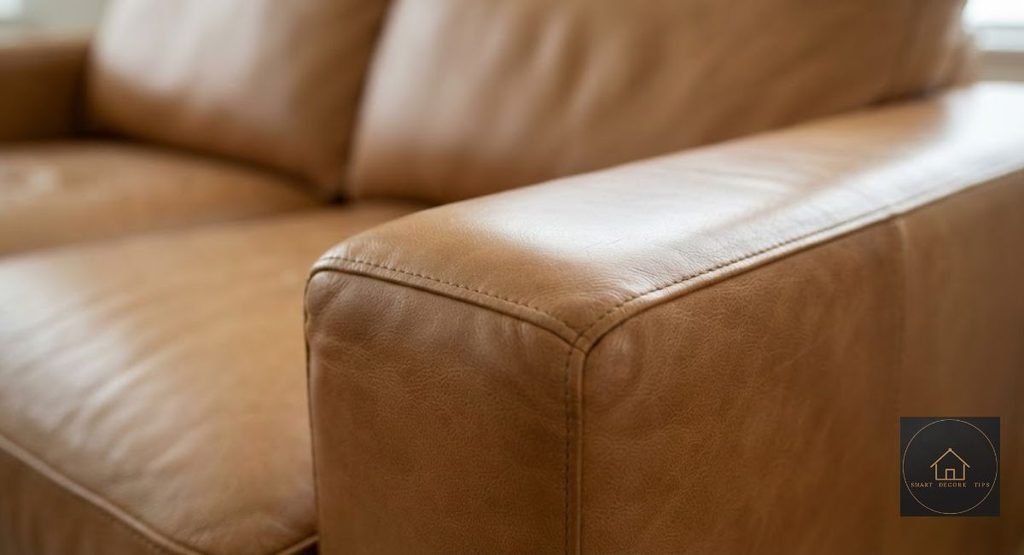
Pigmented leather is the forgiving choice. Castlery calls its protective coat the reason it copes with chaos, while aniline shows every spill. Sharp objects like belt buckles, zippers and claws can leave permanent marks on unprotected aniline.
If you have kids and pets, pick pigmented or semi-aniline. Still weighing real leather against a cheaper option? Our genuine vs PU leather furniture comparison covers the five-year picture, and the leather caterpillar sofa guide covers a leather style that’s harder to clean around.
The trade-off: leather is a poor match if you know you won’t clean and condition it. Furniture Fair says to think about that before you buy. And if your sofa is bonded or faux, conditioner won’t fix peeling, because the coating is separating from its backing.
Leather Sofa Care in a Small Apartment
Small rooms push sofas against radiators and leave one big window pouring sun on them. Airflow is usually poor too. My own sectional sits in a sunny apartment, which is why I stay on the shorter conditioning interval.
Two fixes cover most of it. Run a small humidifier near the sofa in winter, and hang a sheer curtain in summer. Move the sofa off a vent if the layout lets you.
FAQs
Dust or vacuum a leather sofa weekly and deep-clean it monthly if it gets daily use, or every three months if it doesn’t. Leather Honey suggests the monthly schedule, while Klaussner suggests every three to six months for a deep clean.
Condition a leather sofa every 6 to 12 months, and every 3 to 6 months if it sits in sun or gets heavy daily use. Klaussner also says a sofa that still feels soft and looks healthy can wait.
A pH-balanced leather cleaner is the safer choice than Dawn or other dish soap. Leather Honey says Dawn strips leather’s natural oils and leads to cracking, though Tom’s Guide and Klaussner accept a few drops of mild soap in water for light cleaning.
Murphy’s oil soap is a gamble on leather, and a pH-balanced leather cleaner is safer. Colgate-Palmolive’s consumer team said it had not tested its wood cleaner on leather and would not recommend it, though another Murphy label lists leather as a non-wood surface.
Skip baby wipes on a leather sofa, because leather-care sellers Fibrenew and Leather Honey say their ingredients can damage the finish. For sanitizing, Clorox’s leather guide covers its Disinfecting Mist on finished leather and warns against bleach and against use on suede or nubuck.
Dab the ink with a cotton swab dipped in rubbing alcohol, switching to a fresh swab as the ink lifts. Test a hidden spot first and never rub, since rubbing can push ink deeper.
Condition the leather on schedule, keep the sofa two to three feet from heat sources and out of direct sun, and hold indoor humidity around 40 to 60 percent.
Conclusion
Wipe weekly, clean monthly or quarterly, condition once or twice a year, and keep the sofa out of direct sun and away from vents. That’s the whole leather sofa care guide. If something on your sofa is overdue, it’s probably the conditioner, so start there.

Hi, I’m Shahzad Ahmad welcome to Smart Decore Tips!
I write and research every guide on this site myself, focused on real, practical home decor advice for renters, first-time homeowners, and small-space living. Before publishing anything, I check actual product listings, current prices, and real customer reviews not just what other sites already say.
My goal is simple: help you make smarter, more affordable decor decisions without the guesswork or sales pitch.





One Comment