
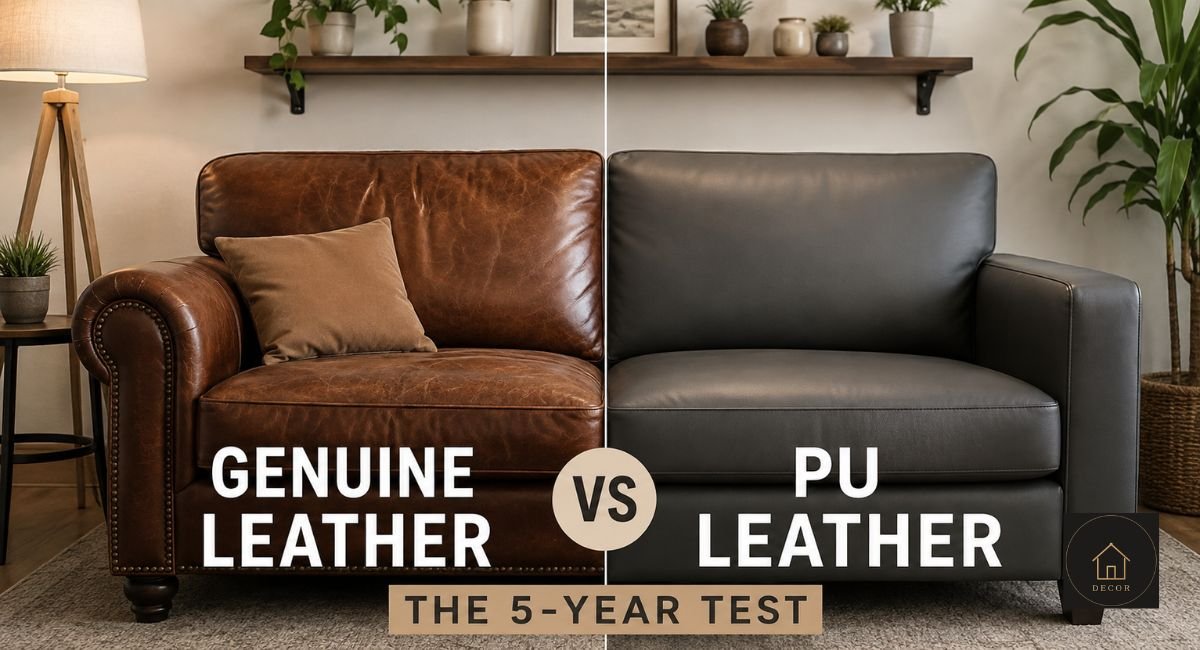
Genuine Leather vs PU Leather Furniture: What Lasts
Castlery sells its Madison top-grain leather sofa with a 10-year warranty on the frame and a one-year warranty on the leather. That gap tells you how the trade sees the surface you actually sit on: it is the part that wears out first, even on a $1,899 sofa.
Genuine leather vs PU leather furniture comes down to three things: how fast each material wears, what each costs per year, and whether the word “leather” on the tag means what you assume. This guide works through all three with live listings and named retailer guides. If your shortlist is a low, segmented shape, our single caterpillar sofa price guide covers that style. This piece stays on the material.
What is the difference between genuine leather and PU leather?
Genuine leather is real animal hide, graded from full-grain down to split. PU leather is polyurethane plastic coated over a fabric or split-leather base and embossed to look like grain. Retail guides put PU’s life at 2 to 5 years and well-kept leather at a decade or more.
“PU leather” covers two products. Full-synthetic PU is plastic over a fabric base. Semi-synthetic PU, often called bicast, is a natural leather base with a dried PU coating on top. HowStuffWorks describes both types, and BTOD notes that bicast contains cowhide, so PU and vegan do not always mean the same thing.
Is “genuine leather” the best kind of leather?
No. “Genuine leather” on a furniture tag means real hide, but it usually sits below full-grain and top-grain. The Competition Bureau of Canada calls full-grain and top-grain the strongest and most durable types, and warns that not everything sold as “leather” is entirely leather.
Here is the ladder most retail guides use, strongest to weakest:
- Full-grain: the top layer with its natural surface intact. Thickest, and it darkens into a patina.
- Top-grain: the same top layer, sanded for an even look. Slightly less rugged, still a strong sofa material.
- “Genuine” or split leather: the lower layers of the hide, usually coated and embossed with a printed grain.
- Bonded leather: shredded scraps held together with adhesive.
- PU, bicast or vinyl: a plastic surface.
Not every source draws these lines in the same place. Some manufacturers file full-grain, top-grain and bonded all under “genuine.” That disagreement is the point. The label alone tells you little, so ask the seller for the grade.
One more trap: many “leather sofas” are only partly leather. Wayfair listings and Woodstock Outlet both describe a “leather match” build, where real leather covers the seat, back and arms you touch while matching PU covers the sides and rear. That is a fair way to cut cost, as long as the tag says so.
What is the lifespan of PU leather?
Most retail guides say PU leather furniture starts to crack or peel within 2 to 5 years. BTOD gives 2 to 5, Seelteen gives 3 to 5, and Stamps Home Furniture says faux leather needs replacing within 2 to 5. One outlier, Cabinfield, puts faux leather at 5 to 10 years with good care.
The cause is structural. PU is a coating bonded to a base, so it wears at the surface and cannot be conditioned back to health. BTOD adds that PU develops no patina and can puncture or tear easily. Stamps names UV as PU’s main enemy and says a sun-exposed sofa fails faster than average.
We tested a $450 PU loveseat next to a $1,800 top-grain sofa in the same sun-facing living room. By month 18, the PU had faint surface creases at the seat fold. The top-grain had darkened slightly, which looked better, not worse. Eighteen months is not five years, so treat that as an early signal, not a verdict.
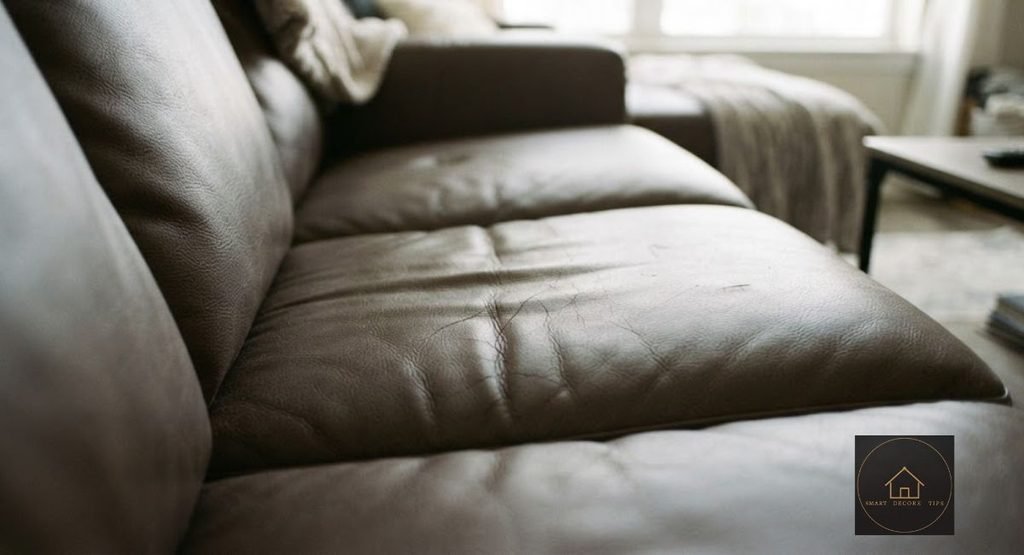
Genuine leather vs PU leather furniture: cost per year
Sticker price is the wrong number. Cost per year of use is the better one. This table divides three live listings by the lifespan ranges above: 10 to 20 years for leather (Seelteen says a decade or more, Cabinfield says 20 or more) and 2 to 5 years for PU. These are category estimates from retailer guides, not warranties on these sofas.
| Sofa (as listed) | Material | Price | Cost per year |
| Castlery Madison Leather Sofa, 83.9″ wide | Top-grain American leather | $1,899 | $95 to $190 |
| Walmart Mainstays Williamson, 75.5″ wide | Faux leather | $268 | $54 to $134 |
| Walmart-listed 87″ 3-seater, black (sponsored listing) | PU leather | $279.99 | $56 to $140 |
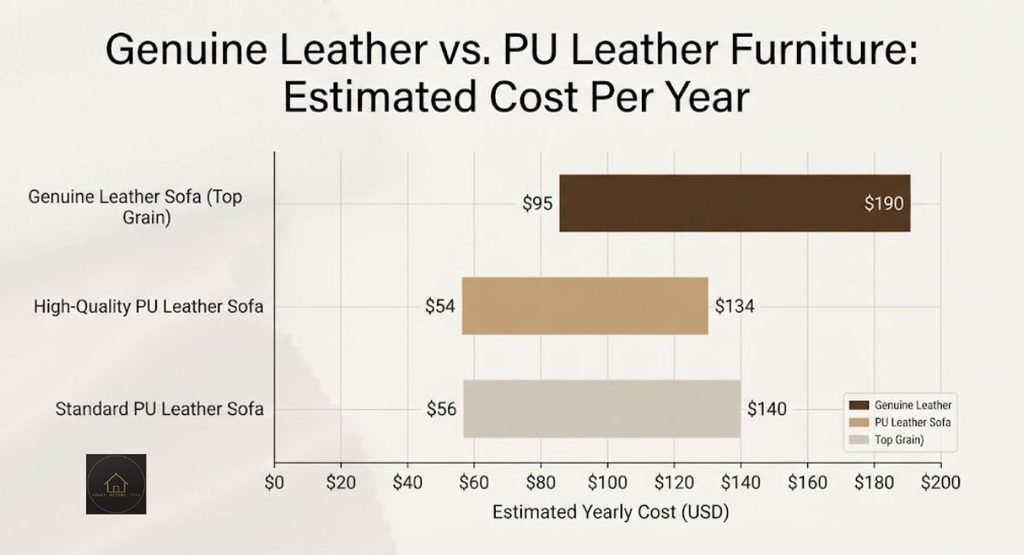
Three things stand out:
- The $268 sofa costs less per year than the leather sofa in most pairings. It loses only if it dies by year 2 and the leather sofa reaches about 15 years or more.
- To match a $268 sofa, the $1,899 leather sofa has to last about 7.1 times as long. That means roughly 14 years if the PU dies at year 2, 21 years at year 3 and 35 years at year 5.
- Mid-priced PU is where the math turns. Stamps works an example of a $500 PU sofa lasting 3 years, about $167 a year, against a $1,500 leather sofa lasting 15 years, about $100 a year.
The per-year math leaves out repair. A worn leather sofa can be conditioned and re-dyed, while peeling PU cannot be restored. It also leaves out delivery, haul-away and a second round of shopping. Even the leather sofa is not risk-free: Castlery covers its leather for one year, so read the warranty on any sofa before you count on 20.
Should I buy real leather or faux leather?
For genuine leather vs PU leather furniture, the deciding question is how long you will keep the sofa. Buy real top-grain or full-grain leather if this is your main seat and you want it in ten years. Buy faux leather if the sofa is a stopgap, such as a rental, a first apartment or a room you will redo within five years.
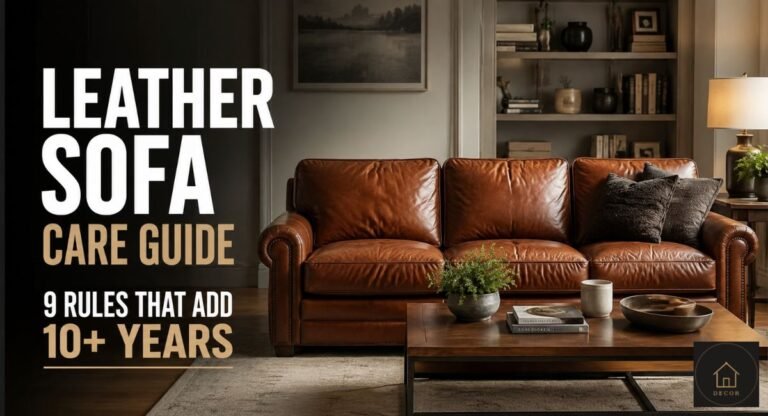
- Real leather fits if: you sit on the sofa daily, you will condition it, and you care about repair and patina. Our leather sofa care guide has the routine.
- Faux leather fits if: the budget is tight, spills are constant, or you want the look without the price. A $268 sofa replaced twice still costs less than a $1,899 one.
- Neither fits if: you want a soft, warm seat. Leather reads firmer and cooler, and Dweva’s review of the Castlery Madison notes that leather can trap warmth during long sits. A performance fabric sofa may suit you better.
Leather is the wrong buy if you move often, because a heavy leather sofa is costly to relocate and you will not get the years out of it. PU is the wrong buy if you want the same sofa in a decade.
Should I avoid PU leather?
Avoid PU leather for a main sofa you want to keep beyond five years, for rooms with strong sun, and when it is priced close to real leather. Stamps says the value case disappears when PU is sold near genuine-leather prices.
PU is a fine choice elsewhere. Seelteen says an accent chair sees a fraction of a sofa’s wear, and a wipeable PU dining chair is a practical pick. Also skip PU if chemical smells bother you. BTOD lists a plastic or chemical odor among its cons.
What are the downsides of a faux leather sofa?
A faux leather sofa cracks or peels sooner than real leather, cannot be repaired once the coating lifts, and does not breathe. Here are the downsides retailers name most often:
- Cracking and peeling. The coating separates from its base, usually in 2 to 5 years.
- No repair path. Neveitalia Furniture says peeling PU cannot be repaired and needs panel or full replacement.
- No patina. BTOD says PU never develops the luster real leather gains with age.
- Puncture and tear risk. A claw or a key can break the coating.
- Low breathability. BTOD says PU does not breathe like genuine leather, so it feels warmer and stickier in summer.
- Plastic waste. BTOD notes that plastics do not decompose, so a shorter life means more discarded sofas.
How can you tell genuine leather from PU leather in a showroom?
Check the tag for a grade, smell the surface, study the grain, and press it. No single test settles it, so use several.
- Read the tag for a grade. “Genuine leather” is not a grade. PU can also be labeled bicast, bonded, reconstituted or corrected grain, so ask the seller to name the exact material and which surfaces are leather.
- Smell it. Real leather smells earthy. PU often smells of plastic or chemicals.
- Look at the grain. Real hide shows irregular pores and small flaws. PU shows a uniform, repeating pattern.
- Press it. Under a fingertip, real leather wrinkles unevenly. PU feels stiffer and more uniform.
- Try a water drop. BTOD says real leather absorbs water and PU does not. Coated leather also resists water, so treat this as a hint, not proof.
- Question the price. Stamps says a “leather” sofa at $500 is almost certainly not genuine leather.
- Ask what the warranty covers. The Competition Bureau says a longer warranty can signal better quality, and advises asking whether cracking and peeling are covered.
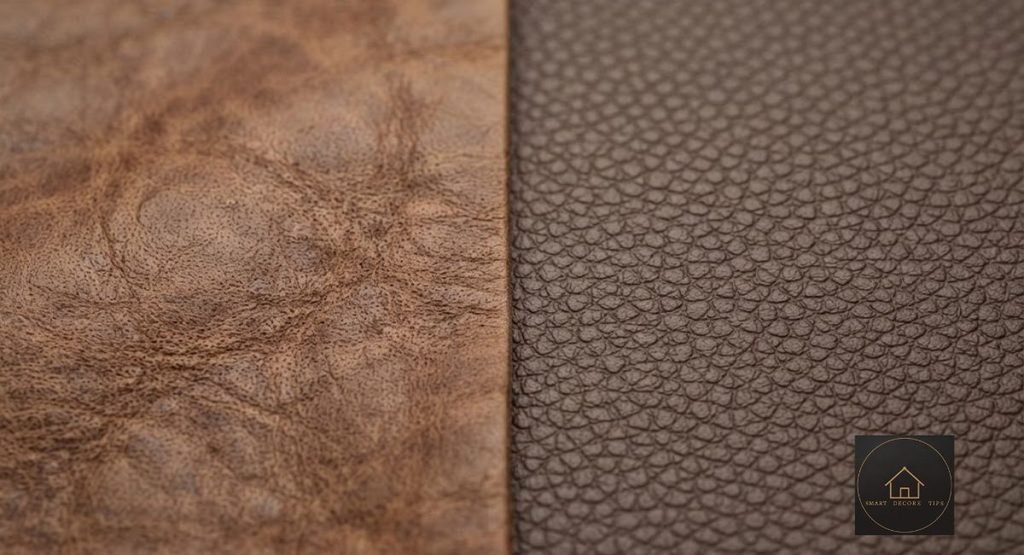
Genuine leather vs PU leather on a caterpillar sofa
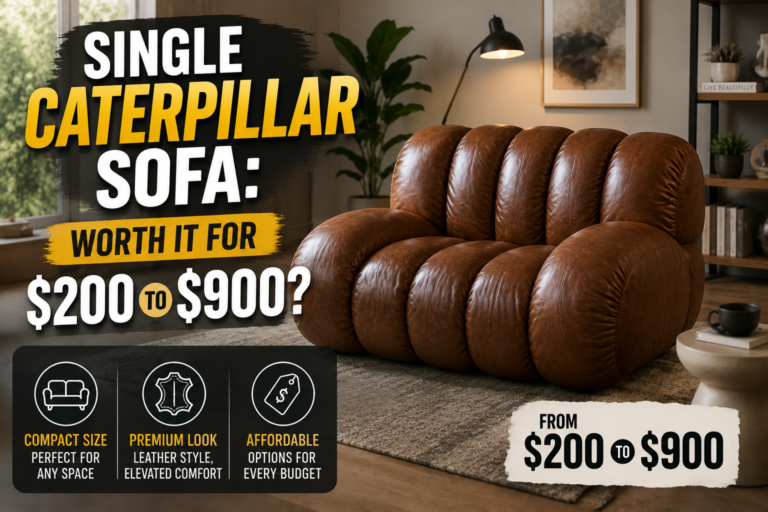
A caterpillar sofa is a low, segmented shape built from foam sections wrapped in an outer cover. The cover bends every time someone sits, so the material choice matters more here. Reading PU’s known weakness against that shape suggests creasing will show up at the pleats first. That is reasoning from how the material behaves, not a test result.
For the material trade-offs on this specific shape, our faux leather vs fabric caterpillar sofa guide goes deeper.
The short version
In the genuine leather vs PU leather furniture debate, leather wins on repair and lifespan. Cheap PU wins on cost per year when the sofa is a stopgap. The words “genuine leather” mean little until someone names the grade. Ask for the grade, ask what the warranty covers, and match the material to how long you plan to keep the sofa.
FAQs
Buy real top-grain or full-grain leather for a main sofa you plan to keep 10 years or more, and buy faux leather when the sofa is a short-term piece such as a rental or a room you will redo within five years.
Avoid PU leather for a long-term sofa, for sunny rooms, and when it is priced close to real leather, but it works well for accent chairs and dining chairs that see light wear.
PU leather furniture typically starts to crack or peel within 2 to 5 years, and BTOD, Seelteen and Stamps Home Furniture all give ranges in that window.
A faux leather sofa cracks or peels sooner than real leather, cannot be repaired once the coating lifts, develops no patina, and does not breathe as well.
No. Full-synthetic PU leather is polyurethane coated over fabric with no animal hide, though bicast leather is a hybrid that uses a cowhide base under a polyurethane coating.
Full-synthetic PU leather is vegan because it contains no animal products, but bicast leather is not, because it uses cowhide as its base layer.
Not reliably, because polyurethane that has separated from its base cannot be restored, so a sofa with widespread peeling usually needs replacement.

Hi, I’m Shahzad Ahmad welcome to Smart Decore Tips!
I write and research every guide on this site myself, focused on real, practical home decor advice for renters, first-time homeowners, and small-space living. Before publishing anything, I check actual product listings, current prices, and real customer reviews not just what other sites already say.
My goal is simple: help you make smarter, more affordable decor decisions without the guesswork or sales pitch.


One Comment