
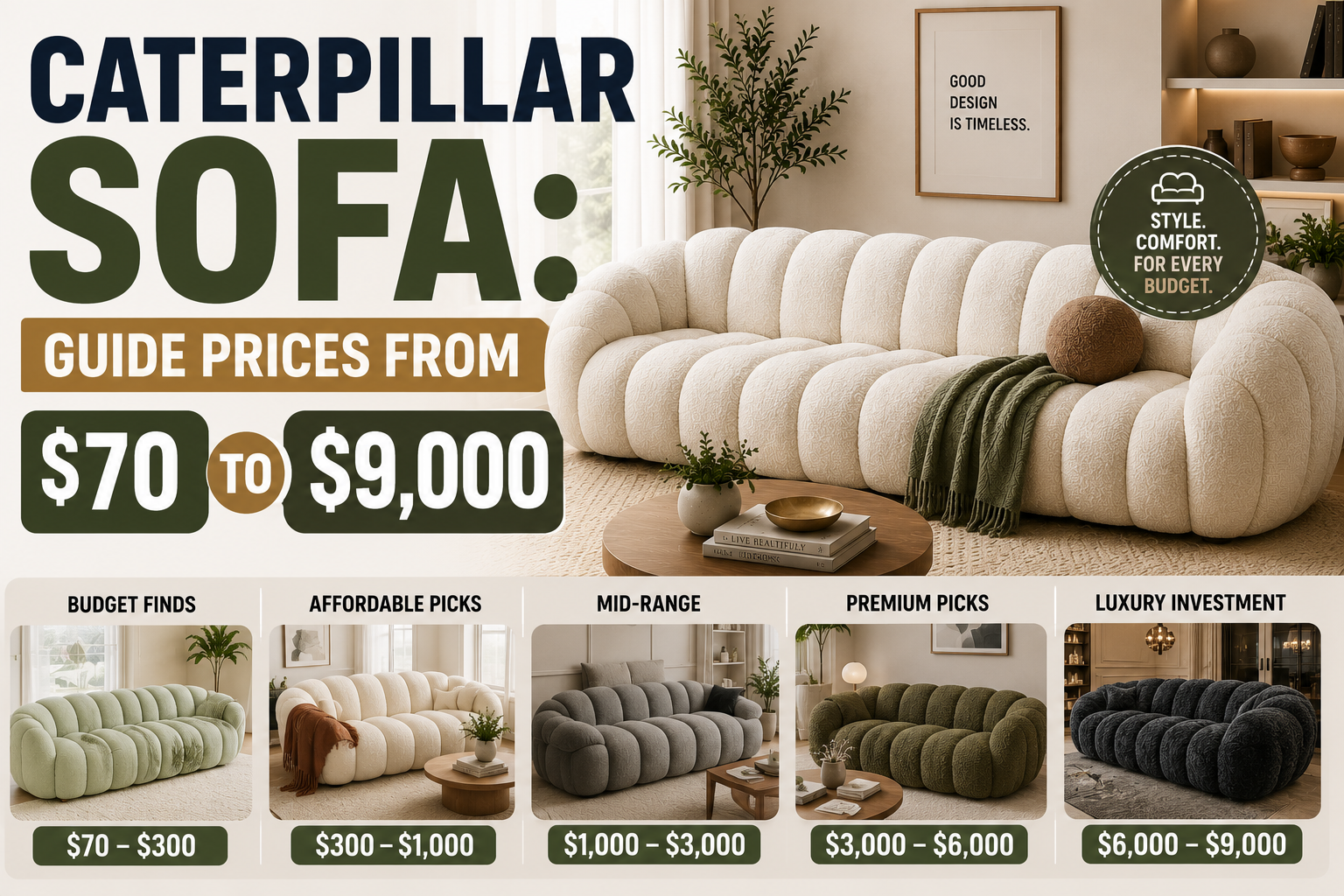
Caterpillar Sofa: Guide Prices From $70 to $9,000+(2026)
The caterpillar sofa has taken over living rooms, dorm rooms, and reading corners across the country, and I get asked about it more than almost any other piece in the smart decor world right now. So let’s actually break down what it is, what it costs, who it’s for, and where the good ones are hiding.
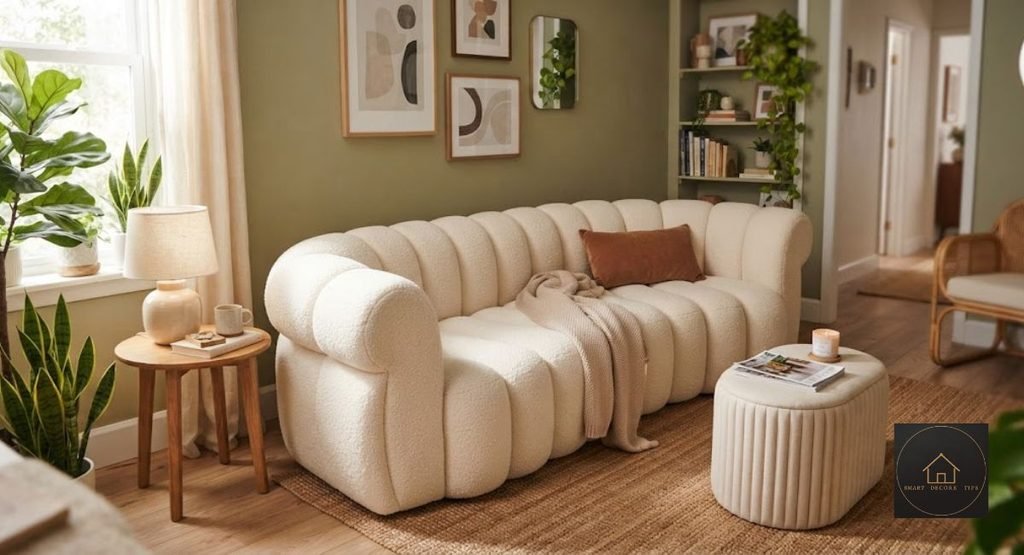
A caterpillar sofa is a low-profile, foam-filled seat made of soft, rolled segments that resemble a caterpillar’s body. It has no visible legs or frame, sits close to the floor, and is built for sinking in rather than sitting upright. You may also see it called a caterpillar couch or worm sofa.
Quick Takeaways
- It runs $70–$300 for basic foam versions, $400–$1,750 for quality mid-range pieces, and $3,000–$9,360 for designer or vintage-inspired builds.
- The segmented silhouette traces back to the 1972 De Sede DS-600 “Snake” sofa — not the Togo, which is a different (and often confused) 1970s design.
- It’s a great fit for small spaces and renters, but a tough one for guests, older family members, or anyone with knee or back issues.
- Foam density (not the shape) is what separates a sofa that lasts from one that sags in a year. Look for listings that actually state a density or ILD number.
What Is a Caterpillar Sofa, Exactly?
A caterpillar sofa is a frameless, low-to-the-ground seat made from puffy foam rolls stitched or shaped into segments, giving it that unmistakable “row of pillows” look. Most have no wooden or metal frame at all — just high-density foam wrapped in a soft cover.
Here’s a detail that gets mixed up constantly, including by other sites covering this trend. The segmented, rolled shape isn’t a fresh invention — and it isn’t the Togo sofa either, even though the two get lumped together online. The rolled-segment look descends from the De Sede DS-600, nicknamed the “Snake” or “Non-Stop” sofa — a Swiss modular design created in 1972 by Ueli Berger, working with Eleonore Peduzzi-Riva, Heinz Ulrich, and Klaus Vogt for De Sede. It was leather, built on a beech-wood-and-foam module system, and sold for a serious sum even then.
The Togo — the quilted, angular-looking cousin you’ll see mentioned in the same breath — is a separate design by Michel Ducaroy for Ligne Roset, launched in 1973. It’s a common mix-up (one competing product page gets it wrong too, crediting the DS-600’s look to “Ducaroy, 1973”), but the two sofas have different silhouettes, different designers, and different companies behind them.
Today’s caterpillar sofa borrows the DS-600’s rolled, segmented silhouette but swaps the leather and internal hardware for solid foam. That’s exactly why you can now buy one for under $100 on Amazon.
How Much Does a Caterpillar Sofa Cost?
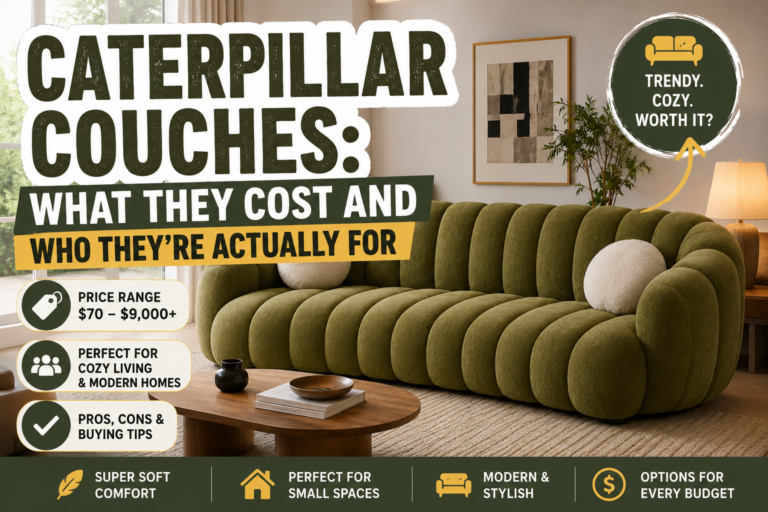
A caterpillar sofa typically costs between $70 and $9,360, depending on foam quality, fabric, and whether it’s mass-produced or designer-made. The shape alone doesn’t tell you the price — construction does.
| Tier | Price Range | What You’re Getting |
| Budget (Amazon, Etsy, Walmart) | $70–$300 | Compressed lower-density foam, teddy velvet or polyester cover, single-seat only |
| Mid-Range (Etsy makers, CurverK-style replicas) | $400–$1,750 | Higher-density foam, better stitching, some sectional/modular options |
| Designer (LA studios like Bend Goods) | $3,000–$9,360 | Reinforced construction, premium fabric or leather, made-to-order |
I’ve sat on both ends of this range while researching pieces for this site. The difference is obvious within about ten seconds — cheap foam flattens fast, while higher-density foam bounces right back. If a listing doesn’t mention foam density or an ILD (Indentation Load Deflection) number at all, that’s usually a sign it’s on the lower end. Foam sold as CERTIPUR-US certified meets an independent set of content, emissions, and durability standards, so it’s a reasonable quality signal to look for on any upholstered piece, caterpillar sofa included.
At the top of the range, Bend Goods’ Slim Caterpillar Sofa — a modular, rounded-square design made in Los Angeles — lists at $9,360 before discount. That’s a useful ceiling for what a fully designer-built version actually costs today. At the budget end, Amazon’s Hobestluk brand is one of the currently-listed names showing up under the sub-$300 filter, if you want a real starting point instead of an unnamed “generic foam sofa.”
Caterpillar Sofa vs. Togo, Bubble Sofa & Bean Bag: What’s the Difference?
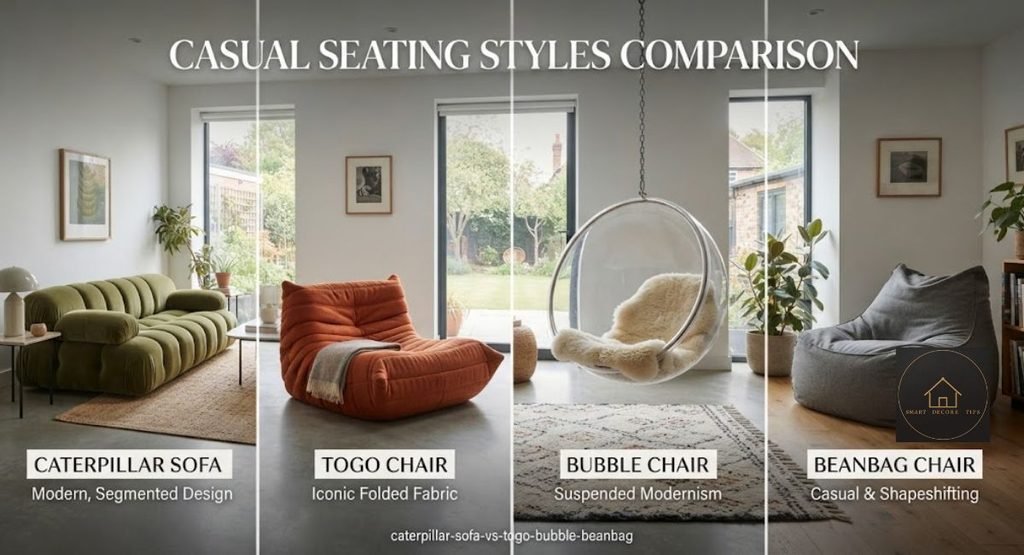
A caterpillar sofa is foam-filled and rolled into segments, a Togo sofa uses quilted foam over a hidden steel base, a bubble/cloud sofa has rounder overstuffed cushions, and a bean bag is filled with loose beads instead of solid foam.
They all chase the same “sink in and relax” feeling, but they behave very differently once you’re sitting on them.
| Style | Fill | Feel | Best For |
| Caterpillar sofa | Solid, rolled foam segments | Firm-but-plush, holds its shape | Small spaces, modular layouts |
| Togo sofa | Quilted foam over a steel base | Structured slouch | Living rooms wanting a design-world name |
| Bubble/cloud sofa | Overstuffed foam | Deep, marshmallow-soft | Maximum lounging, movie nights |
| Bean bag chair | Loose foam beads | Molds to your body, less support | Casual, kid-friendly seating |
Choose this one if you want something that photographs well, holds its shape over time, and can be rearranged. Choose a Togo if you want the original, design-world-recognized name and don’t mind the higher price tag that comes with it. If you’re leaning toward the premium fabric route, our Maggis Caterpillar Sofa review breaks down that specific line in more depth.
What Sizes and Layouts Do Caterpillar Sofas Come In?
They usually come as single-seat chairs (roughly 30–34 inches wide), loveseats (roughly 50–60 inches), or modular sectionals you can arrange in a line, curve, or L-shape. Because most are frameless, you’re not locked into one fixed shape the way you are with a traditional couch.
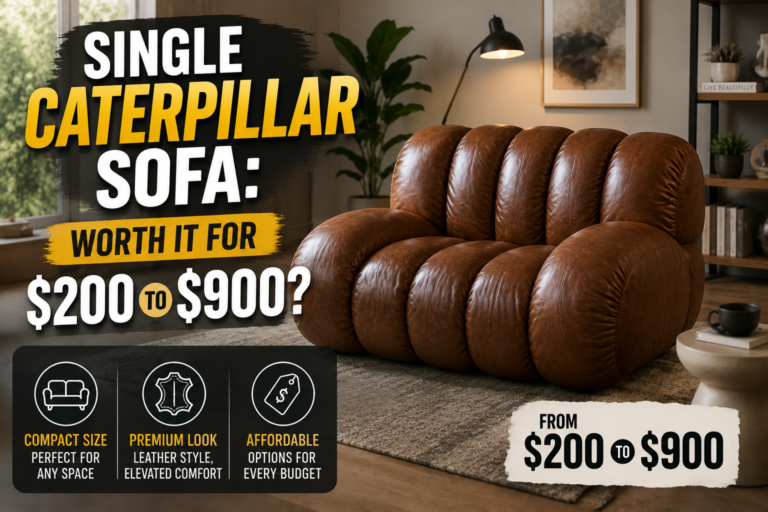
The single-seat size works well as an accent chair or reading-nook piece. Loveseats and 3-seaters get used as a main sofa in studio apartments. The modular versions are the most flexible — you can split a curved layout into two separate pieces for movie night, then push them back together when guests come over. If you’re deciding between a solo seat and a bigger piece, our single caterpillar sofa guide goes deeper on whether the one-seat version alone makes sense for your space.
Is a Caterpillar Sofa Good for Small Apartments and Renters?
Yes — a caterpillar sofa is one of the better options for renters because it’s lightweight, doesn’t need assembly, and often ships compressed for easy transport into walk-ups or small elevators.
No frame also means no scratched walls or door frames during a move. That said, it sits directly on the floor, so it can collect dust around the edges faster than a legged sofa. It also won’t hide much on hardwood if your rental has an uneven floor.
If you’re in a studio or one-bedroom and want a piece that works double duty as extra floor seating for guests, this is a genuinely smart pick.
Is a Caterpillar Sofa Worth It? Pros and Honest Trade-Offs
A caterpillar sofa is worth it if your priority is lounging comfort and flexible small-space seating — it’s a harder sell if you need a formal main sofa for guests or have mobility concerns.
Here’s the honest trade-off: what makes it so cozy — sitting low, sinking in deep — is the exact same thing that makes it awkward to get up from. That’s especially true for older family members.
I’ll be straight with you: I wouldn’t put one as the only seating in a home where you regularly host older relatives. But as a second piece — a reading corner, a media room chair, a dorm or studio main seat — it earns its spot.
How Do You Clean and Care for a Caterpillar Sofa?
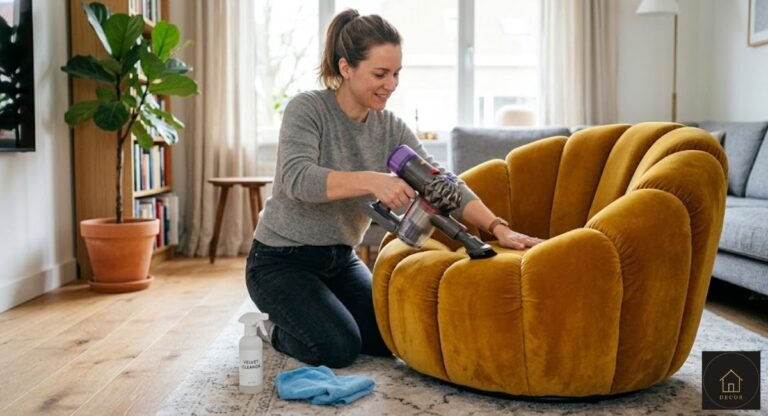
Vacuum a caterpillar sofa weekly with an upholstery attachment, spot-clean spills immediately with a mild fabric cleaner, and keep it out of direct sun to prevent fading.
Because most covers wrap tightly around solid foam rather than removable cushions, deep cleaning is trickier than with a standard couch. When I checked a handful of listings for this guide, only about half actually mentioned a real zipper on the cover. The rest were sewn shut, and that changes your cleaning options completely.
- Vacuum the seams and folds weekly — dust settles fast in the segmented grooves.
- Blot spills right away; don’t rub, especially on teddy velvet.
- Check if the cover is removable and machine-washable before buying — not all are.
- Rotate the piece occasionally if it sits in a sunny spot, so fading is even.
Where to Buy a Caterpillar Sofa in the US
You can shop budget options on Amazon, Walmart, and Etsy; mid-range and handmade pieces on Etsy and through replica makers like CurverK; and premium, made-to-order versions through LA design studios such as Bend Goods.
For in-person shopping, check HomeGoods and Target for occasional in-stock finds. Don’t rule out secondhand shops either — original 1970s De Sede segmented sofas do turn up at estate sales and vintage dealers, usually at prices well above the foam reproductions covered here.
FAQs
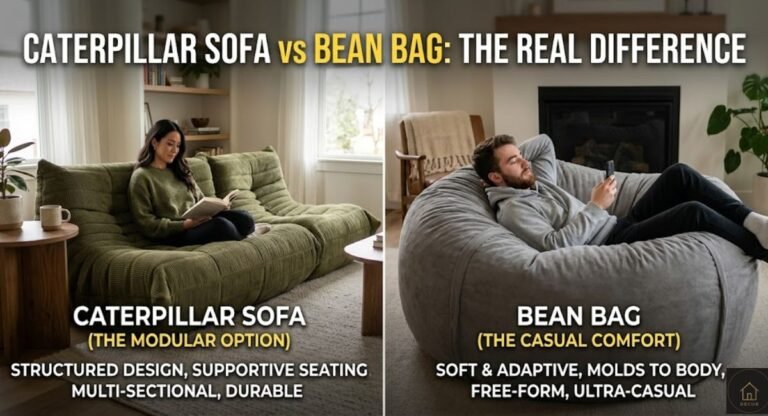
No. A caterpillar sofa packs in solid, shaped foam rolled into segments while a bean bag is filled with loose foam beads. The caterpillar sofa holds a fixed shape; a bean bag molds around you.
A well-made single-seat piece with high-density foam typically runs $200–$600. Mid-range sectionals and replica pieces land closer to $1,000–$1,750, and fully designer-built versions run $3,000–$9,360.
A caterpillar sofa uses rolled foam segments with no internal frame tracing back to the 1972 De Sede DS-600. A Togo sofa uses quilted foam over a hidden steel base; Michel Ducaroy designed it for Ligne Roset in 1973. They look related but come from two different design houses.
They can be, but the low-to-the-floor design means taller people sometimes find their knees higher than their hips. Look for deeper, longer models if you’re over 6 feet.
It’s not ideal for overnight guests. The curved segments and shorter length on 1- and 2-seat versions don’t lie flat the way a sofa bed does.
Which Ueli Berger designed with Eleonore Peduzzi-Riva, Heinz Ulrich, and Klaus Vogt. Eleonore Peduzzi-Riva, Heinz Ulrich, and Klaus Vogt. Today’s foam version is a budget-friendly reinterpretation of that original leather design.
Yes — it’s lightweight, needs no assembly, and often ships compressed, which makes it easier to get into small spaces and walk-up apartments.
Conclusion
A caterpillar sofa isn’t just a passing trend — it’s a genuinely useful piece if you know what you’re buying and why. The shape stays similar across every price point, but foam density and fabric quality are what actually decide whether yours lasts five years or five months.
Whether you grab a $90 version to test it out or invest in a designer sectional, now you know exactly what you’re paying for and where the real price ceiling sits.

Hi, I’m Shahzad Ahmad welcome to Smart Decore Tips!
I write and research every guide on this site myself, focused on real, practical home decor advice for renters, first-time homeowners, and small-space living. Before publishing anything, I check actual product listings, current prices, and real customer reviews not just what other sites already say.
My goal is simple: help you make smarter, more affordable decor decisions without the guesswork or sales pitch.

One Comment