
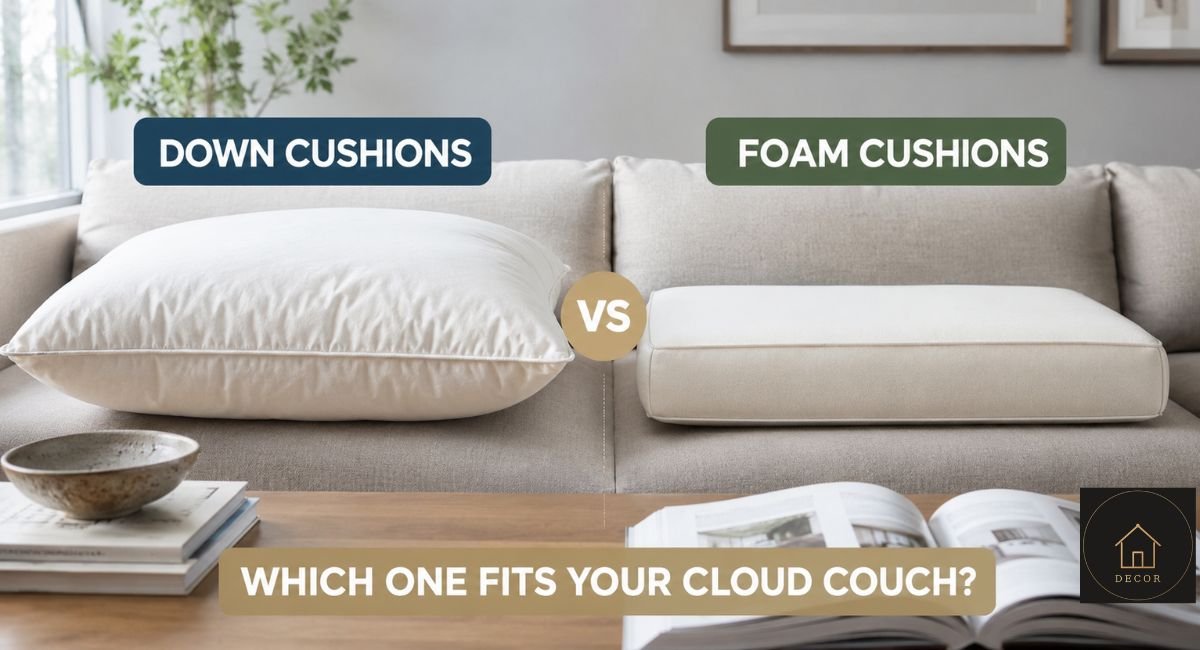
Down vs Foam Cushions: Which One Actually Fits Your Sofa?
Sitting on a couch for five minutes in a showroom tells you almost nothing. Down vs foam cushions is a decision that only shows its real face after months of actual use naps, guests, kids, a dog claiming the corner seat. If you’re picking cushion fill for a cloud couch or any deep-seated sofa, here’s what changes day to day, not just on delivery day.
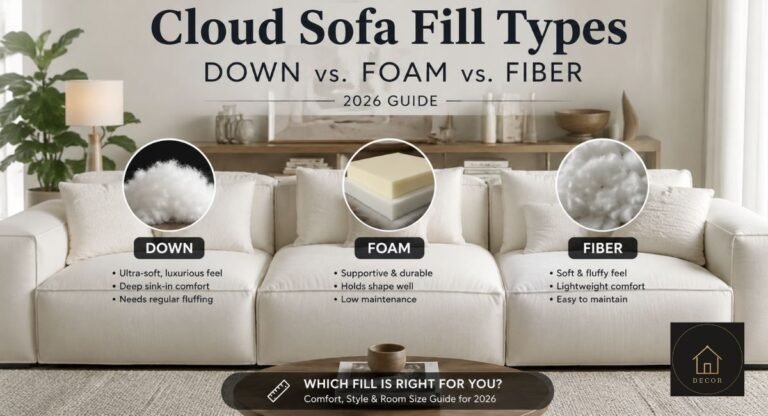
Down vs foam cushions describes the two main sofa cushion fills. Foam cushions use dense polyurethane that bounces back on its own. Down cushions use soft duck or goose underlayer that sinks around you but needs regular fluffing. Most cloud couch dupes actually blend both in a hybrid core.
Quick Takeaways
- Foam holds its shape with almost no maintenance; down needs fluffing every few days to two weeks.
- Down feels softer and more “sink-in”; foam feels firmer and more supported.
- Foam typically lasts 5–8 years before a core swap; down can last 8–10 years but only with regular upkeep.
- Foam is the lower-risk pick for allergy-prone households, pets, and kids.
- Most premium sofas including pieces from Maiden Home, Arhaus, and Sixpenny actually use a hybrid build: a foam or spring core wrapped in a softer down or down-alternative layer.
What’s the Real Difference Between Down vs Foam Cushions?
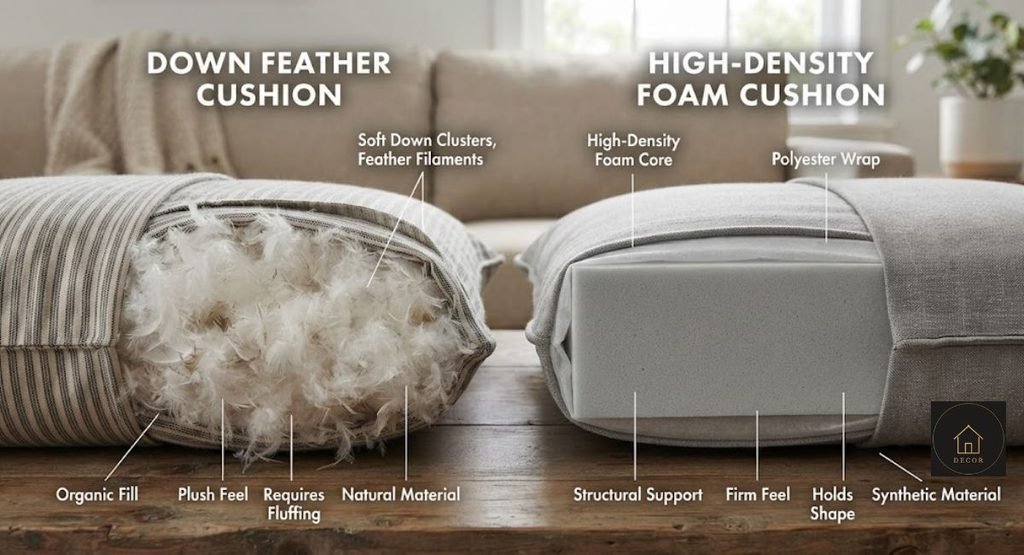
Down cushions use the soft underlayer found beneath duck or goose feathers. Foam cushions use polyurethane foam, rated by density, that compresses under you and pushes back on its own.
Room & Board’s comfort guidance places firmer cushions in the structured, supportive category, which tracks with how foam-based seating behaves in daily living rooms.
Down, by contrast, is prized for how it compresses and springs back slowly that’s what creates the “sink-in” feel people either love or find impractical.
Here’s what I noticed testing a few dupes side by side: pure foam cushions look “correct” the moment you stand up.
Down and down-blend cushions keep the shape of whoever last sat there for a few minutes, which is either charming or mildly annoying depending on your patience level.
Most premium sofas don’t use pure down at all. Maiden Home builds a high-density foam core wrapped in a down-feather-fiber blend on select seat cushions. Sixpenny keeps a foam core inside every seat cushion even on its feather-down option. That combination gives a plush top layer without the whole cushion collapsing by month three.
Comfort: Which Actually Feels Better?
Down wins on initial softness. Foam wins on consistency. If you curl up sideways with a blanket and a book, a down or down-wrapped cushion will feel more luxurious. If your couch is the default seat for movie nights, laptop work, and guests, foam holds its shape better through all of that traffic.
I sat on a down-wrapped floor model for ten minutes at a local showroom once, just to see how it changed. By minute eight, I’d sunk into the exact dent the last person left, and getting back upright took an actual push off the armrest.
Foam never does that it just holds you at the same height the whole time. Nobody regrets foam on a random Tuesday night. Plenty of people regret down after the third week of daily re-fluffing.
How Much Maintenance Does Each Fill Actually Need?
Foam needs almost none vacuum occasionally and spot-clean spills. Down needs active fluffing every few days to two weeks, more often on a high-traffic cloud couch.
This is the part most comparison articles gloss over, and it’s the one that actually changes people’s minds. Sixpenny’s own care notes make the point directly: the more loose fill a cushion holds, the more you sink in, and the more you have to fluff it to keep that loft. On a daily-use sectional, that can mean every few days, not the two-week baseline some retailers quote.
How to Fluff Down Cushions (5 Steps)
- Remove the cushion cover, or lift the whole cushion if it doesn’t unzip.
- Grip one edge and stand it upright on the floor.
- Strike the front and back firmly with an open hand, four to five times per side.
- Rotate the cushion 180 degrees before placing it back on the frame.
- Repeat for every seat cushion back cushions need this less often.
I measured a cloud couch seat cushion once, before and after a week of normal daily use: it had lost close to two inches of loft by day five.
A minute of fluffing brought most of that back. The whole process for a full sectional takes under five minutes and is the single biggest thing that keeps down cushions looking new.

Foam vs Down: Full Comparison at a Glance
| Factor | Down / Down-Blend | Foam |
| Initial feel | Soft, sink-in, moldable | Firm, structured, bounces back |
| Maintenance | Fluff every few days–2 weeks | Vacuum + spot-clean only |
| Typical lifespan | 8–10 years, with upkeep | 5–8 years, foam-core swap |
| Allergy risk | Higher, but processing matters | Lower, synthetic |
| Best for | Reading nooks, low-traffic lounges | Families, pets, daily main seating |
| Starting price | Higher | Lower |
Which Lasts Longer: Down or Foam?
Well-built foam or hybrid cushions usually hold their shape longer in daily use, but down isn’t as fragile as people assume when it’s fluffed regularly.
Cushion fill naturally settles over time. Down, cared for on a consistent schedule, can hold up for 8 to 10 years. Foam cores typically get swapped sooner usually 5 to 8 years on a mid-range dupe but swapping is simpler, since you’re replacing an insert, not re-fluffing a natural fill for the rest of the couch’s life.
Allergies, Pets, and Kids: Which Cushion Fill Is Safer?
Foam is the lower-risk default for allergy-prone households. That said, the picture is more nuanced than the usual assumption that synthetic is automatically safer. A 2019 study on down and feather safety, published in the International Journal of Molecular Sciences, found that contamination and inadequate washing were real concerns but also noted that true down allergy appears to be rare, and that older pillow research didn’t find processed feather products collecting more dust-mite allergen than synthetic fills.
Families with active kids and pets still tend to prefer foam, mainly because it holds shape against jumping and daily roughhousing while down needs more patience to look put-together. If you want the down look without the allergy uncertainty, ask for a down-alternative fill most current dupe brands offer it as a standard option, not an upsell.
Can You Get Both? The Hybrid Cushion Explained
Yes most quality cloud couches already do this. A firm foam or spring core sits inside, wrapped in a softer down, feather, or down-alternative layer on the outside. You get a plush surface without the whole seat collapsing after six months.
Arhaus describes constructions that combine dense foam, down-feather padding, and in some cases spring support for extra comfort. This is the build most people picture when they say a sofa “feels like a cloud” but still holds up.
Which Costs Less: Down or Foam?
Foam wins on price almost every time. Down and down-blend cushions cost more because natural fill is harder to source and process, and because most “down” cushions on the market are really a foam core wrapped in down an extra manufacturing step that foam-only cushions skip entirely.
If budget is the deciding factor, foam or foam-wrapped-in-down-alternative gets you most of the comfort at a lower price than a full feather-down build.
How to Check the Exact Fill Spec Before You Buy
Most furniture listings don’t say enough. “Down cushions” or “foam cushions” on a product page rarely describes the actual build and the build is what determines how the sofa feels in six months, not the label on the listing.
Ask for three things before you buy, whether you’re shopping in person or online:
- The exact layer breakdown. A “down” cushion might be 80% foam and 20% loose fill, or the reverse. Sixpenny, for example, lists specific ratios per model some seat cushions run 60% foam to 40% loose fill, others 80/20. That ratio changes how much fluffing you’ll actually do week to week.
- Foam density, not just the word “foam.” Low-density foam softens faster than high-density foam, even within the same brand’s lineup. If a listing doesn’t mention density, it’s a fair question to ask the retailer directly before you order.
- Whether the seat and back cushions use the same fill. Many brands use a firmer construction for seat cushions, which carry your weight, and a softer fill for back cushions, which mainly shape how you lean. Reading one spec line and assuming it covers the whole sofa is a common mistake.
I’ve run into this gap myself: two sofas listed as “down-filled” from different retailers felt completely different in the showroom one had a real foam core doing most of the work, the other was almost entirely loose fill. Neither listing made that obvious until I asked.
FAQs
Foam is generally better for daily, high-traffic seating because it needs no upkeep and holds its shape. Down suits low-traffic lounge spots where softness matters more than convenience.
No. Down feels softer initially, but comfort over a full evening also depends on support and pressure distribution, which foam and hybrid builds often handle more consistently.
Down can last 8–10 years with regular fluffing. Foam cores typically need replacing after 5–8 years but are simpler to swap out than re-fluffing a natural fill.
Not automatically. Processed feather products don’t always carry higher allergen loads than synthetic fills, though sensitive households may still prefer foam or a down alternative as the lower-uncertainty choice.
Yes. Most premium sofas including builds from Maiden Home and Sixpenny use a foam or spring core wrapped in a softer down or down-alternative layer.
A quick fluff every two weeks is the general baseline, but daily-use cloud couches often need it every few days to stay looking full.
Very little vacuum occasionally and spot-clean spills. No fluffing schedule is required.
Conclusion
If your couch is the main seat in a busy household, foam is the practical pick it holds its shape and asks nothing of you. If your couch is a quiet lounge spot for reading and long evenings, down or a down-wrapped foam core gives you that genuine sink-in feel.
Down cushions aren’t for anyone who wants a couch that looks guest-ready without prep work if fluffing before every visitor sounds like a chore, skip pure down and go hybrid or foam instead.
For more on picking the right couch overall, see our full Cloud Couch buying guide.

Hi, I’m Shahzad Ahmad welcome to Smart Decore Tips!
I write and research every guide on this site myself, focused on real, practical home decor advice for renters, first-time homeowners, and small-space living. Before publishing anything, I check actual product listings, current prices, and real customer reviews not just what other sites already say.
My goal is simple: help you make smarter, more affordable decor decisions without the guesswork or sales pitch.





3 Comments