
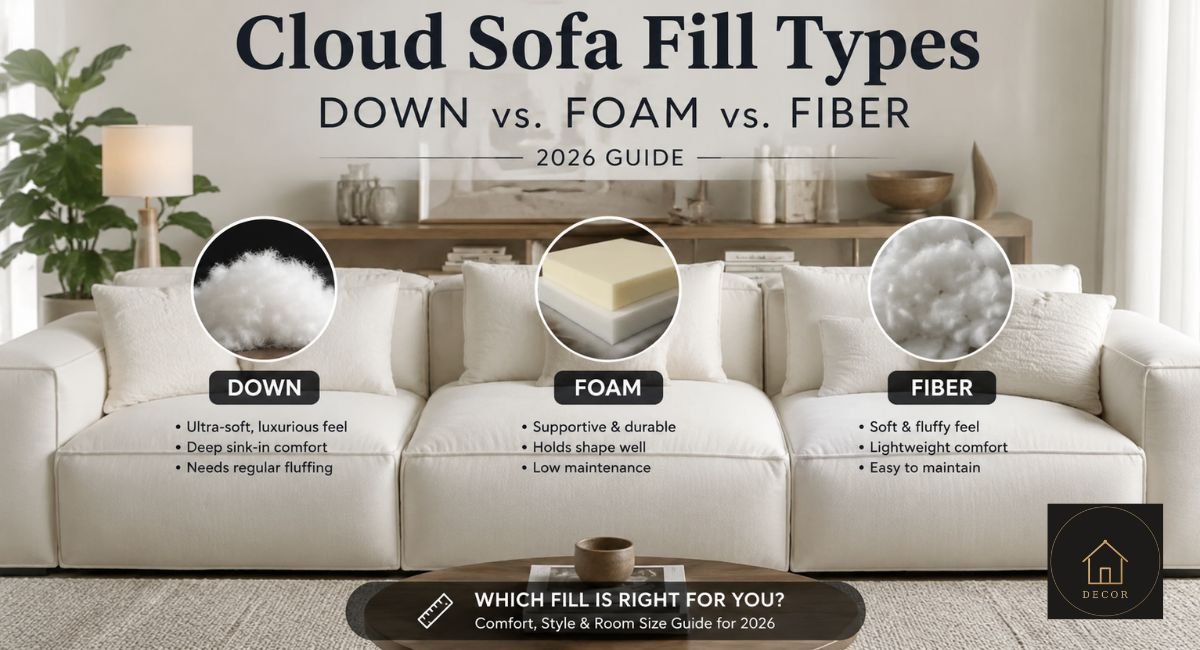
Cloud Sofa Fill Types: Down vs. Foam vs. Fiber
A cloud sofa can look soft in a product photo and still feel surprisingly structured when you sit down. Cushion construction explains why. The upholstery changes the surface, but the seat core, loose fill, wrap, and back-cushion materials decide how deeply you sink, how quickly the cushion recovers, and how much reshaping it needs.
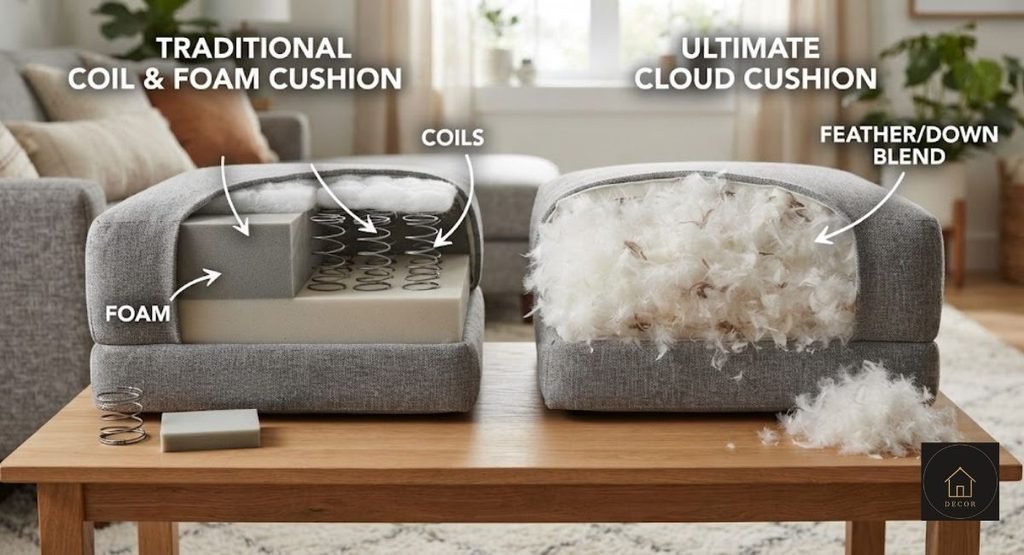
Cloud sofa fill types usually combine structural foam with softer materials such as feather, down, or polyester fiber rather than relying on one material alone. Foam provides support and shape; loose fill or a soft wrap creates the sink-in surface. The best choice depends on how soft you want the sofa and how much cushion maintenance you will actually do.
If you’re still choosing the sofa itself, start with the SmartDecorTips cloud couch buying guide. If your main question is down versus foam, the down vs. foam cushions guide goes deeper on that comparison.
Quick Comparison: Which Fill Fits Your Life?
| Cushion construction | Typical feel | Shape recovery | Routine upkeep | Best fit |
| Foam only or layered foam | Structured to soft | High | Low | Busy rooms, buyers who dislike fluffing |
| Foam + polyester fiber wrap | Softer surface, stable core | High | Low to moderate | Practical family sofas |
| Foam + feather/down wrap | Plush surface, supported base | Moderate to high | Moderate | Sink-in comfort without a fully loose seat |
| Loose poly fiber around foam | Puffy and relaxed | Moderate | Regular reshaping | Feather-free cloud feel |
| Very high loose feather/down content | Deep and body-molding | Low without reshaping | High | Buyers who accept a rumpled look |
Two sofas can both say “high-density foam” and feel completely different. Firmness, density, layer thickness, suspension, upholstery tension, and loose-fill amount all affect the sit.
What Is Actually Inside a Cloud Sofa Cushion?
The biggest mistake is picturing a cloud cushion as a bag filled with feathers.
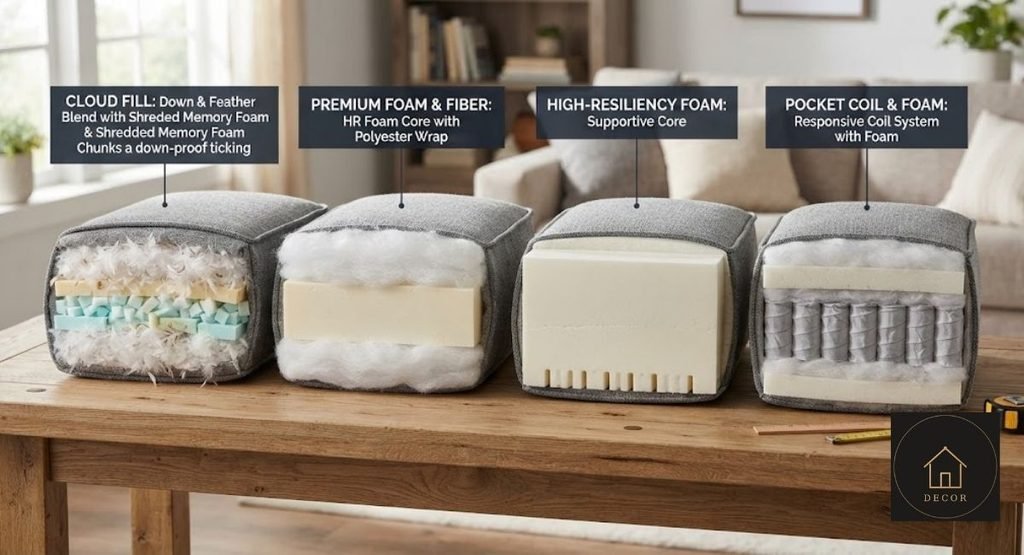
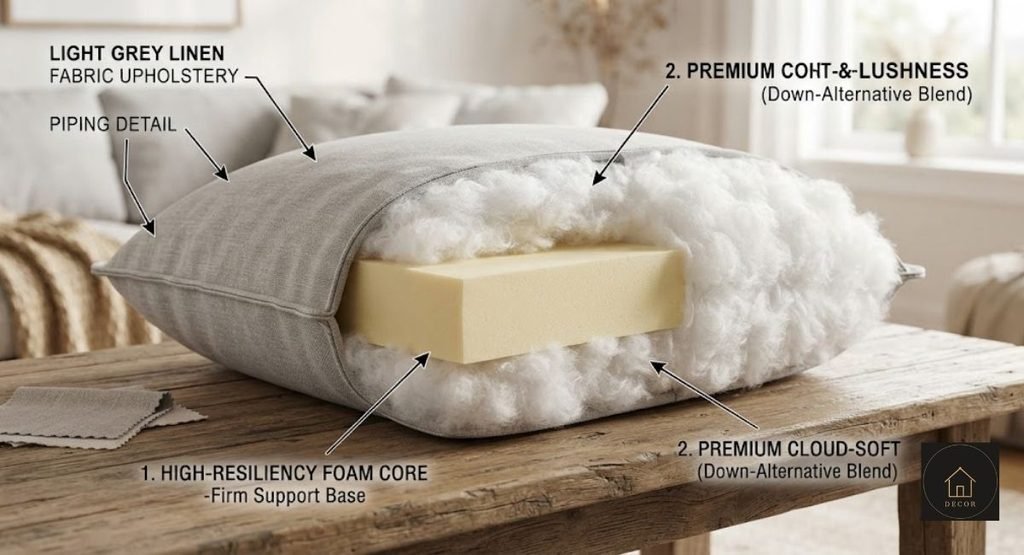
The original RH Cloud sofa is not built that way. RH describes the Cloud as soft feather-and-down construction around a premium foam core. That foam core provides structural support beneath the plush surface.
Current sofas show several variations on the same idea. Sixpenny’s Neva sofa uses a five-layer seat cushion with high-density foam in the center and loose fill above and below. West Elm’s Harmony sofa uses fiber-wrapped high-resiliency polyurethane foam seat cores, while its back cushions use a separate feather/down/polyester blend.
That distinction matters: seat cushions and back cushions often use different fill systems. A listing that says “feather and down cushions” does not necessarily mean the weight-bearing seat is loose feather and down from edge to edge.
Here’s what I noticed while comparing current manufacturer specifications: the useful listings separate the seat core, comfort layer, and back cushion. Vague listings collapse everything into phrases such as “cloud-soft” or “plush.”
Down and Feather: What Does It Actually Do?
Down and feathers add loft, softness, and a relaxed surface. They compress and shift as you sit, which is part of the appeal and also why loose-fill cushions need reshaping.
For cloud-style seating, ask “Where is the down?” rather than only “Does it contain down?”
RH puts feather and down around a foam core. Cisco Home’s cushion-fill guide shows another approach: its Feather and Down option uses a foam core surrounded by a channeled envelope containing 90% feathers and 10% down. Cisco’s separate 10/90 No Core option removes the foam core and requires regular fluffing.
A high feather/down percentage therefore does not tell you how supportive the seat will feel. Core construction matters just as much.
Choose a feather/down-heavy cushion if you like a soft, less-tailored surface and are comfortable redistributing the fill. Think twice if you want the sofa to look freshly arranged immediately after everyone stands up.
Is Foam Better for a Cloud Sofa?
Foam is better when you value predictable support, quicker recovery, and less hands-on reshaping. It is not automatically firm.
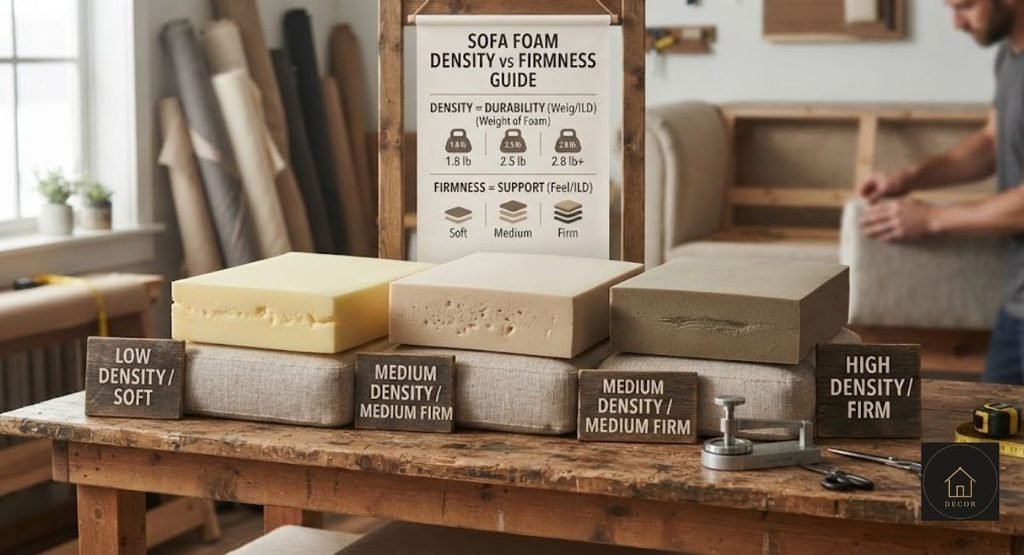
The Polyurethane Foam Association’s foam-performance guidance explains that foam density and firmness are separate properties. Density is mass per unit volume and affects durability and support. Firmness is commonly measured by Indentation Force Deflection, or IFD. A higher-density foam can still be formulated to feel soft.
The association also reports that industry experience and test data indicate polyurethane foams with polymer densities of 1.8 pounds per cubic foot or higher perform better in seating applications than lower-density foams. Treat that as a useful quality signal, not a promise that every 1.8-PCF cushion will feel the same or last a fixed number of years.
For a cloud sofa, “high-resiliency foam core with a fiber wrap” tells you more than “premium foam.”
What Is the Difference Between Foam Density and Firmness?
Density is about how much foam material exists in a given volume; firmness is about how much force it takes to compress the foam. You can therefore have dense soft foam or less-dense firm foam.
A quick hand press cannot verify foam quality. Recovery speed and surface feel tell you something about comfort, but they do not reveal the foam’s density specification.
If a retailer provides only a firmness scale, ask whether it can also provide the foam density or technical cushion construction.
Polyester Fiber and Down Alternative
Polyester fiber can appear as loose fill, a wrap around foam, or part of a feather/down blend. Those constructions should not be treated as equivalent.
Sixpenny’s Neva seat is listed as 60% foam and 40% loose fill. Buyers can choose Feather Down or Poly Fill for that loose-fill portion, while the back cushions are entirely loose fill. Sixpenny says both versions benefit from periodic fluffing because loose material shifts with use.
Sixpenny’s fill FAQ and construction explanation says the Feather Down seat option uses feather and down at a 9:1 feather-to-down ratio for the feather/down portion. The Poly Fill version uses vegan poly fiber instead.
That is more useful than calling polyester “budget stuffing.” A deliberately engineered poly-fill system over a supportive core serves a different role from loose fiber used as the only seat support.
Choose poly fiber when you want a feather-free soft layer. Do not assume “down alternative” means zero maintenance; loose poly fill can still need reshaping.
The Hybrid Cushion Is Not One Standard Recipe
A foam-core hybrid is what many shoppers are picturing when they say they want a cloud sofa. But “hybrid” can mean very different things.
RH uses feather and down around a premium foam core. West Elm Harmony uses fiber-wrapped high-resiliency foam in the seats and a back-cushion blend of 50% polyester fiber, 45% duck feather, and 5% duck down. Sixpenny Neva uses multiple foam layers plus loose fill on the top and bottom.
Cisco Home’s Feather Cloud seat surrounds a foam core with a channeled envelope of 45% feathers, 5% down, and 50% polyester fiber. Its Feather and Down version uses 90% feathers and 10% down around a foam core.
Those examples show why this cloud sofa fill types decision should be based on the full cushion recipe, not one headline ingredient.
Four Current Brands That Show the Difference
RH Cloud
RH’s current Cloud page describes feather-and-down construction around a premium foam core. The important lesson is that the original category reference point itself uses a hybrid construction.
Sixpenny Neva
Neva lists its seat as 60% foam and 40% loose fill, with five layers in total. Its back cushions are 100% loose fill, so you should expect the back to behave differently from the seat.
West Elm Harmony
Harmony uses fiber-wrapped high-resiliency polyurethane foam in the seat and a polyester/feather/down blend in the back. West Elm rates the sofa a 1 on its 1-to-5 firmness scale, showing that a foam-cored seat can still be very soft. (West Elm)
Cisco Home
Cisco Home shows several recipes side by side: foam with polyester wrap, foam with feather/down/fiber, foam with a higher feather/down share, and a no-core feather/down option. It is a useful demonstration of how one brand can create very different feels by changing the layers.
Why Do Cloud Sofa Cushions Go Flat?
A flat-looking cushion does not have one universal cause.
Loose feather, down, and fiber can migrate away from the area you sit on most. Redistributing and fluffing the fill can restore loft. Foam can also lose height or firmness through fatigue over time. The Polyurethane Foam Association uses flex-fatigue testing to measure changes in foam firmness and height after repeated compression.
A relaxed cover can also look empty when the loose fill shifts even though the core underneath is still supporting you.
Diagnose the problem before replacing anything:
- Reshape the loose fill. If loft returns, fill migration was a major part of the problem.
- Rotate reversible cushions. This spreads repeated loading.
- Check the foam core. A lasting depression in the core will not be fixed by fluffing the outer layer.
- Inspect the cover fit. A loose casing can exaggerate normal settling.
For routine care and stains, use the SmartDecorTips cloud couch cleaning guide and follow the manufacturer’s instructions for your upholstery.
How to Read a Cushion Specification Before Buying
A useful product page should let you answer these questions:
- What is inside the seat cushion?
- What is inside the back cushion?
- Is there a foam core?
- Is the foam described by density, resilience, or only a marketing adjective?
- Is loose fill feather/down, polyester fiber, or a blend?
- Is the loose fill channeled into compartments?
- Are the cushions reversible?
- Does the manufacturer recommend fluffing or rotation?
- Can the cushion insert or core be replaced?
If the listing says only “plush foam” or “premium down blend,” ask customer service for the layer construction.
A useful question is: “Can you tell me the seat-core material, any wrap or loose-fill material, and the back-cushion fill separately?”
Which Cloud Sofa Fill Type Should You Pick?
For a low-maintenance family sofa, start with a foam or high-resiliency foam seat core and a modest fiber wrap. You get surface softness without relying on loose fill for all the support.
For the deepest relaxed look, choose a feather/down-heavy construction and accept that reshaping is part of ownership.
For a feather-free cloud feel, look for a foam core combined with polyester fiber. Check the care instructions because loose poly fill can still need fluffing.
For the middle ground, focus on the actual hybrid recipe. A supportive core plus a soft outer layer can balance shape and plushness, but the amount of loose fill determines how maintenance-heavy it feels.
One honest trade-off: if standing up from a low, deep sofa is already difficult for you, chasing the softest possible fill can make the problem worse. Seat height, depth, suspension, and firmness deserve as much attention as the fill material.
Common Cloud Sofa Fill Mistakes
Treating all foam as the same. Density, firmness, resilience, thickness, and layering are separate variables.
Assuming down means there is no foam. Current RH, West Elm, Sixpenny, and Cisco Home examples show how often foam and loose fill work together.
Comparing only seat cushions. Soft back cushions can make a structurally supported seat feel much more enveloping.
Buying a maintenance level you will not maintain. If you already dislike plumping pillows, a loose-fill-heavy sofa is unlikely to suit you.
Using price as a shortcut for construction. Price alone cannot tell you whether a sofa uses lower-density foam, high-resiliency foam, fiber wrap, or feather/down. Read the specification.
The previous version of this guide used price bands as a proxy for fill. I would not use that shortcut now. Current manufacturer construction pages provide a more reliable way to judge the seat.
Conclusion
The best way to compare cloud sofa fill types is to stop asking “down, foam, or fiber?” as if each sofa contains only one material.
Start with the seat core. Then identify the wrap or loose fill. Check the back cushions separately. Finally, decide how much reshaping you are willing to do.
If you want the softest relaxed surface, lean toward more loose feather/down or fiber. If you want both, a well-specified hybrid is the place to start.
FAQs
Many cloud-style sofas combine a foam seat core with a softer layer of feather, down, polyester fiber, or a blend. The seat and back cushions may use different constructions.
Foam is better for shape recovery and lower routine maintenance. Down creates a softer, more relaxed surface but needs more redistribution and fluffing. A foam-core hybrid can combine both traits.
The Polyurethane Foam Association reports better seating performance for polyurethane foam with polymer density of 1.8 pounds per cubic foot or higher. Density is not the same as firmness, so also evaluate the full cushion build and preferred feel.
No. Sixpenny offers a poly-fill option, and many cushions use polyester fiber wraps or loose synthetic fill. Even sofas containing feathers often combine them with foam.
Loose feather, down, and polyester fiber shift and compress during use. Fluffing redistributes that loose material so the cushion regains a fuller shape.
Not automatically. A fiber wrap around a foam core can be relatively low maintenance, while a cushion containing a large amount of loose fiber may need periodic reshaping.
Read the construction section and separate the seat specification from the back-cushion specification. If it is vague, ask the retailer for the core material, foam density if available, outer wrap or loose fill, and care requirements.

Hi, I’m Shahzad Ahmad welcome to Smart Decore Tips!
I write and research every guide on this site myself, focused on real, practical home decor advice for renters, first-time homeowners, and small-space living. Before publishing anything, I check actual product listings, current prices, and real customer reviews not just what other sites already say.
My goal is simple: help you make smarter, more affordable decor decisions without the guesswork or sales pitch.



6 Comments