
Bellini Dupe Hardware and Foam Quality: What Holds Up
Three months. That’s roughly how long it takes before a Bellini-style dupe starts showing up in complaint threads on r/InteriorDesign, and the complaint is almost never about the fabric. It’s modules sliding apart, or cushions that look flattened in photos taken barely a season after delivery.
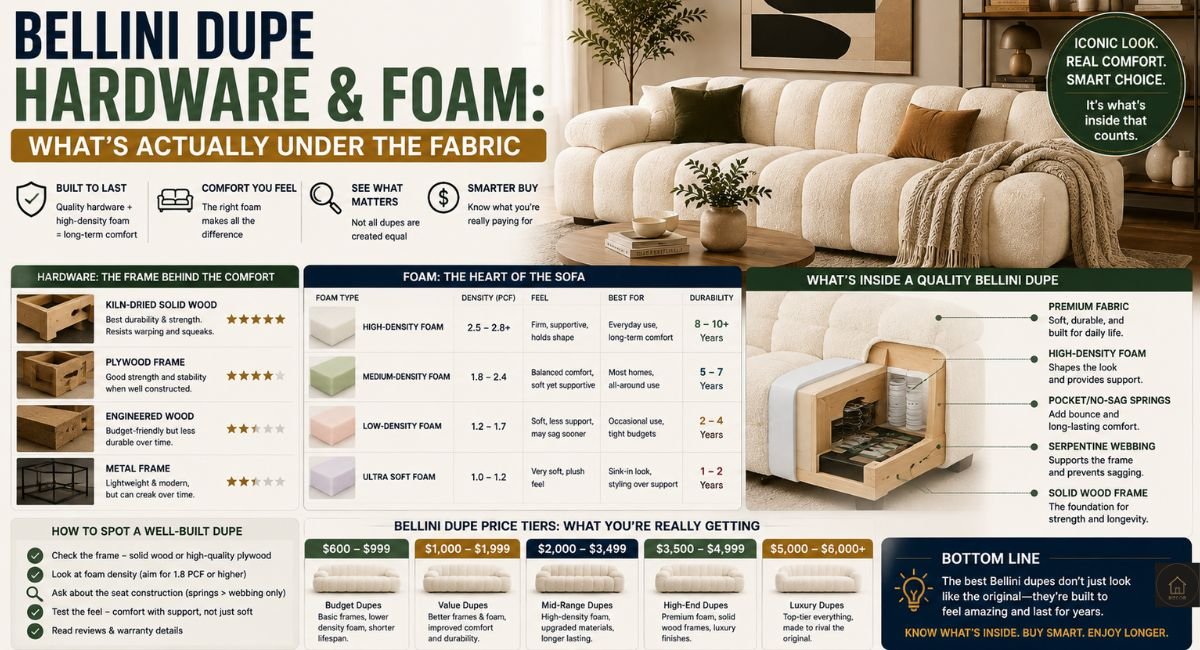
Bellini dupe hardware and foam quality refers to the connector system holding modules together and the foam density inside the cushions, the two hidden factors that decide whether a Camaleonda-style sofa holds its shape and stays put for years, not just months.
If you haven’t already, our Bellini Couch Dupe: Real Prices From $600 to $6,000 guide covers what you get at each price tier. This article is about the “why” behind those jumps — the parts hiding under the fabric.
Everything below comes down to reading Bellini dupe hardware and foam quality correctly before you buy, not after the return window closes.
Quick Takeaways
- Standard polyurethane foam runs 1.5–1.8 lb/ft³ and typically sags within 1–2 years of daily use.
- True high-resiliency (HR) foam, by the foam industry’s own definition, starts at 2.5 lb/ft³ — but some furniture brands market foam as low as 1.8 lb/ft³ as “high-resiliency,” which is a labeling gap worth knowing about.
- Velcro-only module connectors are the most common cause of sofas that drift apart on hardwood or tile.
- Metal brackets, carabiners, or a cable-and-ring system — combined with module weight — are what actually keep sections locked together.
- Frame material matters almost as much as foam: kiln-dried hardwood and furniture-grade plywood outlast particleboard and thin MDF at the joints.
- Even brands with strong foam specs sometimes pair it with plastic connectors, so check both independently — one good spec doesn’t guarantee the other.
What Connector System Does a Bellini Dupe Actually Use?
Most Bellini-style dupes use one of three connector tiers, and the gap between them shows up fast once the sofa is in a real living room, not a studio photo.
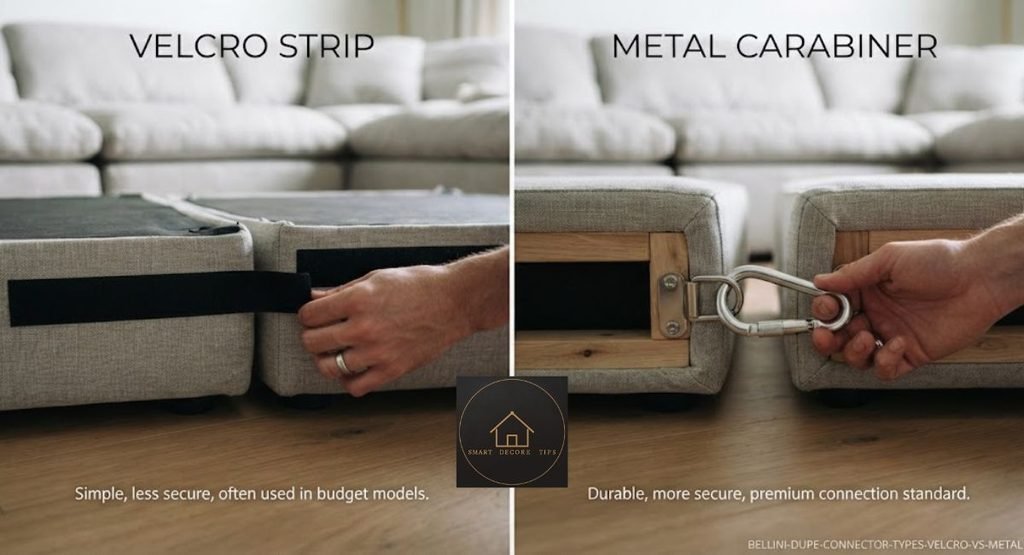
- Velcro strips (budget tier). Cheap to manufacture, but the strips lose grip within months, especially on hardwood or tile — modules creep apart every time someone sits down or a pet jumps on.
- Clips or fabric straps (mid tier). An improvement, but they still rely on tension. Straps stretch and clips loosen over months of regular use.
- Metal connectors, carabiners, or a cable-and-ring system (top tier). This is closest to what the real Camaleonda uses. Hays Concept’s Camaleonda replica, for example, uses anti-rust stainless steel carabiner connectors to fasten modules — a genuinely different tier from a Velcro strip.
Here’s the trade-off worth knowing: a good foam spec doesn’t automatically mean good hardware. Sohnne’s Camaleonda-style module, for instance, ships with a high-resilience layered foam core, but its connector system is plastic, not metal — a detail that’s easy to miss if you’re comparing sofas on foam alone.
Module weight matters too. Heavier, denser modules resist sliding simply because there’s more mass to move — a well-built dupe pairs solid hardware with enough weight to anchor itself, not just a clip working alone.
How Can You Tell Connector Quality From Product Photos Before You Buy?
You can often spot the connector tier before you buy just by looking closely at listing photos and the fine print in the description.
- Zoom into any photo showing the underside or back seam where modules meet — Velcro shows up as a fuzzy strip; metal hardware shows a visible bracket, ring, or carabiner.
- Search the product description for “cable system,” “steel connector,” “carabiner,” or “interlocking bracket.” A listing that only says “easy assembly” is a soft signal for Velcro or clip-only hardware.
- Check the reviews section for phrases like “keeps sliding apart” or “modules separate” — that’s close to a guaranteed sign of budget-tier connectors. One furniture retailer’s own product page for a modular sectional confirms this is the exact failure mode connectors are built to prevent: designed to stay locked on hardwood or tile while still releasing easily when you want to reconfigure.
What Foam Density Actually Holds Up in a Bellini Dupe?
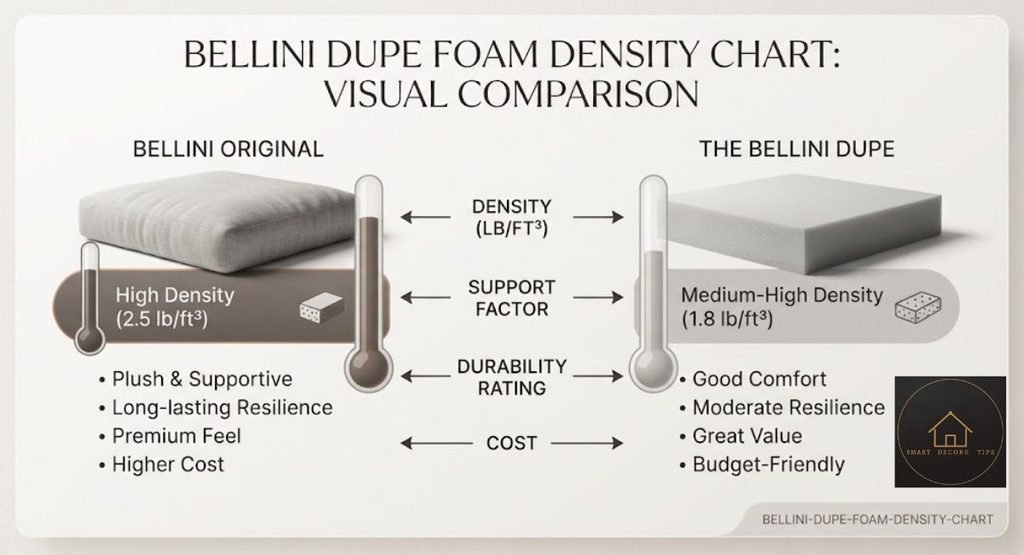
A foam density of at least 2.5 lb/ft³ — the foam industry’s own threshold for high-resiliency (HR) foam — is what keeps Bellini-style cushions from flattening within the first year or two.
Most standard polyurethane foam used in budget dupes runs 1.5–1.8 lb/ft³, and it looks identical to HR foam in a showroom or a listing photo. The difference only shows up after months of actual sitting.
| Foam type | Typical density | What you’ll notice |
| Standard poly foam | 1.5–1.8 lb/ft³ | Visible sagging within 1–2 years of daily use |
| High-density foam | 1.8–2.2 lb/ft³ | Holds shape moderately well, softens gradually over 3–4 years |
| High-resiliency (HR) foam | 2.5–3.0 lb/ft³ | Bounces back quickly, holds rounded module shapes for roughly 8–10 years |
Worth flagging: not every brand uses “high-resiliency” the same way. Adorn Croft’s own buying guide, for example, describes HR foam as starting at a 1.8 lb/ft³ minimum — a full point below the 2.5 lb/ft³ threshold that foam manufacturers themselves use for the HR label. That’s not necessarily dishonest, but it means the phrase “high-resiliency” on a listing isn’t a guarantee of the number you’re picturing. Ask for the actual lb/ft³ figure, not just the marketing term.
I’ve sat on both ends of this range in showrooms, and honestly, a 1.6 lb foam cushion and a 2.6 lb foam cushion feel almost the same on day one. The gap only shows up after a few months of real use, which is exactly why so many buyers get surprised. On one floor model with what turned out to be Velcro-only connectors, I could shift an entire module sideways with one hand — a thing no product photo will ever show you.
Does Frame Material Matter as Much as Foam and Hardware?
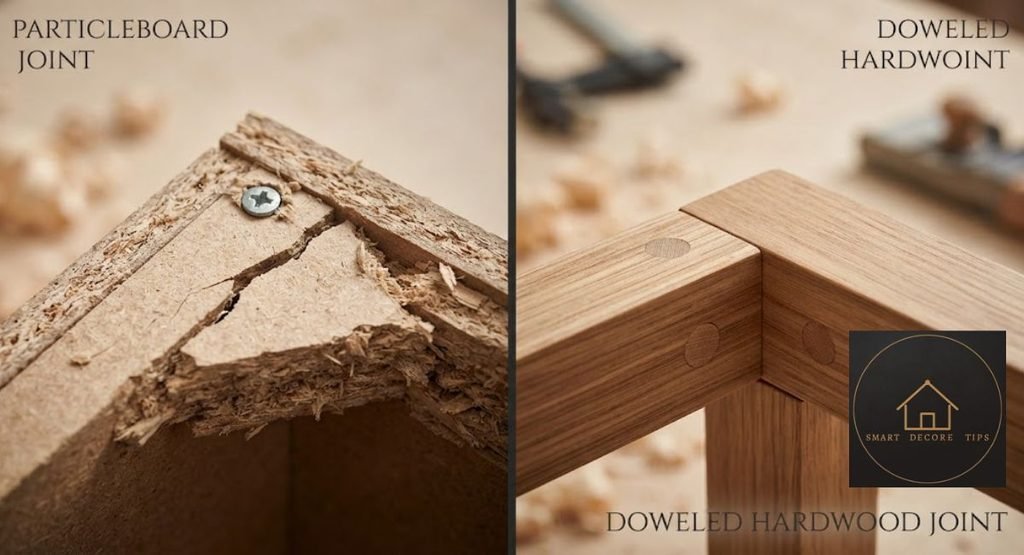
Yes — frame material is the third piece of the puzzle, and it’s just as easy to overlook. A kiln-dried hardwood or furniture-grade plywood frame, glued and doweled at the joints, outlasts a particleboard or thin-MDF frame by years, especially in modules that get moved or reconfigured often.
- Particleboard frames tend to crack at screw points if you rearrange your sectional more than a couple of times.
- Hardwood frames flex slightly instead of splitting — useful if you’re a renter who moves furniture between apartments.
- Sohnne’s armless Camaleonda-style module uses an MDF wood-fiber base with solid wood feet, which sits a notch above particleboard but still isn’t the kiln-dried hardwood some higher-end dupes use.
- If a listing doesn’t state frame material, ask directly — legitimate sellers usually know their frame construction without having to look it up.
How Do the Individual Pieces of a Modular Sectional Stay Together?
Quality modular sofas use mechanical connectors or clips designed to keep pieces securely attached during normal use — sturdy enough that modules won’t slide apart on hardwood or tile, but still easy to disengage when you want to rearrange the layout. Whether a specific dupe actually delivers on that depends entirely on which connector tier it uses, which is why checking the hardware matters as much as checking the fabric.
How to Test Connector and Foam Quality In Person
If you can see the sofa before buying — a showroom, a warehouse pickup, a friend’s place — a few minutes of hands-on checking tells you more than any listing ever will.
- Push down on a cushion and count the seconds it takes to spring back. Standard foam under 1.8 lb/ft³ rebounds slowly and may leave a faint indent for a moment. True HR foam at 2.5 lb/ft³ or higher springs back almost instantly.
- Try to slide one module away from its neighbor with light, steady pressure. A Velcro or strap connection gives way with surprisingly little effort. A metal bracket, carabiner, or cable-and-ring system resists noticeably, and you’ll feel a distinct locked point rather than gradual give.
- Lift one corner of a module slightly. Heavier modules (denser foam, hardwood frame) feel substantially harder to shift than a light, hollow-feeling one — weight is a rough but useful proxy for build quality when you can’t check specs directly.
- Ask the salesperson or seller for the foam density in lb/ft³, not just the marketing term. As the labeling gap above shows, “high-resiliency” alone isn’t a specific number — a seller who can produce the actual figure on request is a good sign the rest of their listing is accurate too.
None of this replaces checking the actual spec sheet, but it catches the gap between what a listing claims and what’s actually inside the module — which, per the Reddit complaint pattern above, is exactly where most buyer regret starts.
Is a Cheap Bellini Dupe Ever Worth It?
It depends entirely on how you plan to use it. For a temporary space, a starter apartment, or a guest room that sees light use, a budget dupe with lower foam density and simpler connectors can be a completely reasonable choice — you’re trading longevity for upfront savings, and that’s a fair trade for some situations.
If it’s going in your main living room and needs to survive daily use, kids, or pets, spending more for HR foam and real hardware pays for itself. You won’t be replacing cushions or gluing connectors back together within two years.
One honest trade-off worth knowing: heavier, better-built modules are also harder to move solo. Great for stability, annoying if you rearrange your layout often or move apartments a lot.
If your dupe already has weaker connectors and you’re not ready to replace it, a grip-style accessory such as TEDDY Grips (sold as an add-on for modular sofas prone to drifting) can reduce sliding without solving the underlying hardware issue — it’s a workaround, not a fix, but it’s a real option worth knowing exists.
Last verified: Foam density figures, connector descriptions, and frame material claims above were checked against manufacturer and foam-industry pages as of September 2026. Brands change materials and suppliers without notice, so confirm current specs directly with the seller before buying.
FAQs
Look for at least 2.5 lb/ft³, the foam industry’s actual threshold for high-resiliency (HR) foam. Anything under 1.8 lb/ft³ is standard budget foam and will likely sag within a year or two of regular use.
This almost always comes down to Velcro-only connectors, which lose grip over time, especially on hardwood or tile floors. Metal brackets or cable-and-ring systems hold up far better over years of use.
Sometimes. Adding non-slip pads under modules or a grip-style accessory like TEDDY Grips can reduce sliding temporarily, but neither fixes a fundamentally weak connector design.
No. The foam industry’s own standard puts HR foam at 2.5 lb/ft³ or higher, but some furniture brands market foam as low as 1.8 lb/ft³ using the same “high-resiliency” label. Always ask for the actual lb/ft³ number.
Often, yes. Extra weight usually reflects denser foam and a solid hardwood frame, both of which correlate with a longer-lasting sofa. It’s not a perfect rule, but it’s a useful quick check in a showroom.
HR foam in the 2.5–3.0 lb/ft³ range typically holds its shape for roughly 8–10 years of regular use, compared to 1–2 years for standard budget foam.
No. Some higher-priced dupes pair strong foam with plastic connectors, so a higher price tag doesn’t guarantee better hardware — check the connector type and the foam density separately.
Conclusion
The fabric and silhouette are what sell you on a Bellini dupe — but Bellini dupe hardware and foam quality are what decide whether it still looks that way in two years. Check for real hardware (not just Velcro), ask for the actual foam density number rather than trusting the word “high-resiliency” alone, and don’t assume a good-looking photo means a well-built sofa underneath. A few minutes of checking connectors and cushions now saves you from a sagging, sliding couch later, and it costs you nothing but a couple of extra minutes in the showroom or on the listing page before you commit to a purchase you’ll be living with for years.

Hi, I’m Shahzad Ahmad welcome to Smart Decore Tips!
I write and research every guide on this site myself, focused on real, practical home decor advice for renters, first-time homeowners, and small-space living. Before publishing anything, I check actual product listings, current prices, and real customer reviews not just what other sites already say.
My goal is simple: help you make smarter, more affordable decor decisions without the guesswork or sales pitch.




2 Comments